
UNITED STATES
SECURITIES AND EXCHANGE COMMISSION
Washington, D.C. 20549
___________________________________
FORM 10-K
__________________________
| ANNUAL REPORT PURSUANT TO SECTION 13 OR 15(d) OF THE SECURITIES EXCHANGE ACT OF 1934 | |||||
For the fiscal year ended December 31 , 2025
or
| TRANSITION REPORT PURSUANT TO SECTION 13 OR 15(d) OF THE SECURITIES EXCHANGE ACT OF 1934 | |||||
For the transition period from to
Commission File Number 001-16441
__________________________

(Exact name of registrant as specified in its charter)
__________________________
| (State or other jurisdiction of incorporation or organization) | (I.R.S. Employer Identification No.) | |||||||
(Address of principal executive offices) (Zip Code)
(713 ) 570-3000
(Registrant's telephone number, including area code)
| Securities Registered Pursuant to Section 12(b) of the Act | Trading Symbols | Name of Each Exchange on Which Registered | ||||||||||||
Securities Registered Pursuant to Section 12(g) of the Act: NONE.
______________________________________
Indicate by check mark if the registrant is a well-known seasoned issuer, as defined in Rule 405 of the Securities Act. Yes ☒ No ☐
Indicate by check mark if the registrant is not required to file reports pursuant to Section 13 or Section 15(d) of the Act. Yes ☐ No ☒
Indicate by check mark whether the registrant (1) has filed all reports required to be filed by Section 13 or 15(d) of the Securities Exchange Act of 1934 during the preceding 12 months (or for such shorter period that the registrant was required to file such reports), and (2) has been subject to such filing requirements for the past 90 days. Yes ☒ No ☐
Indicate by check mark whether the registrant has submitted electronically every Interactive Data File required to be submitted pursuant to Rule 405 of Regulation S-T (§232.405 of this chapter) during the preceding 12 months (or for such shorter period that the registrant was required to submit such files). Yes ☒ No ☐
Indicate by check mark whether the registrant is a large accelerated filer, an accelerated filer, a non-accelerated filer, a smaller reporting company, or an emerging growth company. See definitions of a "large accelerated filer," "accelerated filer," "smaller reporting company," and "emerging growth company" in Rule 12b-2 of the Exchange Act.
If an emerging growth company, indicate by check mark if the registrant has elected not to use the extended transition period for complying with any new or revised financial accounting standards provided pursuant to Section 13(a) of the Exchange Act ☐
Indicate by check mark whether the registrant has filed a report on and attestation to its management's assessment of the effectiveness of its internal control over financial reporting under Section 404(b) of the Sarbanes-Oxley Act (15 U.S.C. 7262(b)) by the registered public accounting firm that prepared or issued its audit report. ☒
If securities are registered pursuant to Section 12(b) of the Act, indicate by check mark whether the financial statements of the registrant included in the filing reflect the correction of an error to previously issued financial statements. ☐
Indicate by check mark whether any of those error corrections are restatements that required a recovery analysis of incentive-based compensation received by any of the registrant’s executive officers during the relevant recovery period pursuant to §240.10D-1(b). ☐
Indicate by check mark whether the registrant is a shell company (as defined in Rule 12b-2 of the Act). Yes ☐ No ☒
The aggregate market value of the voting and non-voting common equity held by non-affiliates of the registrant was approximately $44.7 billion as of June 30, 2025, the last business day of the registrant's most recently completed second fiscal quarter, based on the New York Stock Exchange closing price on that day of $102.73 per share.
Applicable Only to Corporate Registrants
As of February 19, 2026, there were 436,070,436 shares of common stock outstanding.
Documents Incorporated by Reference
The information required to be furnished pursuant to Part III of this Form 10-K will be set forth in, and incorporated by reference from, the registrant's definitive proxy statement for the annual meeting of stockholders ("2026 Proxy Statement"), which will be filed with the Securities and Exchange Commission not later than 120 days after the end of the fiscal year ended December 31, 2025.
CROWN CASTLE INC.
TABLE OF CONTENTS
| Page | |||||||||||
| Item 1. | |||||||||||
| Item 1A. | |||||||||||
| Item 1B. | |||||||||||
Item 1C. | |||||||||||
| Item 2. | |||||||||||
| Item 3. | |||||||||||
| Item 4. | |||||||||||
| Item 5. | |||||||||||
| Item 6. | |||||||||||
| Item 7. | |||||||||||
| Item 7A. | |||||||||||
| Item 8. | |||||||||||
| Item 9. | |||||||||||
| Item 9A. | |||||||||||
| Item 9B. | |||||||||||
| Item 9C. | |||||||||||
| Item 10. | |||||||||||
| Item 11. | |||||||||||
| Item 12. | |||||||||||
| Item 13. | |||||||||||
| Item 14. | |||||||||||
| Item 15. | |||||||||||
| Item 16. | |||||||||||
Cautionary Language Regarding Forward-Looking Statements
This Annual Report on Form 10-K ("2025 Form 10-K") contains forward-looking statements that are based on our management's expectations as of the filing date of this report with the Securities and Exchange Commission ("SEC"). Statements that are not historical facts are hereby identified as forward-looking statements. In addition, words such as "estimate," "anticipate," "will," "project," "plan," "intend," "believe," "expect," "likely," "predicted," "positioned," "continue," "seek," "focus" and any variations of these words and similar expressions are intended to identify forward-looking statements.
Examples of forward-looking statements include our full year 2026 outlook and plans, projections, expectations and estimates regarding (1) our strategy and the value of our business model, (2) demand for our towers, including factors driving such demand, (3) the growth potential of the U.S. market for towers, (4) demand for data and factors driving such demand, (5) tenants' investment to improve network quality and expand capacity, (6) our ability to service our debt and comply with debt covenants, (7) the level of commitment under our debt instruments, (8) our ability to remain qualified as a real estate investment trust ("REIT"), (9) site rental revenues, (10) our liquidity, including the sources and uses thereof, (11) impact from the Sprint cancellations (as defined below), (12) cash inflows and drivers of cash flow growth, (13) dividends and share repurchases, (14) discretionary and sustaining capital expenditures, including investments therein, (15) non-renewals, (16) our restructuring activities, including cost saving charges related thereto, and the timing of payments and actions associated therewith, (17) pending sale of our Fiber Business (as defined below), (18) our capital allocation framework, (19) maintenance of an
2
investment grade credit profile, and (20) the impact of the termination of our agreements with DISH. Dividends and the share repurchase program remain subject to the approval of our board directors, which has the discretion to determine whether to declare dividends or authorize a repurchase program and the amounts and timing of the dividends and share repurchase program.
Such forward-looking statements should, therefore, be considered in light of various risks, uncertainties and assumptions, including prevailing market conditions, risk factors described under "Item 1A. Risk Factors" herein and other factors. Should one or more of these risks or uncertainties materialize, or should underlying assumptions prove incorrect, actual results may vary materially from those expected.
Our filings with the SEC are available through the SEC website at www.sec.gov or through our investor relations website at investor.crowncastle.com. We use our investor relations website to disclose information about us that may be deemed to be material. We encourage investors, the media and others interested in us to visit our investor relations website from time to time to review up-to-date information or to sign up for e-mail alerts to be notified when new or updated information is posted on the site.
Interpretation
As used herein, the term "including," and any variation thereof, means "including without limitation." The use of the word "or" herein is not exclusive. Unless this 2025 Form 10-K indicates otherwise or the context otherwise requires, the terms, "we," "our," "our company," "the company" or "us" as used in this 2025 Form 10-K refer to Crown Castle Inc. and its predecessor (organized in 1995), as applicable, each a Delaware corporation (together, "CCI"), and their subsidiaries. Additionally, unless the context suggests otherwise, references to "U.S." are to the United States of America and Puerto Rico, collectively.
3
PART I
Item 1. Business
Overview
We own, operate and lease shared communications infrastructure that is geographically dispersed throughout the U.S., including (1) more than 40,000 towers and other structures, such as rooftops (collectively, "towers"), (2) approximately 105,000 small cell nodes either currently generating revenue or under contract and (3) approximately 90,000 route miles of fiber primarily supporting small cells and fiber solutions. We refer to our towers, small cells and fiber assets collectively as "communications infrastructure," and, at times, to our customers on our communications infrastructure as "tenants." Our operating segments historically consisted of (1) Towers and (2) Fiber, which includes both small cells and fiber solutions.
On March 13, 2025, management signed a definitive agreement ("Strategic Fiber Agreement") to sell our Fiber segment, together with certain supporting assets and personnel ("Fiber Business"), with Zayo Group Holdings Inc. ("Zayo") acquiring the fiber solutions business and EQT Active Core Infrastructure fund ("EQT") acquiring the small cell business ("Strategic Fiber Transaction"). Under the agreement, we will receive $8.5 billion in aggregate, subject to certain closing adjustments. The Strategic Fiber Transaction is expected to close in the first half of 2026, subject to certain closing conditions and regulatory approvals.
As the aforementioned sale represents a material strategic shift for the Company, the Fiber Business' results and net assets are presented herein as discontinued operations and comparable prior periods have been recast to reflect this change. Pending the closing of the Strategic Fiber Transaction, we will continue to operate the Fiber Business in accordance with the Strategic Fiber Agreement. Following the classification of the Fiber Business as discontinued operations, the Company has one reportable segment, which is also its operating segment, that constitutes consolidated results consisting of its towers operations. Unless otherwise noted, all activities and amounts reported in this document relate to the continuing operations of the Company and exclude activities and amounts related to the Fiber Business.
Our core business is providing access, including space or capacity, to our towers via long-term contracts in various forms, including lease, license, sublease and service agreements (collectively, "tenant contracts"). We seek to increase our site rental revenues by adding more tenants on our towers, which we expect to result in significant incremental cash flows due to our low incremental operating costs. We operate as a REIT for U.S. federal income tax purposes. See "Item 1. Business—REIT Status" and notes 2 and 10 to our consolidated financial statements.
Approximately 56% and 71% of our towers are located in the 50 and 100 largest U.S. basic trading areas ("BTAs"), respectively. Our towers have a significant presence in each of the top 100 BTAs. We derive approximately 40% of our towers Adjusted Site Rental Gross Margin from towers located on land that we own, including through fee interests and perpetual easements, and we derive approximately 60% of our towers Adjusted Site Rental Gross Margin from towers located on land that we lease, sublease, manage or license. The contracts for the land under our towers have an average total remaining life of approximately 35 years (including all renewal terms exercisable at our option), weighted based on towers Adjusted Site Rental Gross Margin.
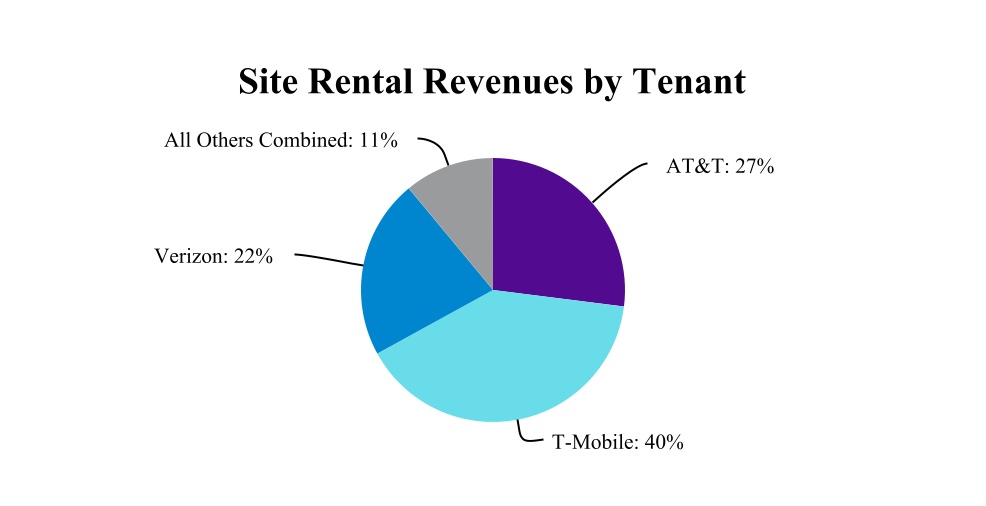
Our largest tenants are T-Mobile, AT&T and Verizon Wireless, which collectively accounted for approximately 90% of our 2025 site rental revenues. See note 15 to our consolidated financial statements for further information regarding our largest tenants. Site rental revenues represented 95% of our 2025 net revenues. The vast majority of our site rental revenues are of a recurring nature and are derived from long-term tenant contracts. See "Item 1. Business—The Company" for further information. As of December 31, 2025, exclusive of renewals exercisable at the tenants' option, our tenant contracts had a weighted-average remaining life of approximately six years and represented $23.7 billion of expected future cash inflows, exclusive of amounts owed from DISH Wireless L.L.C. ("DISH"). See note 18 to our consolidated financial statements for a discussion of the notice of default and termination delivered to DISH.
As part of our effort to provide comprehensive tower solutions, as an ancillary business, we also offer certain services relating to our towers predominately consisting of pre-construction site development services relating to existing or new tenant equipment installations, including: site acquisition, architectural and engineering, or zoning and permitting (collectively, "site development services").
4
See note 17 to our consolidated financial statements for a discussion of the July 2023 restructuring ("2023 Restructuring Plan"), which included discontinuing tenant equipment installations and subsequent augmentations (collectively, "installation services") as a towers product offering and (2) the June 2024 restructuring plan ("2024 Restructuring Plan," and together with the 2023 Restructuring Plan, "2023 and 2024 Restructuring Plans"). In February 2026, we initiated a restructuring plan ("2026 Restructuring Plan") as part of our efforts to enhance the efficiency and effectiveness of our tower business. See note 18 to our consolidated financial statements for a discussion of the 2026 Restructuring Plan.
Strategy
As a leading provider of towers in the U.S., our strategy is to create long-term stockholder value via a combination of (1) growing cash flows generated from our existing portfolio of towers, (2) returning a meaningful portion of our cash generated by operating activities to our common stockholders in the form of dividends and (3) investing capital efficiently to grow cash flows and long-term dividends per share. Our strategy is based, in part, on our belief that the U.S. is the most attractive market for tower investment with the greatest long-term growth potential. We measure our efforts to create "long-term stockholder value" by the combined payment of dividends to stockholders and growth in our per-share results. The key elements of our strategy are to:
•Grow cash flows from our existing towers. We are focused on maximizing the recurring site rental cash flows generated from providing our tenants with long-term access to our towers, which we believe is the core driver of value for our stockholders. Tenant additions or modifications of existing tenant equipment (collectively, "tenant additions") enable our tenants to expand coverage and capacity in order to meet increasing demand for data while generating high incremental returns for our business. We believe our towers provide an efficient and cost-effective solution for our wireless tenants' growing networks that provides an opportunity to generate cash flows and increase stockholder return.
•Return cash generated by operating activities to stockholders in the form of dividends and share repurchases. We believe that distributing a meaningful portion of our cash generated by operating activities appropriately provides stockholders with increased certainty for a portion of expected long-term stockholder value while still allowing us to retain sufficient flexibility to invest in our business and deliver growth. We believe this decision reflects the translation of the high-quality, long-term contractual cash flows of our business into stable capital returns to stockholders.
•Invest capital efficiently to grow cash flows and long-term dividends per share. In addition to adding tenants to existing towers, we seek to invest our available capital, including the net cash generated by our operating activities and external financing sources, in a manner that will increase long-term stockholder value on a risk-adjusted basis. These investments include constructing and acquiring new towers that we expect will generate future cash flow growth and attractive long-term returns by adding tenants to those assets over time. Our historical investments have included the following (in no particular order):
◦acquisitions of land interests (which primarily relate to land assets under towers);
◦construction of towers;
◦acquisitions of towers;
◦improvements and structural enhancements to our existing towers;
◦purchases of shares of our common stock from time to time; and
◦purchases, repayments or redemptions of our debt.
Our strategy to create long-term stockholder value is based on our belief that there will be considerable future demand for our towers based on the location of our assets and the rapid and continuing growth in the demand for data. We believe that such demand for our towers will continue, will result in growth of our cash flows due to tenant additions on our existing towers, and will create other growth opportunities for us, such as demand for newly constructed or acquired towers, as described above. Further, we seek to augment the long-term value creation associated with growing our recurring site rental cash flows by offering certain ancillary site development services.
5
REIT Status
We operate as a REIT for U.S. federal income tax purposes. As a REIT, we are generally entitled to a deduction for dividends that we pay and, therefore, are not subject to U.S. federal corporate income tax on our net taxable income that is currently distributed to our stockholders. We may be subject to certain federal, state, local and foreign taxes on our income or assets, including (1) taxes on any undistributed income, (2) taxes related to our taxable REIT subsidiaries ("TRSs"), (3) franchise taxes, (4) property taxes and (5) transfer taxes. In addition, we could, under certain circumstances, be required to pay an excise or penalty tax, which could be significant in amount, in order to utilize one or more relief provisions under the Internal Revenue Code of 1986, as amended ("Code"), to maintain qualification for taxation as a REIT. Qualified REIT dividends (within the meaning of Section 199A(e)(3) of the Code) constitute a part of a non-corporate taxpayer's "qualified business income amount" and thus our non-corporate U.S. stockholders may be eligible to take a qualified business income deduction in an amount equal to 20% of such dividends received from us. This deduction was made permanent with Public Law 119-21, commonly referred to as the "One Big Beautiful Bill Act", being signed into law in the U.S. on July 4, 2025.
The vast majority of our assets and revenues are in the REIT. See notes 2 and 10 to our consolidated financial statements. Additionally, we have included in TRSs certain other assets and operations. Those TRS assets and operations will continue to be subject, as applicable, to federal and state corporate income taxes or to foreign taxes in the jurisdictions in which such assets and operations are located.
Our foreign assets and operations (primarily our tower operations in Puerto Rico) most likely will be subject to foreign income taxes in the jurisdictions in which such assets and operations are located, regardless of whether or not they are included in a TRS.
To remain qualified and be taxed as a REIT, we are generally required to annually distribute to our stockholders at least 90% of our REIT taxable income, after the utilization of our net operating loss carryforwards "NOLs" (determined without regard to the dividends paid deduction and excluding net capital gain). See notes 2 and 10 to our consolidated financial statements. Our quarterly common stock dividend will delay the utilization of our NOLs and may cause certain of the NOLs to expire without utilization. See "Item 1A. Risk Factors" for risks associated with our REIT status.
Industry Overview
Consumer demand for data continues to grow due to increases in data consumption and increased penetration of bandwidth-intensive devices. This increase in data consumption is driven by factors such as growth in (1) mobile entertainment (such as mobile video, mobile applications and social networking), (2) mobile internet usage (supporting web browsing and trends in telehealth, remote working, online learning and other remote communications), (3) machine-to-machine applications or the "Internet of Things" (such as connected cars and wearables), and (4) the adoption of other bandwidth-intensive applications (such as cloud services, artificial intelligence and video communications). As a result, consumer wireless devices are trending toward bandwidth-intensive devices, including smartphones, laptops, tablets and other emerging and embedded devices, and U.S. wireless carriers are among the first carriers in the world to offer commercial 5th Generation ("5G") mobile cellular communications services to further support such growth.
We expect the following factors to contribute to potential demand for our towers:
•consumers' growing wireless data consumption leading major wireless carriers to upgrade and enhance their networks through the efficient use of towers, including in connection with 5G deployments, in an effort to improve network quality and capacity and customer retention or satisfaction;
•prior and future potential spectrum auctioned, licensed or made available by the Federal Communications Commission ("FCC") enabling additional wireless carrier network development;
•next-generation technologies and new uses for wireless communications may potentially result in new entrants or increased demand in the wireless industry, which may include companies involved in the continued evolution and deployment of the Internet of Things;
•the continued adoption of bandwidth-intensive applications, including artificial intelligence; and
•increased government initiatives to expand broadband infrastructure to support connectivity throughout the U.S.
The Company
Virtually all of our towers operations are located in the U.S. Following the classification of the Fiber Business as discontinued operations, the Company has one reportable segment, which is also its single operating segment, that constitutes consolidated results consisting of its towers operations. For more information, see "Item 7. MD&A—Results of Operations" and note 15 to our consolidated financial statements. Our core business is providing access, including space or capacity, to our towers via long-term tenant contracts in the U.S. We believe our towers are integral to our tenants' networks and organizations. See "Item 1. Business—Strategy."
6
We believe towers are the most efficient and cost-effective solution for providing coverage and capacity for wireless carrier network deployments. We acquired ownership interests or exclusive rights to the majority of our towers directly or indirectly from the largest U.S. wireless carriers (or their predecessors) through transactions consummated since 1999, including towers from (1) AT&T in 2013, (2) T-Mobile in 2012, (3) companies now part of T-Mobile in 2007, (4) companies now part of Verizon Wireless in 1999 and 2000 and (5) companies now part of AT&T in 1999 and 2000.
We generally receive monthly rental payments and, in some cases, upfront payments, from our tenants pursuant to long-term tenant contracts with (1) initial contract terms generally between five to 15 years, (2) multiple renewal periods of generally five years each, exercisable at the option of the tenant, (3) limited termination rights for our tenants and (4) contractual escalations of the rental price. We strive to negotiate with our existing tenant base for longer contractual terms, which often contain fixed escalation rates.
Our tenant contracts, while amended and re-negotiated over time, have historically led to a long-term relationship with tenants on our towers, resulting in a retention rate generally between 98% and 99% each year. In general, each renewable tenant contract automatically renews at the end of its term unless (1) the tenant provides prior notice of its intent not to renew or (2) the contract is amended or re-negotiated. See "Item 1A. Risk Factors" for additional information regarding higher non-renewals (which we define as the reduction in site rental revenues as a result of tenant churn, terminations and, in limited circumstances, reductions of existing lease rates) incurred as a result of the T-Mobile and Sprint network consolidation as well as in relation to the notice of default and termination delivered to DISH. See notes 4 and 18 to our consolidated financial statements for a tabular presentation of the minimum rental payments due to us by tenants pursuant to tenant contracts without consideration of tenant renewal options as of December 31, 2025 and discussion of the DISH default and termination, respectively.
The average monthly rental payment from a new tenant added to towers can vary based on (1) aggregate tenant volume, (2) the location of the tower, or (3) the amount of tower and ground space leased to a tenant, which can be influenced by the quantity, size, and weight of the tenant's antenna installation or related equipment. When possible, we seek to receive rental payment increases in connection with tenant contract amendments, pursuant to which our tenants add antennas or other equipment to our towers or ground space on which they already have equipment pursuant to preexisting tenant contracts. Our tenant contracts and pricing are not influenced by whether or not we perform the site development services.
As of December 31, 2025, the average number of tenants (calculated as a unique license together with any related amendments thereto) per tower was approximately 2.4.
Additional Site Rental Information. We have existing master agreements with our largest tenants, including T-Mobile, AT&T and Verizon Wireless. Such agreements provide certain terms (including economic terms) that govern underlying contracts (entered into during the term of the master agreements) regarding the right to use our towers by such tenants.
Approximately 75% of our site rental costs of operations, exclusive of depreciation, amortization, and accretion, which is shown separately, consists of ground lease expenses, and the remainder includes employee compensation or related benefit costs, property taxes, repairs and maintenance, and utilities. Assuming current leasing activity levels, our operating expenses generally tend to escalate at approximately the rate of inflation. We seek to add tenants to our existing towers at low incremental operating cost, delivering high incremental returns to our business. Once constructed, our towers require minimal sustaining capital expenditures, including maintenance or other non-discretionary capital expenditures, which are typically approximately 1% of net revenues. See note 14 to our consolidated financial statements for a tabular presentation of the rental payments we owe to landlords pursuant to our operating lease agreements.
Services. As part of our effort to provide comprehensive tower solutions, as an ancillary business, we also offer certain services primarily relating to pre-construction site development services. See note 17 to our consolidated financial statements for a discussion of the July 2023 restructuring plan, which included discontinuing installation services as a towers product offering. In 2025, our services and other revenues primarily related to site development services. We seek to grow our services revenues through capitalizing on (1) increased leasing volumes that may result from carrier network upgrades, (2) promoting site development services, (3) expanding the scope of our services, and (4) focusing on tenant service and deployment speed. We do not always provide the site development services for our tenants on our towers as other service providers also provide these services (see also "—Competition" below). Typically, our site development services are non-recurring and are billed on a fixed fee basis, and the terms and pricing of site development services are negotiated separately from our tenant contracts.
Customers. Our largest customers are primarily comprised of wireless carriers that operate national networks.
7
Our three largest tenants are T-Mobile, AT&T and Verizon Wireless. Collectively, these three tenants accounted for approximately 90% of our 2025 site rental revenues. See "Item 1A. Risk Factors" for risks associated with our dependence on a small number of customers and note 15 to our consolidated financial statements. For 2025, our site rental revenues by tenant were as follows:
Sales and Marketing. Our sales organization markets our towers with the objective of contracting access with tenants to existing towers. We seek to become the critical partner and preferred independent tower provider for our tenants and increase tenant satisfaction relative to our peers by leveraging our (1) existing unique tower footprint, (2) tenant relationships, (3) process-centric approach, and (4) technological tools.
Our sales team is organized based on a variety of factors, including tenant type (such as large wireless carriers, vertical customers and organizations) and geography. A team of national account directors maintains our relationships with our largest tenants. These directors work to develop new business opportunities, as well as to ensure that tenants' needs are efficiently translated into new contracts for our towers. Sales personnel develop and maintain relationships with our tenants that are expanding their networks, entering new markets, seeking new or additional tower offerings, bringing new technologies to market or requiring maintenance or add-on business. In addition to our full-time sales or marketing staff, a number of senior-level employees spend a significant portion of their time on sales and marketing activities and call on existing or prospective tenants.
Competition. We face competition for site rental tenants from various sources, including (1) other independent tower owners or operators, including competitors that own, operate, or manage towers, rooftops, broadcast or transmission towers, (2) owners or operators of small cells, including the operators of our small cell assets following the closure of our Strategic Fiber Transaction, (3) tenants who own or operate their own towers or (4) new alternative deployment methods for towers.
Some of our largest competitors are American Tower Corporation and SBA Communications Corporation. We believe that location, existing tower footprint, deployment speed, quality of service, expertise, reputation, capacity and price have been and will continue to be the most significant competitive factors affecting our businesses. See "Item 1A. Risk Factors" for a discussion of competition in our industry.
Competitors to our services offering can include site acquisition consultants, zoning consultants, real estate firms, right-of-way consulting firms, construction companies, tower owners or managers, radio frequency engineering consultants, our tenants' internal staff or contractors, or telecommunications equipment vendors who can provide turnkey site development services through multiple subcontractors. We believe that our tenants base their decisions on the outsourcing of services on criteria such as a company's experience, record of accomplishment, reputation, price and time for completion of a project.
Sustainability
Our multi-tenant towers model results in the use of fewer resources, including water, energy, metals and other materials, than would otherwise be needed to construct and maintain towers under a single-tenant infrastructure model. We are committed to operating responsibly and ethically and considering social and environmental impacts as we make business decisions. We currently maintain annual sustainability targets in our senior unsecured credit facility.
8
The Nominating and Governance Committee assists the board of directors with sustainability oversight. Our executive management team and senior management keep our board of directors apprised of our sustainability priorities, goals and initiatives.
Additional information regarding our sustainability initiatives and progress is also available through the Investors section of our website at https://investor.crowncastle.com. The information on our website, including our sustainability reports, is not, and shall not be deemed to be, incorporated by reference into this 2025 Form 10-K or any other filings with the SEC unless expressly noted in any such other filings.
Human Capital
The people who work for Crown Castle are essential to our ability to execute on our strategy. As of January 31, 2026, we employed approximately 4,000 people, including approximately 2,500 people recorded in our discontinued operations. All of our employees are based in the U.S. See note 18 to our consolidated financial statements for a discussion of the 2026 Restructuring Plan, which will reduce our employee headcount. From time to time, we also add contingent workers to support our business.
We believe attracting, developing and retaining talented employees is paramount to serving our customers and our communities and creating value for our stockholders. We also periodically conduct company-wide employee surveys to help us understand how our employees feel about working at our company and track the results to inform our human capital strategies. We focus on building and retaining a strong and innovative workforce with a variety of backgrounds, experiences and points of view.
The well-being of our employees is a crucial element of our safety culture, employee engagement and productivity. We offer a comprehensive total rewards package which includes market-based pay, performance-based annual incentive awards, healthcare and retirement benefits, mental health benefits, parental and family leave, holiday and paid time off and tuition assistance. We further invest in our employees' professional growth and development by providing resources and opportunities to hone their skills and expand their subject-matter expertise, which empowers them to advance their careers and enables our business to prosper.
We are not a party to any collective bargaining agreements and have not experienced any strikes or work stoppages. See "Item 1A. Risk Factors" and note 17 to our consolidated financial statements for further discussion of our 2023 and 2024 Restructuring Plans, which resulted in a reduction of total employee headcount in prior years.
Regulatory and Environmental Matters
We are required to comply with a variety of federal, state and local regulations and laws in the U.S., including FCC and Federal Aviation Administration ("FAA") regulations and those discussed under "—Environmental" below. To date, we have not incurred any material fines or penalties or experienced any material adverse effects to our business as a result of any domestic or international regulations, including any environmental regulations. The summary below is based on regulations currently in effect, and such regulations are subject to review or modification by the applicable governmental authority from time to time. If we fail to comply with applicable laws and regulations, we may be fined or lose our rights to conduct some of our business.
Federal Regulations. Both the FCC and the FAA regulate towers used for wireless communications, radio, or television broadcasting. Such regulations control the siting, construction, modification, lighting, and marking of towers and may, depending on the characteristics of particular towers, require the registration of tower facilities with the FCC and the issuance of determinations confirming no hazard to air traffic. Wireless communications devices operating on towers are separately regulated and independently licensed based upon the particular frequency used. In addition, the FCC and the FAA have developed standards to consider proposals for new or modified tower or antenna structures based upon the height or location, including proximity to airports. Proposals to construct or to modify existing tower or antenna structures above certain heights are reviewed by the FAA to ensure the structure will not present a hazard to aviation, which determination may be conditioned upon compliance with lighting or marking requirements. The FCC requires its licensees to operate communications devices only on towers that comply with FAA rules and are registered with the FCC, if required by its regulations. Where tower lighting is required by FAA regulation, tower owners bear the responsibility of notifying the FAA of any tower lighting outage and ensuring the timely restoration of such outages.
State and Local Regulations. The U.S. Telecommunications Act of 1996 amended the Communications Act of 1934 to preserve state and local zoning authorities' jurisdiction over the siting of communications towers. The law, however, limits state and local zoning authority by prohibiting actions by such authorities that discriminate between different service providers of wireless communications or prohibit altogether (actually or effectively) the provision of wireless communications. Additionally,
9
the law prohibits state and local restrictions based on the environmental effects of radio frequency emissions to the extent the facilities comply with FCC regulations.
Local regulations include city and other local ordinances (including subdivision and zoning ordinances), approvals for construction, modification and removal of towers, and restrictive covenants imposed by community developers. These regulations vary greatly, but typically require us to obtain prior approval from local officials. Local zoning authorities may render decisions that prevent the construction or modification of towers, or place conditions on such construction or modifications that are responsive to community residents' concerns regarding the height, visibility, or other characteristics of such infrastructure. Over the last several years, the FCC has adopted regulations and 32 states have passed legislation intended to expedite and streamline the deployment of wireless networks, including establishing presumptively reasonable timeframes for reviews by local and state governments. Notwithstanding such developments, decisions of local regulatory authorities and utilities in certain jurisdictions may continue to adversely affect deployment timing and cost.
Certain of our subsidiaries hold state authorizations to provide intrastate telecommunication services in addition to FCC authorization to provide domestic interstate telecommunication services. State authorizations often allow us to deploy such infrastructure in locations where zoning restrictions might otherwise delay, restrict, or prevent building or expanding traditional wireless tower and rooftop sites. See "Item 1A. Risk Factors" for additional information regarding rights to our infrastructure.
Environmental. We are required to comply with a variety of federal, state and local environmental laws and regulations protecting environmental quality, including air and water quality, and wildlife. To date, we have not incurred any material fines or penalties or experienced any material adverse effects to our business as a result of any domestic or international environmental regulations or matters. See "Item 1A. Risk Factors" for additional information regarding compliance with laws and regulations.
The construction of new towers or, in some cases, their modification in the U.S. may be subject to environmental review under the National Environmental Policy Act of 1969, as amended ("NEPA"), which requires federal agencies to evaluate the environmental impact of major federal actions. NEPA regulations require applicants to investigate the potential environmental impact of the proposed tower construction. If the FCC determines that the proposed tower construction or modification presents a significant environmental impact, the FCC is required to prepare an environmental impact statement, which is subject to public comment. Such determination could significantly delay the FCC's approval of the construction or modification.
Our operations are also subject to federal, state and local laws and regulations relating to the management, use, storage, disposal, emission, or remediation of, or exposure to, hazardous or non-hazardous substances, materials, or wastes. As an owner, lessee, or operator of real property, we are subject to certain environmental laws that impose strict, joint-and-several liability for the cleanup of on-site or off-site contamination relating to existing or historical operations; or we could also be subject to personal injury or property damage claims relating to such contamination. In general, our tenant contracts prohibit our tenants from using or storing any hazardous substances on our tower sites in violation of applicable environmental laws and require our tenants to provide notice of certain environmental conditions caused by them.
We are subject to Occupational Safety and Health Administration and similar guidelines regarding employee protection from radio frequency exposure. In recent years, the scientific community has extensively studied low-level radio frequency emissions to determine whether they have any connection to certain negative health effects, such as cancer.
We have compliance programs and monitoring projects designed to promote compliance with applicable environmental laws and regulations. Nevertheless, there can be no assurance that the costs of compliance with existing or future environmental laws will not have a material adverse effect on us.
Available Information
We maintain a website at www.crowncastle.com. Our annual reports on Form 10-K, quarterly reports on Form 10-Q, current reports on Form 8-K (and any amendments to those reports filed or furnished pursuant to Section 13(a) or 15(d) of the Securities Exchange Act of 1934, as amended ("Exchange Act")), proxy statements and other information about us are made available, free of charge, through the Investors section of our website at https://investor.crowncastle.com and at the SEC's website at http://sec.gov as soon as reasonably practicable after we electronically file such material with, or furnish it to, the SEC.
In addition, our Corporate Governance Guidelines, Proper Business Practices and Ethics Policy, Financial Code of Ethics, Conflicts of Interest and Disclosure Policy, and the charters of our Audit Committee, Compensation and Human Capital Committee and Nominating and Governance Committee are available through the Investors section of our website at https://investor.crowncastle.com, and such information is also available in print to any stockholder who requests it. We intend to post
10
to our website any amendments to or waivers from each of the Business Practices and Ethics Policy and Financial Code of Ethics applicable to our Chief Executive Officer, Chief Financial Officer and Controller that are required to be disclosed.
11
Item 1A. Risk Factors
You should carefully consider all of the risks described below, as well as the other information contained in this document, when evaluating your investment in our securities.
Summary of Risk Factors
The following summarizes our material risk factors, including risk factors relating to our Fiber Business. However, this summary is not intended to be a comprehensive and complete list of all risk factors identified by the Company. Refer to the following pages of this section for additional details regarding these summarized risk factors.
Risks Relating to Our Business and Industry:
•Our business depends on the demand for our communications infrastructure (including towers, small cells and fiber), driven primarily by demand for data, and we may be adversely affected by any slowdown in such demand. Additionally, a reduction in the amount or change in the mix of network investment by our tenants may materially and adversely affect our business (including reducing demand for our communications infrastructure or services).
•A substantial portion of our revenues is derived from a small number of tenants, and the loss, consolidation or financial instability of any of such tenants may materially decrease revenues, reduce demand for our communications infrastructure and services and impact our dividend per share growth.
•The expansion or development of our business, including through acquisitions, increased product offerings or other strategic opportunities, may cause disruptions in our business, which may have an adverse effect on our business, operations or financial results.
•Our Fiber business model contains certain differences from our Towers business model, resulting in different operational risks. If we do not successfully operate our Fiber business model or identify or manage the related operational risks through the closing of the Strategic Fiber Transaction, such operations may produce results that are lower than anticipated.
•Failure to timely, efficiently and safely execute on our construction projects could adversely affect our business.
•New technologies may reduce demand for our communications infrastructure or negatively impact our revenues.
•If we fail to retain rights to our communications infrastructure, including the rights to land under our towers and the right-of-way and other agreements related to our small cells and fiber, our business may be adversely affected.
•Our services business has historically experienced significant volatility in demand, which reduces the predictability of our results.
•As a result of competition in our industry, we may find it more difficult to negotiate favorable rates on our new or renewing tenant contracts.
•New wireless technologies may not deploy or be adopted by tenants as rapidly or in the manner projected.
•If radio frequency emissions from wireless handsets or equipment on our communications infrastructure are demonstrated to cause negative health effects, potential future claims could adversely affect our operations, costs or revenues.
•Cybersecurity breaches or other information technology disruptions could adversely affect our operations, business, and reputation.
•If we do not continue to make appropriate investments in, and effectively implement and maintain, our information technology systems and digital capabilities, our business and operating results could be adversely affected.
•Our business may be adversely impacted by climate-related events, natural disasters, including wildfires, and other unforeseen events.
•Failure to attract, recruit and retain qualified and experienced employees could adversely affect our business, operations and costs.
•Changes to management, including turnover of our top executives, could have an adverse effect on our business.
•Actions that we are taking, or have completed, to restructure our business in alignment with our strategic priorities may not be as effective as anticipated.
•Actions of activist stockholders could impact the pursuit of our business strategies and adversely affect our results of operations, financial condition, or stock price.
12
Risks Relating to Our Pending Sale of the Fiber Business:
•The pendency of the sale of our Fiber Business to Zayo and EQT may have an adverse effect on our business, results of operations, cash flows and financial position.
•Completion of the Strategic Fiber Transaction is subject to the conditions contained in the Strategic Fiber Agreement, including regulatory approvals, which may not be received, and separation of the Fiber Business from our current operations, and if these conditions are not satisfied or waived, the transaction will not be completed.
•The failure to complete the planned sale of the Fiber Business to Zayo and EQT could have a material and adverse effect on our business, results of operations, financial condition, cash flows, and stock price.
Risks Relating to Our Debt and Equity
•Our substantial level of indebtedness could adversely affect our ability to react to changes in our business, and the terms of our debt instruments limit our ability to take a number of actions that our management might otherwise believe to be in our best interests. In addition, if we fail to comply with our covenants, our debt could be accelerated.
•We have a substantial amount of indebtedness. In the event we do not repay or refinance such indebtedness, we could face substantial liquidity issues and might be required to issue equity securities or securities convertible into equity securities, or sell some of our assets, possibly on unfavorable terms, to meet our debt payment obligations.
•Sales or issuances of a substantial number of shares of our common stock or securities convertible into shares of our common stock may adversely affect the market price of our common stock.
•Certain provisions of our restated certificate of incorporation ("Charter") and second amended and restated by-laws, as amended ("By-laws") and operative agreements, and domestic and international competition laws may make it more difficult for a third party to acquire control of us or for us to acquire control of a third party, even if such a change in control would be beneficial to our stockholders.
Risks Relating to Corporate Compliance
•If we fail to comply with laws or regulations which regulate our business and which may change at any time, we may be fined or even lose our right to conduct some of our business.
Risks Relating to Our REIT Status
•Future dividend payments to our stockholders will reduce the availability of our cash on hand available to fund future discretionary investments, and may result in a need to incur indebtedness or issue equity securities to fund growth opportunities. In such event, the then current economic, credit market or equity market conditions will impact the availability or cost of such financing, which may hinder our ability to grow our per share results of operations.
•Remaining qualified to be taxed as a REIT involves highly technical and complex provisions of the Code. Failure to remain qualified as a REIT would result in our inability to deduct dividends to stockholders when computing our taxable income, thereby increasing our tax obligations and reducing our available cash.
•Complying with REIT requirements, including the 90% distribution requirement, may limit our flexibility or cause us to forgo otherwise attractive opportunities, including certain discretionary investments and potential financing alternatives.
•REIT related ownership limitations and transfer restrictions may prevent or restrict certain transfers of our capital stock.
13
Risks Relating to Our Business and Industry
Our business depends on the demand for our communications infrastructure (including towers, small cells and fiber), driven primarily by demand for data, and we may be adversely affected by any slowdown in such demand. Additionally, a reduction in the amount or change in the mix of network investment by our tenants may materially and adversely affect our business (including reducing demand for our communications infrastructure or services).
Tenant demand for our communications infrastructure depends on consumers' and organizations' demand for data. Additionally, the willingness of our tenants to utilize our communications infrastructure, or renew or extend existing tenant contracts on our communications infrastructure, is affected by numerous factors, including:
•availability or capacity of our communications infrastructure or associated land interests;
•location of our communications infrastructure;
•financial condition of our tenants, including their profitability and availability or cost of capital, including through government funding;
•willingness of our tenants to maintain or increase their network investment or changes in their capital allocation strategy;
•need for integrated networks and organizations;
•availability and cost of spectrum for commercial use;
•increased use of network sharing, roaming, joint development, or resale agreements by our tenants;
•mergers or consolidations by and among our tenants;
•changes in, or success of, our tenants' business models;
•governmental regulations and initiatives, including local or state restrictions on the proliferation of communications infrastructure;
•cost of constructing communications infrastructure;
•our market competition, including tenants that may elect to self-perform;
•technological changes, including those (1) affecting the number or type of communications infrastructure needed to provide data to a given geographic area or which may otherwise serve as a substitute or alternative to our communications infrastructure or (2) resulting in the obsolescence or decommissioning of certain existing wireless networks; and
•our ability to efficiently satisfy our tenants' service requirements.
A slowdown in demand for data or our communications infrastructure may negatively impact our growth or otherwise have a material adverse effect on us. If our current or potential tenants are unable to raise adequate capital to fund their business plans, as a result of disruptions in the financial and credit markets or otherwise, they may reduce their spending, which could adversely affect our anticipated growth or the demand for our communications infrastructure or services.
The amount, timing, and mix of our tenants' network investment is variable and can be significantly impacted by the various matters described in these risk factors. Changes in tenant network investment typically impact the demand for our communications infrastructure. As a result, changes in tenant plans such as delays in the implementation of new systems, new and emerging technologies, or change in plans to expand coverage or capacity may reduce demand for our communications infrastructure.
Furthermore, the industries in which our tenants operate (particularly those in the wireless industry) could experience a slowdown or slowing growth rates as a result of numerous factors, including a reduction in consumer demand for data or general economic conditions. There can be no assurances that weakness or uncertainty in the economic environment will not adversely impact our tenants or their industries, which may materially and adversely affect our business, including by reducing demand for our communications infrastructure or services. In addition, a slowdown may increase competition for site rental tenants or services. Such an industry slowdown or a reduction in tenant network investment may materially and adversely affect our business.
14
A substantial portion of our revenues is derived from a small number of tenants, and the loss, consolidation or financial instability of any of such tenants may materially decrease revenues, reduce demand for our communications infrastructure and services and impact our dividend per share growth.
Our three largest tenants are T-Mobile, AT&T and Verizon Wireless. In addition to our three largest tenants, we also derived a meaningful portion of our revenues and previously anticipated future growth from DISH. The loss of any one of our three largest tenants as a result of consolidation, merger, bankruptcy, insolvency, network sharing, roaming, joint development, resale agreements by our tenants or otherwise may result in (1) a material decrease in our revenues, (2) uncollectible account receivables, (3) an impairment of our deferred site rental receivables, communications infrastructure assets, or intangible assets (including goodwill), or (4) other adverse effects to our business. We cannot guarantee that tenant contracts with our largest tenants will not be terminated or that these tenants will renew their tenant contracts with us.
Consolidation among our largest tenants will likely result in duplicate or overlapping parts of networks, for example, where they are co-residents on a tower or small cell network, which may result in the termination, non-renewal or re-negotiation of tenant contracts and negatively impact revenues from our communications infrastructure. Due to the long-term nature of our tenant contracts, we generally expect that the impact to our site rental revenues from any termination of our tenant contracts as a result of such potential consolidation would be spread out over multiple years. Such consolidation (or potential consolidation) may result in a reduction or slowdown in such tenants' network investment in the aggregate because their expansion plans may be similar. Tenant consolidation could decrease the demand for our communications infrastructure and services, which in turn may result in a reduction in our revenues or cash flows and may trigger a review for impairment of certain long-lived assets.
On January 6, 2022, we entered into an agreement with T-Mobile that addressed the T-Mobile and Sprint network consolidation. This consolidation resulted in approximately $200 million in Towers non-renewals in 2025, and we anticipate additional non-renewals from this agreement, which we expect to fall within our historical non-renewal range of 1% to 2% of Towers annual site rental revenues, to occur each year through 2034. We expect an additional impact of approximately $40 million in aggregate Fiber non-renewals to occur in 2026 and in subsequent years, until the closing of the Strategic Fiber Transaction.
On January 12, 2026, we delivered a notice of default and termination to DISH relating to our Master Lease Agreement and underlying agreements with DISH as a result of DISH failing to make required payments and defaulting on its obligations under the agreements. As a result of the termination, we assert in the notice that DISH owes us all remaining payments under these agreements, which total in excess of $3.5 billion. As of December 31, 2025, associated with our agreements with DISH, we had recorded on our consolidated balance sheet approximately $50 million within "Receivables, net" and approximately $150 million within "Deferred site rental receivables," partially offset by approximately $34 million recorded within "Deferred revenues" and "Other long-term liabilities." We expect the total net balance sheet impact of approximately $165 million will ultimately be recoverable, and accordingly no adjustments have been made to reserve such net amount as of December 31, 2025. We do not intend to recognize additional revenue under these agreements pending further developments with respect to this matter.
See "Item 1. Business—The Company" and note 15 to our consolidated financial statements for further information regarding our largest tenants.
The expansion or development of our business, including through acquisitions, increased product offerings or other strategic opportunities, may cause disruptions in our business, which may have an adverse effect on our business, operations or financial results.
We seek to expand and develop our business, including through acquisitions, increased product offerings, or other strategic opportunities. In the ordinary course of our business, we review, analyze and evaluate various potential transactions or other activities in which we may engage. Such transactions or activities could be complex, costly and time-consuming, or cause disruptions in, increase risk to or otherwise negatively impact our business. Among other things, such transactions and activities may:
•disrupt our business relationships with our tenants and landlords, depending on the nature of or counterparty to such transactions and activities;
•divert capital and the time or attention of management away from other business operations, including as a result of post-transaction integration activities;
•fail to achieve revenue or margin targets, operational synergies or other benefits contemplated;
•increase operational risk or volatility in our business;
•temporarily decrease the volume of our business;
•not result in the benefits management had expected to realize from such expansion and development activities, or those benefits may take longer to realize than expected;
15
•impact our cost structure and result in the need to hire additional employees;
•increase demands on current employees or result in current or prospective employees experiencing uncertainty about their future roles with us, which might adversely affect our ability to retain or attract key employees; or
•result in the need for additional TRSs or contributions of certain assets to TRSs, which are subject to federal and state corporate income taxes.
Our Fiber business model contains certain differences from our Towers business model, resulting in different operational risks. If we do not successfully operate our Fiber business model or identify or manage the related operational risks through the closing of the Strategic Fiber Transaction, such operations may produce results that are lower than anticipated.
The business model for our Fiber operations contains certain differences from our business model for our Towers operations, including those relating to tenant base, competition, contract terms (including requirements for service level agreements regarding network performance and maintenance), upfront capital requirements, labor costs, landlord demographics, deployment and ownership of certain network assets, operational oversight requirements, government regulations, growth rates and applicable laws.
While our Fiber operations have certain risks that are similar to our Towers operations, they also have certain operational risks (including the scalability of processes) that are different from our Towers business, including:
•the use of public rights-of-way and franchise agreements;
•the use of poles and conduits owned solely by, or jointly with, third parties;
•risks relating to overbuilding competitive fiber assets;
•risks relating to the specific markets in which we choose or plan to operate;
•risks relating to construction hazards, including boring, trenching, utility and maintenance of traffic hazards;
•construction management and construction-related billings to tenants;
•risks relating to efficiently and rapidly adjusting the size of the personnel needed to operate our Fiber business;
•risks relating to wireless carriers building their own small cell networks, or tenants utilizing their own or alternative fiber assets;
•the risk of failing to optimize the use of our finite supply of fiber strands;
•damage to our assets and the need to maintain, repair, upgrade and periodically replace our assets;
•the risk of failing to properly maintain or operate highly specialized hardware and software;
•network data security risks;
•the risk of new technologies that could enable tenants to realize the same benefits with less utilization of our fiber;
•potential damage to our overall reputation as a communications infrastructure provider; and
•the use of competitive local exchange carrier ("CLEC") status.
In addition, the rate at which tenants adopt or prioritize small cells and fiber solutions has been lower or slower than we anticipated, and may continue to be lower or slower, or may cease to exist altogether. For example, our tenants have initially focused on utilizing towers in the first phase of deploying their 5G networks, which has led to delays in some of our small cell deployments. We anticipate that these delays will be temporary, as our tenants plan for the next phase of their 5G network deployment which we believe will require small cells at scale. Our Fiber operations also expose us to different safety or liability risks or hazards than our Towers business as a result of numerous factors, including those stemming from the deployment, location or nature of the assets involved. There may be risks and challenges associated with small cells and fiber solutions being comparatively new and emerging technologies that are continuing to evolve, and there may be other risks related to small cells and fiber solutions of which we are not yet aware. See "—The pendency of the sale of our Fiber Business to Zayo and EQT may have an adverse effect on our business, results of operations, cash flows and financial position.", "—Completion of the Strategic Fiber Transaction is subject to the conditions contained in the Strategic Fiber Agreement, including regulatory approvals, which may not be received, and separation of the Fiber Business from our current operations, and if these conditions are not satisfied or waived, the transaction will not be completed.", "—The failure to complete the planned sale of the Fiber Business to Zayo and EQT could have a material and adverse effect on our business, results of operations, financial condition, cash flows, and stock price." and "—Our business depends on the demand for our communications infrastructure (including towers, small cells and fiber), driven primarily by demand for data, and we may be adversely affected by any slowdown in such demand. Additionally, a reduction in the amount or change in the mix of network investment by our tenants may materially and adversely affect our business (including reducing demand for our communications infrastructure or services.)", and note 3 to our consolidated financial statements, for discussions of the Strategic Fiber Transaction.
Failure to timely, efficiently and safely execute on our construction projects could adversely affect our business.
Our construction projects and related contracts can be long-term, complex in nature, dangerous, costly and challenging to execute. The quality of our performance on such construction projects depends in large part upon our ability to manage (1) the
16
associated tenant relationship and (2) the project itself by timely deploying and properly managing appropriate internal and external project resources. In connection with our construction projects, we generally bear the risk of cost over-runs, labor availability and productivity, and contractor pricing and performance.
In addition, the construction projects (including modifications of existing communications infrastructure) can pose certain safety risks, including:
•risks resulting from elevated work, including falling hazards;
•risks of third-party non-compliance with safety regulations, industry best practices or other applicable standards;
•risks associated with utility hazards, including gas line, electrical or sewage strikes, which may result in explosions, electrocution and other potentially catastrophic events; and
•risk of potential wildfires, including due to welding, grinding, cutting, or other construction activity.
Such safety risks may cause personal injury or loss of life, severe damage to or destruction of property, suspension of operations or services, or significant damage to the environment, creating financial, regulatory or reputational damage that could adversely affect our business. See "—Our business may be adversely impacted by climate-related events, natural disasters, including wildfires, and other unforeseen events" below for additional information regarding potential adverse impacts to our business which may result from wildfires and other climate-related events.
Further, investments in newly constructed communications infrastructure may result in lower initial returns compared to returns on our existing communications infrastructure or us not being able to realize future tenant additions at anticipated levels.
Additionally, contracts with our tenants for these projects typically specify delivery dates, performance criteria and penalties for our failure to perform. Our failure to perform timely and in accordance with the performance criteria exposes us to penalties specified in the contract or possible litigation. We often experience unforeseen delays, primarily in our Fiber business, from municipalities and utility companies that result in longer construction timelines than expected, which impact our ability to timely deliver on our projects. We may also experience unforeseen delays and increased project costs as a result of labor shortages, which may impact the availability of contractors to work on our construction projects. Our failure to manage such tenant relationships, project resources, and project milestones in a timely and efficient manner and appropriately manage safety risks could have a material adverse effect on our business.
New technologies may reduce demand for our communications infrastructure or negatively impact our revenues.
Improvements in the efficiency, architecture, and design of communication networks may reduce the demand for our communications infrastructure. For example, new technologies and spectrum that may promote network sharing, joint development, backhaul and fronthaul efficiency or resale agreements by our tenants, such as signal combining technologies or network virtualization, may reduce the need for our communications infrastructure. In addition, other technologies, such as WiFi, satellite (such as low earth orbiting) and mesh transmission systems may serve as substitutes for, or alternatives to, leasing on communications infrastructure that might otherwise be anticipated or expected had such technologies not existed. In addition, new technologies that enhance the range, efficiency and capacity of communication equipment could reduce demand for our communications infrastructure. Any significant reduction in demand for our communications infrastructure resulting from the new technologies may negatively impact our revenues or otherwise have a material adverse effect on us.
If we fail to retain rights to our communications infrastructure, including the rights to land under our towers and the right-of-way and other agreements related to our small cells and fiber, our business may be adversely affected.
The property interests and other rights to our communications infrastructure, including the land under our towers, are derived from leasehold and sub-leasehold interests, fee interests, easements, licenses, rights-of-way, and franchise and other agreements. A loss of these interests and other rights may interfere with our ability to conduct our business or generate revenues. For various reasons, we may not always have the ability to access, analyze, or verify all information regarding titles or other issues prior to acquiring communications infrastructure. Further, we may not be able to renew ground leases or other agreements on commercially viable terms.
Our ability to retain rights to the land on which our towers are located depends on our ability to purchase such land, by acquiring fee interests and perpetual easements, or renegotiate or extend the terms of the agreements relating to such land. Approximately 10% of our towers Adjusted Site Rental Gross Margin for the year ended December 31, 2025 was derived from towers where the leases for the land under such towers had final expiration dates of less than 10 years. If we are unable to retain rights to the property on which our communications infrastructure is located, our business may be adversely affected.
As of December 31, 2025, approximately 55% of our towers were leased or subleased or operated and managed under master leases, subleases, or other agreements with AT&T and T-Mobile (including those which T-Mobile assumed in its merger
17
with Sprint). We have the option to purchase these towers at the end of their respective lease terms. We have no obligation to exercise such purchase options. We may not have the required available capital to exercise our right to purchase some or all of these towers at the time these options are exercisable. Even if we do have available capital, we may choose not to exercise our right to purchase these towers or some or all of the T-Mobile or AT&T towers for business or other reasons. In the event that we do not exercise these purchase rights, or are otherwise unable to acquire an interest that would allow us to continue to operate these towers after the applicable period, we will lose the cash flows derived from such towers, which may have a material adverse effect on our business. In the event that we decide to exercise these purchase rights, the benefits of the acquisition of these towers may not exceed the costs, which could adversely affect our business. Additional information concerning these towers and the applicable purchase options as of December 31, 2025 is as follows:
•22% of our towers are leased or subleased or operated and managed under a master lease or other related agreements with AT&T. We have the option to purchase the leased and subleased towers from AT&T at the end of the respective lease or sublease terms for aggregate option payments of approximately $4.2 billion, which payments, if such option is exercised, would be due between 2032 and 2048.
•32% of our towers are leased or subleased or operated and managed under master leases, subleases or other agreements with T-Mobile (including those which T-Mobile assumed in its merger with Sprint). In 2037, we have the option to purchase all (but not less than all) of approximately half of such leased and subleased towers from T-Mobile for approximately $2.3 billion. We have the option to purchase the remainder of such towers from T-Mobile at the end of the respective terms for aggregate option payments of approximately $2.0 billion, which payments, if such option is exercised, would be due between 2035 and 2049. In addition, another 1% of our towers under master leases, subleases, and other agreements with T-Mobile are subject to a lease and sublease or other related arrangements with AT&T. We have the option to purchase these towers from AT&T at the end of their respective lease terms for aggregate option payments of up to approximately $373 million as of December 31, 2025, which payments, if such option is exercised, would be due prior to 2032 (less than $5 million would be due before 2029).
Under master lease or master prepaid lease arrangements we have with AT&T and T-Mobile (including those which T-Mobile assumed in its merger with Sprint), certain of our subsidiaries lease or sublease, or are otherwise granted the right to operate and manage, towers from bankruptcy remote subsidiaries of such carriers. If one of these bankruptcy remote subsidiaries should become a debtor in a bankruptcy proceeding and is permitted to reject the underlying ground lease, our subsidiaries could lose their interest in the applicable sites. If our subsidiaries were to lose their interest in the applicable sites or if the applicable ground leases were to be terminated, we would lose the cash flow derived from the towers on those sites, which may have a material adverse effect on our business. We have similar bankruptcy risks with respect to sites that we operate under management agreements.
For our small cells and fiber, we must maintain rights-of-way, franchise, pole attachment, conduit use, fiber use and other agreements to operate our assets. For various reasons, we may not always have the ability to maintain these agreements or obtain future agreements to construct, maintain and operate our fiber assets. Access to rights-of-way may depend on our CLEC status, and we cannot be certain that jurisdictions will (1) recognize such CLEC status or (2) not change their laws concerning CLEC access to rights-of-way. If a material portion of these agreements are terminated or are not renewed, we might be forced to abandon our assets, which may adversely impact our business. In order to operate our assets, we must also maintain fiber agreements that we have with public and private entities. There is no assurance that we will be able to renew these agreements on favorable terms, or at all. If we are unable to renew these agreements on favorable terms, we may face increased costs or reduced revenues.
Additionally, in order to expand our communications infrastructure footprint to new locations, we often need to obtain new or additional rights-of-way and other agreements. Our failure to obtain these agreements in a prompt and cost-effective manner may prevent us from expanding our footprint, which may be necessary to meet our contractual obligations to our tenants and could adversely impact our business.
Our services business has historically experienced significant volatility in demand, which reduces the predictability of our results.
The operating results of our services business for any particular period may experience significant fluctuations given its non-recurring nature and should not necessarily be considered indicative of longer-term results for this activity. Our services business is generally driven by demand for our communications infrastructure and may be adversely impacted by various factors, including:
•competition;
•the timing, mix and amount of tenant network investments;
•the rate and volume of tenant deployment plans;
18
•unforeseen delays or challenges relating to work performed;
•economic weakness or uncertainty;
•labor availability and productivity;
•availability of key components;
•our market share; and
•changes in the size, scope, or volume of work performed.
During both 2024 and 2025, due primarily to our discontinuation of installation services as a towers product offering previously announced in July 2023, services and other revenues decreased by 54% and 49%, respectively, when compared to year ended December 31, 2023. We continue to offer site development services on our towers. See note 17 to our consolidated financial statements and "Item 7. MD&A—General Overview—Highlights of Business Fundamentals and Results" for further discussion of our 2023 Restructuring Plan, which included discontinuing installation services as a towers product offering.
As a result of competition in our industry, we may find it more difficult to negotiate favorable rates on our new or renewing tenant contracts.
Our growth is dependent on our entering into new tenant contracts (including amendments to tenant contracts upon modification of existing towers, small cells or fiber), as well as renewing or renegotiating tenant contracts when existing tenant contracts terminate. Competition in our industry may make it more difficult for us to attract new tenants, maintain or increase our gross margins, or maintain or increase our market share. In addition, competition (primarily in our fiber solutions business) may, in certain circumstances, cause us to renegotiate certain existing tenant contracts to avoid early contract terminations. We face competition for site rental tenants and associated contractual rates from various sources, including (1) other independent communications infrastructure owners or operators, including those that own, operate, or manage towers, rooftops, broadcast or transmission towers, utility poles, fiber (including non-traditional competitors such as cable providers) or small cells, (2) tenants who elect to self-perform and (3) new alternative deployment methods for communications infrastructure.
Our Fiber business generally has different competitors than those in our Towers business, including other owners of fiber, as well as new entrants into small cells and fiber solutions, some of which may have larger networks, greater financial resources or more experience in managing such assets than we have. The level of non-renewals associated with fiber solutions is generally higher than that of Towers and small cells.
New wireless technologies may not deploy or be adopted by tenants as rapidly or in the manner projected.
There can be no assurances that new wireless services or technologies, which may drive demand for our communications infrastructure, will be introduced or deployed as rapidly or in the manner projected by the wireless carriers. In addition, demand or tenant adoption rates for such new technologies may be lower or slower than anticipated for numerous reasons. As a result, growth opportunities or demand for our communications infrastructure arising from such technologies may not be realized at the times or to the extent anticipated.
If radio frequency emissions from wireless handsets or equipment on our communications infrastructure are demonstrated to cause negative health effects, potential future claims could adversely affect our operations, costs or revenues.
The potential connection between radio frequency emissions and certain negative health effects, including some forms of cancer, has been the subject of substantial study by the scientific community in recent years. We cannot guarantee that claims relating to radio frequency emissions will not arise in the future or that the results of such studies will not be adverse to us.
Public perception of possible health risks associated with cellular or other wireless connectivity services and wireless technologies (such as 5G) may slow or diminish the growth of wireless companies and deployment of new wireless technologies, which may in turn slow or diminish our growth. In particular, negative public perception of, and regulations regarding, these perceived health risks may slow or diminish the market acceptance of wireless services and technologies. If a connection between radio frequency emissions and possible negative health effects were established, our operations, costs, or revenues may be materially and adversely affected. We currently do not maintain any significant insurance with respect to these matters.
Cybersecurity breaches or other information technology disruptions could adversely affect our operations, business, and reputation.
Despite existing security measures, certain of our information technology and communications infrastructure may be subject to damage, disruptions, or shutdowns due to unauthorized access, computer viruses, ransomware or other malicious software, cyber-attacks and other security breaches. In addition, integration and adoption of artificial intelligence and machine learning ("AI") into our business may pose new information security risks and challenges. The increased prevalence of AI may
19
also heighten cybersecurity and data protection risks. AI-enabled systems, as well as AI-driven techniques used by threat actors, may increase the sophistication, scale, frequency, and speed of cyberattacks targeting our information technology systems, operational technology, or sensitive data. Further, our reliance on cloud- or internet-based services and on remote access to information systems increases our exposure to potential cybersecurity incidents. An attack attempt or security breach, such as a distributed denial of service attack, could potentially result in (1) interruption or cessation of certain of our services to our tenants or access by our tenants to certain of our information technology systems, (2) our inability to meet expected levels of service to our tenants, (3) data transmitted over our tenants' networks being compromised or misappropriated, or (4) business or other sensitive data being compromised, misappropriated or lost. Although we believe we have a comprehensive incident response plan and other cybersecurity measures and policies in place, we cannot guarantee that our security measures will not be circumvented, resulting in tenant network failures or interruptions that could impact our tenants' network availability and have a material adverse effect on our business, financial condition, or operational results.
Additionally, security incidents impacting our tenants, vendors and business partners could result in a material adverse effect on our business. We may be required to expend significant resources to protect against or recover from such threats. If an actual or perceived breach of our cybersecurity or information technology, or that of our cloud- or internet-based service providers, occurs, the market perception of the effectiveness of our security measures could be harmed, and we could lose tenants. Further, the perpetrators of cyber-attacks are not restricted to particular groups or persons. These threats can arise from external parties, such as cyber terrorists or nation-state actors, as well as insiders, such as our employees or contractors, who knowingly or unknowingly engage in or enable malicious cyber activities. In addition, our acquisitions and divestitures, both past and future, may alter our potential exposure to the risks described above. While we maintain insurance that includes coverage in the event of cybersecurity or other information technology breaches, there can be no assurances that such coverage will be adequate to cover exposure from such incidents.
If we do not continue to make appropriate investments in, and effectively implement and maintain, our information technology systems and digital capabilities, our business and operating results could be adversely affected.
Our business relies on information technology ("IT") systems to support key operational, commercial, and financial processes, including site and asset management, leasing and contract administration, billing and collections, construction and supply chain activities, regulatory compliance, and financial reporting. Our industry continues to experience increasing operational complexity and growing reliance on digital tools, automation, data analytics, and integrated systems, including the use of artificial intelligence. We continue to seek to drive organizational improvement through digital transformation initiatives and modernizing our legacy IT systems.
If we do not invest in modernizing our IT systems or fail to effectively execute our digital transformation initiatives, we may experience operational inefficiencies, higher operating costs, reduced scalability, and limitations on our ability to respond to customer requirements or support deployment activity. In addition, reliance on legacy or fragmented systems may affect data accuracy, system reliability, and management’s ability to obtain timely and actionable information.
Some of our IT and digital initiatives require significant investment, which can be complex and are subject to risks, including implementation delays, cost overruns, integration challenges, and disruption to ongoing operations. Even when successfully implemented, such systems may not deliver anticipated benefits or may require ongoing investment to remain effective as technologies, customer expectations, and industry practices evolve.
If our competitors or customers adopt advanced digital capabilities more quickly than we do, we could be at a competitive disadvantage. Any failure to effectively invest in or execute our IT and digital initiatives could adversely affect our operational performance, financial results, and ability to execute our business strategy.
Our business may be adversely impacted by climate-related events, natural disasters, including wildfires, and other unforeseen events.
We could be negatively impacted by unforeseen events, such as extreme weather events or natural disasters (including as a result of any potential effects of climate change), or acts of vandalism. There is increasing concern that global climate change is occurring and could result in increased frequency of certain types of natural disasters and extreme weather events. Although we have implemented a wildfire risk mitigation program, the effects of climate change have increased the risk and extent of wildfires that could potentially result from certain of our construction and maintenance projects and other operating activities. We cannot predict with certainty the rate at which climate change is occurring or the potential direct or indirect impacts of climate change to our business. Any such unforeseen events could, among other things, damage or delay deployment of our communications infrastructure, interrupt or delay service to our tenants or could result in legal claims or penalties, regulatory action or fines, disruption in operations, damage to our reputation, negative market perception, or costly response measures, which could adversely affect our business.
20
While we currently maintain insurance policies that include coverage in the event of natural disasters and other unforeseen events, including possible incidents in which our actions (or the actions of those acting on our behalf) contribute to such events, there can be no assurances that such coverage will be adequate to cover exposure from such events. Further, we do not maintain, and do not expect to maintain, insurance policies that provide adequate coverage in the event that our actions (or those actions of those acting on our behalf) contribute to a wildfire event, as a result of the fact that such insurance policies are generally not economically available.
Failure to attract, recruit and retain qualified and experienced employees could adversely affect our business, operations and costs.
Our ability to sustain and grow our business and execute on our strategy requires us, in part, to attract, recruit and retain qualified and experienced employees, including key management personnel and other talent. We have encountered a competitive labor market for experienced talent in our industry due, in part, to macroeconomic conditions. Our stock price performance has caused, and may continue to cause, a failure to achieve certain metrics on which vesting of our performance-based equity awards is based. If our total compensation package is not viewed as competitive, our ability to successfully attract, recruit and retain key employees could adversely impact our business, operations, and costs, which could result in the loss of institutional knowledge and expertise of departing employees.
We have recently experienced, and may continue to experience, the departure of key management personnel, as well as the elimination and consolidation of roles and responsibilities. See "—Changes to management, including turnover of our top executives, could have an adverse effect on our business.", "—Actions that we are taking, or have completed, to restructure our business in alignment with our strategic priorities may not be as effective as anticipated." and "— The pendency of the sale of our Fiber Business to Zayo and EQT may have an adverse effect on our business, results of operations, cash flows and financial position." for a discussion of the Strategic Fiber Transaction, recent management changes and the reductions in our workforce in 2023 and 2024, and the potential adverse impact on our workforce therefrom.
Changes to management, including turnover of our top executives, could have an adverse effect on our business.
Our business has experienced, and may continue to experience, significant executive management changes, including the consolidation of roles and responsibilities. In December 2023, we announced the retirement of Jay A. Brown, our President and Chief Executive Officer ("CEO") and the appointment of Anthony J. Melone, a member of our board of directors, to serve as interim President and CEO. In April 2024, Steven J. Moskowitz was appointed as President and CEO. Additionally, in January 2025, we announced that Daniel K. Schlanger would cease serving as our Executive Vice President ("EVP") and Chief Financial Officer ("CFO"), effective March 2025. In March 2025, we appointed Sunit Patel as EVP and CFO, effective April 2025. Additionally in March 2025, we announced the appointment of Mr. Schlanger as interim CEO and the termination of Mr. Moskowitz. In August 2025, we announced the appointment of Christian Hillabrant as President and CEO, effective September 2025, after which Mr. Schlanger was appointed EVP and Chief Transformation Officer. We also have experienced and may continue to experience the departure and transition of other members of our executive management team.
These leadership changes may be inherently difficult to manage and may hamper our ability to meet our financial and operational goals as new management becomes familiar with their roles and the business. Such changes may also result in added costs, uncertainty concerning our future direction, decreased employee morale, and the loss of personnel with deep institutional knowledge and industry relationships. Any of the foregoing could result in significant disruptions to our operations and impact our ability to execute on our strategy and pursue strategic initiatives.
Further, we have increased our dependency on the remaining members of our executive management team to facilitate a smooth transition in leadership roles. Our executive officers are at-will employees; as such, their employment with us could terminate at any time, and any such departure could be particularly disruptive in light of the recent leadership changes. If we are unable to mitigate these or other similar risks, our business, results of operations and financial condition may be adversely affected.
Actions that we are taking, or have completed, to restructure our business in alignment with our strategic priorities may not be as effective as anticipated.
In July 2023, we initiated the 2023 Restructuring Plan as part of our efforts to reduce costs to better align our operational needs with lower tower activity. The 2023 Restructuring Plan included reducing our total employee headcount by approximately 15%, discontinuing installation services as a towers product offering, and consolidating office space. As a result of the foregoing actions, we incurred $85 million and $9 million of restructuring charges in 2023 and 2024, respectively. The actions associated with the 2023 Restructuring Plan were substantially completed and related charges were recorded by June 30, 2024, while the payments for the employee headcount reduction were substantially completed by December 31, 2024. The remaining payments for the office space consolidation will be completed by 2032.
21
In June 2024, we initiated the 2024 Restructuring Plan as part of our efforts to drive operational efficiencies and reduce operating costs and capital expenditures, with a primary focus on our Fiber segment. As a result, we announced a reduction of our total employee headcount by more than 10% and the closing of certain offices. Related to the actions undertaken for the 2024 Restructuring Plan, we incurred $100 million of restructuring charges in 2024. The actions associated with the 2024 Restructuring Plan and related charges were substantially completed and recorded by December 31, 2024, while the payments were substantially completed for the employee headcount reduction in 2025 and are expected to be completed for office closures by 2033.
In February 2026, we initiated the 2026 Restructuring Plan as part of our efforts to enhance the efficiency and effectiveness of the our standalone tower business. As a result, we announced a reduction of our total tower and corporate employee headcount by approximately 20%.
In addition to the 2023 and 2024 Restructuring Plans and 2026 Restructuring Plan, we may from time to time take actions to realign our business, operations, and cost structure with our strategic priorities. In undertaking these actions we may incur other charges or cash expenditures not initially contemplated due to unanticipated events that may occur, including in connection with the execution of these actions. We make certain assumptions in estimating the anticipated savings we expect to achieve under these actions, which include the estimated savings from the elimination of certain headcount and the consolidation and closure of office space. These assumptions may turn out to be incorrect due to a variety of factors. In addition, our ability to realize the expected benefits from these actions is subject to significant business, economic and competitive uncertainties and contingencies, many of which are beyond our control. As such, we may not realize, in full or in part, or sustain, the anticipated benefits from these actions or do so within the expected time frame, and anticipated benefits may not be adequate to meet our long-term profitability and operational expectations.
Furthermore, the actions may result in unintended consequences, including:
•employee attrition beyond the intended reduction in force;
•damage to our corporate culture and decreased employee morale and productivity among our remaining employees;
•diversion of management attention;
•adverse effects to our reputation as an employer (which could make it more difficult for us to hire new employees in the future);
•loss of institutional knowledge and expertise of departing employees;
•inability to timely and efficiently scale our workforce in response to shifting demand in our business; and
•potential failure or delays to meet operational and growth targets due to the loss of qualified employees.
If we experience any of these adverse consequences, the actions and other strategic initiatives may not achieve or sustain their intended benefits, or the benefits, even if achieved, may not be adequate to meet our long-term profitability and operational expectations, which could adversely affect our business, results of operations and financial condition.
Actions of activist stockholders could impact the pursuit of our business strategies and adversely affect our results of operations, financial condition, or stock price.
We have been, and may in the future be, subject to activities initiated by activist stockholders. In December 2023, we entered into a Cooperation Agreement ("Cooperation Agreement") with Elliott Investment Management L.P., Elliott Associates, L.P. and Elliott International, L.P. (collectively, "Elliott"). Pursuant to the Cooperation Agreement, we agreed, among other things, (1) to promptly appoint Jason Genrich and Sunit Patel as members of the board of directors, with an initial term that expired at our 2024 Annual Meeting of Stockholders ("2024 Annual Meeting"), (2) to establish a Fiber Review Committee to conduct a strategic and operational review of our Fiber business and (3) to establish a CEO Search Committee to conduct a search for the next CEO of our Company.
On March 3, 2024, we entered into an amendment to the Cooperation Agreement with Elliott, which, among other things, (1) eliminated limitations on the size of our board of directors, the Fiber Review Committee and the CEO Search Committee, (2) provided that Elliott and certain of its affiliates would vote pro rata in accordance with the vote of other stockholders at the 2024 Annual Meeting, subject to certain exceptions, and (3) provided our board of directors could change its recommendation and cease soliciting proxies in favor of Messrs. Genrich or Patel if it first made a determination that its fiduciary duties required it to do so. Messrs. Genrich and Patel were subsequently reelected to serve until our 2025 Annual Meeting of Stockholders. The operational review of our Fiber business and the search for the next CEO of our company concluded during 2024, and the strategic review of our Fiber business concluded in 2025 with our entry into the Strategic Fiber Agreement. In March 2025, we announced that Mr. Patel resigned from our board of directors, effective immediately, and was be appointed as Executive Vice President and CFO, effective April 2025. See "—The pendency of the sale of our Fiber Business to Zayo and EQT may have an adverse effect on our business, results of operations, cash flows and financial position.", "—Completion of the Strategic Fiber Transaction is subject to the conditions contained in the Strategic Fiber Agreement, including regulatory approvals, which may
22
not be received, and separation of the Fiber Business from our current operations, and if these conditions are not satisfied or waived, the transaction will not be completed." and "—The failure to complete the planned sale of the Fiber Business to Zayo and EQT could have a material and adverse effect on our business, results of operations, financial condition, cash flows, and stock price." for a discussion of the Strategic Fiber Transaction. The Cooperation Agreement, as amended, remains in effect.
We strive to maintain constructive, ongoing communications with all stockholders, and we welcome constructive input from all stockholders toward the shared goal of enhancing long-term stockholder value. Nonetheless, we may not be successful in engaging constructively with one or more stockholders, and any resulting activist campaign that contests, or seeks to change, our strategic direction or business mix (for example, our proxy contest in 2024 with Boots Capital) could have an adverse effect on us because: (1) responding to actions by activist stockholders could disrupt our business and operations, be costly or time-consuming, or divert the attention of our board of directors or management from the pursuit of business strategies, which could adversely affect our results of operations or financial condition; (2) perceived uncertainties as to our future direction may lead to the perception of a change in the direction of the business, instability, or lack of continuity, any of which may be exploited by our competitors, cause concern to our current or potential customers and vendors, and our employees and make it more difficult to attract and retain qualified personnel; and (3) these types of actions could cause significant fluctuations in our share price based on temporary or speculative market perceptions or other factors that do not necessarily reflect the underlying fundamentals and prospects of our business.
Risks Relating to Our Pending Sale of the Fiber Business
The pendency of the sale of our Fiber Business to Zayo and EQT may have an adverse effect on our business, results of operations, cash flows and financial position.
On March 13, 2025, we signed the Strategic Fiber Agreement to sell all of our Fiber Business, with Zayo acquiring the fiber solutions business and EQT acquiring the small cell business. The pending sale of the Fiber Business may have an adverse effect on our operating results if our customers delay, defer, or cancel work with us pending completion of the Strategic Fiber Transaction.
We are subject to additional risks in connection with the pendency of the proposed Strategic Fiber Transaction, including:
•Parties with which we do business may be uncertain as to the effects the transaction may have on them, including with respect to current or future business relationships with us, and these relationships may be subject to disruption as customers, suppliers and other persons with whom we have a business relationship may delay or defer certain business decisions or might decide to terminate, change or renegotiate their relationships with us, as applicable, or consider entering into business relationships with parties other than us. The risk, and adverse effect, of any disruption could be exacerbated by a delay in the consummation of the transaction or termination of the Strategic Fiber Agreement;
•The restrictions and requirements imposed on our business and operations pursuant to certain covenants set forth in the Strategic Fiber Agreement and ancillary transaction agreements obligate us to generally conduct our business in a commercially reasonable manner and in all material respects in the ordinary course of business consistent with past practice and may prevent us from pursuing certain opportunities, entering into certain contracts with customers and suppliers, or taking certain other actions without Zayo’s and/or EQT's approval;
•We may be unable to attract, recruit, retain and motivate current and prospective employees who may be uncertain about their future roles following completion of the proposed transaction, and our operations could suffer due to employee attrition or a reduction in employee productivity as a result of this uncertainty; and
•The pursuit and planning for the transaction have placed and will continue to place a significant burden on management and other internal resources and may divert management’s attention away from day-to-day business concerns and other opportunities that may have been beneficial to us, which could adversely affect our business, financial condition and operating results.
See "—The failure to complete the planned sale of the Fiber Business to Zayo and EQT could have a material and adverse effect on our business, results of operations, financial condition, cash flows, and stock price." below for a discussion of risks associated with the potential failure to complete the planned sale of the Fiber Business.
Completion of the Strategic Fiber Transaction is subject to the conditions contained in the Strategic Fiber Agreement, including regulatory approvals, which may not be received, and separation of the Fiber Business from our current operations, and if these conditions are not satisfied or waived, the transaction will not be completed.
The Strategic Fiber Agreement contains closing conditions and requirements with which we must comply pending the closing of the Strategic Fiber Transaction, including (1) obtaining regulatory approvals from certain U.S. regulatory and
23
governmental authorities, including various consents, clearances under antitrust statutes, authorizations and declarations of non-objection, or expiration of waiting periods (or extensions thereof), and (2) separating each of the fiber solutions and small cell businesses from our current operations, in accordance with the terms of the Strategic Fiber Agreement.
In deciding whether to grant the required regulatory approval, consent or clearance, the relevant governmental entities will consider the effect of the transaction on competition within their relevant jurisdiction. Regulatory and governmental entities may impose conditions on their respective approvals, in which case lengthy negotiations may ensue among such regulatory or governmental entities, Zayo, EQT and us. Such conditions, any such negotiations and the process of obtaining regulatory approvals could have the effect of delaying or preventing consummation of the transaction.
The separation and conveyance of each of the fiber solutions and small cells businesses from our current operations to the respective purchaser in connection with the Strategic Fiber Transaction poses significant challenges, including division and allocation of assets, information technology, contracts and employees relating to each of the applicable businesses.
If any of these conditions, certain of which may not be within our control, are not satisfied or waived, the Strategic Fiber Agreement may be terminated, or the Strategic Fiber Transaction may not close.
The failure to complete the planned sale of the Fiber Business to Zayo and EQT could have a material and adverse effect on our business, results of operations, financial condition, cash flows, and stock price.
The Strategic Fiber Transaction, which is expected to close in the first half of 2026, is subject to the satisfaction or waiver of certain closing conditions, and there is no assurance that all of the various conditions will be satisfied, or that the transaction will be completed on the proposed terms, within the expected timeframe or at all. The closing of the transaction may be delayed, and the transaction may ultimately not be completed, due to a number of factors, including as a result of the failure to satisfy any requisite closing condition in the Strategic Fiber Agreement, potential future stockholder litigation and other legal and regulatory proceedings.
If the Strategic Fiber Transaction does not close, we may suffer consequences that could adversely affect our ongoing and future business, financial condition, operating results, cash flows and stock price, and our stockholders would be exposed to additional risks, including for example:
•To the extent that the current market price of our stock reflects an assumption that the transaction will be completed, the price of our common stock could decrease;
•Investor confidence in us could decline and stockholder litigation could be brought against us;
•We have incurred significant costs, including professional services fees and other transaction costs, in connection with the proposed transaction that we would be unable to recover, and devoted substantial commitments of time and resources by our management and employees, which could have otherwise been devoted to day-to-day operations and other opportunities that could have been beneficial to us as an independent company; and
•There can be no assurance that our business, relationships with other parties, liquidity or financial condition will not be adversely affected, as compared to the condition prior to the announcement of the transaction, if the transaction is delayed or not consummated.
24
Risks Relating to Our Debt and Equity
Our substantial level of indebtedness could adversely affect our ability to react to changes in our business, and the terms of our debt instruments limit our ability to take a number of actions that our management might otherwise believe to be in our best interests. In addition, if we fail to comply with our covenants, our debt could be accelerated.
We have a substantial amount of indebtedness (approximately $24.2 billion as of February 19, 2026). See "Item 7. MD&A—Liquidity and Capital Resources" for a tabular presentation of our contractual debt maturities. As a result of our substantial indebtedness:
•we may be more vulnerable to general adverse economic or industry conditions;
•we may find it more difficult to obtain additional financing to fund discretionary investments or other general corporate requirements or to refinance our existing indebtedness;
•we are or will be required to dedicate a substantial portion of our cash flows from operations to the payment of principal or interest on our debt, thereby reducing the available cash flows to fund other projects, including the discretionary investments discussed in "Item 1. Business" and "Item 7. MD&A—Liquidity and Capital Resources";
•we may have limited flexibility in planning for, or reacting to, changes in our business or in the industry;
•we may have a competitive disadvantage relative to other companies in our industry with less debt;
•we may be adversely impacted by changes in interest rates (see below);
•we may be adversely impacted by changes to credit ratings related to our debt instruments;
•we may be required to issue equity securities or securities convertible into equity securities or sell some of our assets, possibly on unfavorable terms, in order to meet our debt payment obligations;
•we may be limited in our ability to take advantage of strategic business opportunities, including communications infrastructure development or mergers and acquisitions; and
•we could fail to remain qualified for taxation as a REIT due to limitations on our ability to declare and pay dividends to stockholders as a result of restrictive covenants in our debt instruments.
An increase in interest rates driven by the Federal Reserve would increase our cost of borrowing. Between March 2022 and August 2023 the Federal Reserve raised the federal funds rate from 0.20% to 5.33%. As of February 19, 2026, approximately 19% of our outstanding indebtedness consisted of variable interest rates. Any prolonged period of elevated interest rates or further increases to interest rates on such debt could continue to adversely impact our financial results and our ability to meet our dividend growth targets, strategically deploy our capital or execute our business plan. See "Item 7A. Quantitative and Qualitative Disclosures about Market Risk" for a further discussion of our interest rate risk.
Currently, we have debt instruments in place that limit, in certain circumstances, our ability to incur additional indebtedness, pay dividends, create liens, sell assets, or engage in certain mergers and acquisitions, among other things. In addition, the credit agreement governing our senior unsecured credit facility ("2016 Credit Agreement"), which consists of our senior unsecured term loan A facility and senior unsecured revolving credit facility (collectively, "2016 Credit Facility"), contains financial maintenance covenants. Our ability to comply with these covenants or to satisfy our debt obligations will depend on our future operating performance. If we violate the restrictions in our debt instruments or fail to comply with our financial maintenance covenants, we will be in default under those instruments, which in some cases would cause the maturity of a substantial portion of our long-term indebtedness to be accelerated. In addition, the closing of the Strategic Fiber Transaction could adversely affect our compliance with certain covenants and restrictions. While we would expect to seek to refinance or amend the affected debt instrument in the event of noncompliance, there can be no assurance that we would be able to do so on acceptable terms. Furthermore, if the limits on our ability to pay dividends prevent us from satisfying our REIT distribution requirements, we could fail to remain qualified for taxation as a REIT. If these limits do not jeopardize our qualification for taxation as a REIT but nevertheless prevent us from distributing 100% of our REIT taxable income, we will be subject to federal and state corporate income taxes, and potentially a nondeductible excise tax, on our undistributed taxable income. If our operating subsidiaries were to default on their debt, the trustee could seek to foreclose the collateral securing such debt, in which case we could lose the communications infrastructure and the associated revenues. See "Item 7. MD&A—Liquidity and Capital Resources—Debt Covenants" for a further discussion of our debt covenants.
CCI is a holding company that conducts all of its operations through its subsidiaries. Accordingly, CCI's sources of cash to pay interest or principal on its outstanding indebtedness are distributions relating to its respective ownership interests in its subsidiaries from the net earnings and cash flows generated by such subsidiaries or from proceeds of debt or equity offerings. Earnings and cash flows generated by CCI's subsidiaries are first applied by such subsidiaries to conduct their operations, including servicing their respective debt obligations, after which any excess cash flows generally may be paid to CCI, in the absence of any special conditions, such as a continuing event of default. However, CCI's subsidiaries are legally distinct from the holding company and, unless they guarantee such debt, have no obligation to pay amounts due on their debt or to make funds available to us for such payment.
25
We have a substantial amount of indebtedness. In the event we do not repay or refinance such indebtedness, we could face substantial liquidity issues and might be required to issue equity securities or securities convertible into equity securities, or sell some of our assets, possibly on unfavorable terms, to meet our debt payment obligations.
We have a substantial amount of indebtedness, which, upon final maturity, we will need to refinance or repay. See "Item 7. MD&A—Liquidity and Capital Resources" for a tabular presentation of our contractual debt maturities. There can be no assurances we will be able to refinance our indebtedness (1) on commercially reasonable terms, (2) on terms, including with respect to interest rates, as favorable as our current debt, or (3) at all. As of February 19, 2026, approximately 60% of our fixed rate debt, with a weighted average interest rate of 3.7%, is scheduled to mature over the next five years. If interest rates remain elevated or continue to increase, we may have to (1) refinance our maturing fixed rate debt at interest rates that exceed the current interest rates on such debt or (2) use our variable interest rate debt to repay such fixed rate debt, thereby increasing our exposure to interest rate fluctuations.
Economic conditions and the credit markets have historically experienced, and may continue to experience, periods of volatility, uncertainty, or weakness that could impact (1) the availability or cost of debt financing, including any refinancing of the obligations described above, (2) our ability to draw the full amount of our $7.0 billion senior unsecured revolving credit facility under our 2016 Credit Facility ("2016 Revolver"), that, as of February 19, 2026, had $5.2 billion of undrawn availability, or (3) our ability to issue the full amount of the $2.0 billion commercial paper notes ("Commercial Paper Notes") under our unsecured commercial paper program ("CP Program"), that, as of February 19, 2026, had $1.9 billion outstanding.
If we are unable to repay or refinance our debt, we cannot guarantee that we will be able to generate enough cash flows from operations or that we will be able to obtain enough capital to service our debt, fund our planned capital expenditures or pay future dividends. In such an event, we could face substantial liquidity issues and might be required to issue equity securities or securities convertible into equity securities, or sell some of our assets, possibly on unfavorable terms, to meet our debt payment obligations. Failure to repay or refinance indebtedness when required could result in a default under such indebtedness. If we incur additional indebtedness, any such indebtedness could exacerbate the risks described above.
Sales or issuances of a substantial number of shares of our common stock or securities convertible into shares of our common stock may adversely affect the market price of our common stock.
Future sales or issuances of common stock or other equity related securities may adversely affect the market price of our common stock, including any shares of our common stock issued to finance capital expenditures, finance strategic initiatives or repay debt. Our business strategy contemplates access to external financing to fund certain discretionary investments, which may include issuances of common stock or other equity related securities. We maintain an "at-the-market" stock offering program ("2024 ATM Program") through which we may, from time to time, issue and sell shares of our common stock having an aggregate gross sales price of up to $750 million to or through sales agents. As of February 19, 2026, we had $750 million of gross sales of common stock remaining under our 2024 ATM Program. From time to time, we may refresh or implement a new "at-the-market" stock offering program. See note 11 to our consolidated financial statements. As of February 19, 2026, we had approximately 436 million shares of common stock outstanding.
We have reserved an aggregate of approximately 14 million shares of common stock for issuance in connection with awards granted under our stock compensation plans.
Further, a small number of common stockholders own a significant percentage of our outstanding common stock. If any one of these common stockholders, or any group of our common stockholders, sells a large quantity of shares of our common stock, or the public market perceives that existing common stockholders might sell a large quantity of shares of our common stock, the market price of our common stock may significantly decline.
Certain provisions of our Charter and By-laws and operative agreements, and domestic and international competition laws may make it more difficult for a third party to acquire control of us or for us to acquire control of a third party, even if such a change in control would be beneficial to our stockholders.
We have a number of anti-takeover devices in place that will hinder takeover attempts or may reduce the market value of our common stock. Our anti-takeover provisions include:
•the authority of the board of directors to issue preferred stock without approval of the holders of our common stock;
•advance notice and other procedural requirements relating to director nominations or proposals submitted by stockholders for actions to be taken at annual meetings of stockholders; and
•provisions that the state courts or, in certain circumstances, the federal courts, in Delaware shall be the sole and exclusive forum for certain actions involving us, our directors, officers, employees and stockholders, and, unless the Company otherwise consents, that the federal courts shall be the sole and exclusive forum for resolution of claims
26
arising under the Securities Act of 1933, as amended (“Securities Act”). Since the Securities Act provides that federal and state courts have concurrent jurisdiction over lawsuits brought pursuant to the Securities Act, there may be uncertainty as to whether a court would enforce such a provision. Stockholders will not be deemed to have waived compliance with the federal securities laws, and this provision does not apply to claims for which the federal courts have exclusive jurisdiction (such as under the Exchange Act).
Such provisions, as well as the provisions of Section 203 of the Delaware General Corporation Law, may impede a merger, consolidation, takeover, or other business combination or discourage a potential acquirer from making a tender offer or otherwise attempting to obtain control of us.
In addition, domestic or international competition laws may prevent or discourage us from acquiring communications infrastructure in certain geographical areas or impede a merger, consolidation, takeover, or other business combination or discourage a potential acquirer from making a tender offer or otherwise attempting to obtain control of us.
Risks Relating to Corporate Compliance
If we fail to comply with laws or regulations which regulate our business and which may change at any time, we may be fined or even lose our right to conduct some of our business.
A variety of federal, state, local, and foreign laws and regulations apply to our business, including those discussed in "Item 1. Business." Failure to comply with applicable requirements may lead to civil or criminal penalties, require us to assume indemnification obligations or breach contractual provisions. We cannot guarantee that existing or future laws or regulations, including federal, state, local, or foreign tax laws, will not adversely affect our business (including our REIT status), increase delays or result in additional costs. We also may incur additional costs as a result of liabilities under applicable laws and regulations, such as those governing environmental and safety matters. These factors may have a material adverse effect on us.
Risks Relating to Our REIT Status
Future dividend payments to our stockholders will reduce the availability of our cash on hand available to fund future discretionary investments, and may result in a need to incur indebtedness or issue equity securities to fund growth opportunities. In such event, the then current economic, credit market or equity market conditions will impact the availability or cost of such financing, which may hinder our ability to grow our per share results of operations.
For the first quarter in the year ended 2025, we paid a common stock dividend of $1.565 per share, and for each remaining quarter in 2025, we paid a common stock dividend of $1.0625, totaling approximately $2.1 billion. As we grow cash flows, we expect to increase our dividend per share. Whether dividends are to be declared and the amount and timing thereof remain subject to the discretion of our board of directors. See note 11 to our consolidated financial statements.
We operate as a REIT for U.S. federal income tax purposes. To remain qualified and be taxed as a REIT, we are generally required to annually distribute at least 90% of our REIT taxable income (determined without regard to the dividends paid deduction, excluding net capital gain and after the utilization of any available NOLs) to our stockholders. Our quarterly cash common stock dividend will delay the utilization of our NOLs and may cause certain of the NOLs to expire without utilization. See also "Item 1. Business—REIT Status" and "Item 7. MD&A—General Overview—Common Stock Dividend."
As discussed in "Item 1. Business—Strategy," we seek to invest our available capital, including the net cash generated by our operating activities and external financing sources, in a manner that we believe will increase long-term stockholder value on a risk-adjusted basis. Our historical discretionary investments have included the following (in no particular order): construction of communications infrastructure; acquisitions of communications infrastructure; acquisitions of land interests (which primarily relate to land assets under towers); improvements and structural enhancements to our existing communications infrastructure; purchases of shares of our common stock from time to time; and purchases, repayments or redemptions of our debt. External financing, including debt, equity, and equity-related issuances to fund future discretionary investments either (1) may not be available to us or (2) may not be accessible by us at terms that would result in the investment of the net proceeds raised yielding incremental growth in our per share operating results. As a result, future dividend payments may hinder our ability to grow our per share results of operations or otherwise adversely affect our ability to execute our business plan.
Remaining qualified to be taxed as a REIT involves highly technical and complex provisions of the Code. Failure to remain qualified as a REIT would result in our inability to deduct dividends to stockholders when computing our taxable income, thereby increasing our tax obligations and reducing our available cash.
As a REIT, we are generally entitled to a deduction for dividends that we pay and therefore are not subject to U.S. federal corporate income tax on our net taxable income that is currently distributed to our common stockholders.
27
While we intend to operate so that we remain qualified as a REIT, given the highly complex nature of the rules governing REITs, the importance of ongoing factual determinations, the possibility of future changes in our circumstances, and the potential impact of future changes to laws and regulations impacting REITs, no assurance can be given that we will qualify as a REIT for any particular year.
In addition, the present U.S. federal tax treatment of REITs is subject to change, possibly with retroactive effect, by legislative, judicial or administrative action at any time, and any such change might adversely affect our REIT status or benefits. We cannot predict the impact, if any, that such changes, if enacted, might have on our business. However, it is possible that such changes could adversely affect our business, including our REIT status.
If, in any taxable year, we fail to qualify for taxation as a REIT and are not entitled to relief under certain provisions of the Code, then:
•we will not be allowed a deduction for dividends paid to stockholders in computing our taxable income;
•we will be subject to federal and state income tax on our taxable income at regular corporate tax rates and, for years beginning before January 1, 2018, any applicable alternative minimum tax; and
•we would be disqualified from re-electing REIT status for the four taxable years following the year during which we were so disqualified.
Although we may have federal NOLs available to reduce any taxable income, to the extent our federal NOLs have been utilized or are otherwise unavailable, any such corporate tax liability could be substantial, would reduce the amount of cash available for other purposes and might necessitate the borrowing of additional funds or the liquidation of some investments to pay any additional tax liability. Accordingly, funds available for investment would be reduced.
Under the Code, for taxable years beginning in or after 2018, no more than 20% of the value of the assets of a REIT may be represented by securities of one or more TRSs. This limitation is increased to 25% beginning in 2026. These limitations may affect our ability to make additional investments in non-REIT qualifying operations or assets, or in any operations held through TRSs. The net income of our TRSs is not required to be distributed to us, and income that is not distributed to us generally will not be subject to the REIT income distribution requirement. However, there may be limitations on our ability to accumulate earnings in our TRSs and the accumulation or reinvestment of significant earnings in our TRSs could result in adverse tax treatment. In particular, if the accumulation of cash in our TRSs causes the fair market value of our securities in our TRSs to exceed current or future limitations of the fair market value of our assets at the end of any quarter, then we may fail to remain qualified as a REIT.
Complying with REIT requirements, including the 90% distribution requirement, may limit our flexibility or cause us to forgo otherwise attractive opportunities, including certain discretionary investments and potential financing alternatives.
To remain qualified and be taxed as a REIT, we are required to satisfy the 90% distribution requirement as described above. We commenced declaring regular quarterly dividends to our common stockholders beginning with the first quarter of 2014. See note 11 to our consolidated financial statements. Whether dividends are to be declared and the amount and timing thereof remain subject to the discretion of our board of directors based on then-current and anticipated future conditions, including our earnings, net cash generated by operating activities, capital requirements, financial condition, our relative market capitalization, our existing federal NOLs of approximately $1.4 billion or other factors deemed relevant by our board of directors.
To the extent that we satisfy the 90% distribution requirement but distribute less than 100% of our REIT taxable income (determined without regard to the dividends paid deduction, excluding net capital gain and after the utilization of any available NOLs), we will be subject to federal corporate income tax on our undistributed taxable income. In addition, we will be subject to a 4% nondeductible excise tax if the actual amount that we pay to our stockholders for a calendar year is less than a minimum amount specified under the Code.
From time to time, we may generate REIT taxable income greater than our cash flow as a result of differences in timing between the recognition of taxable income and the actual receipt of cash or the effect of nondeductible capital expenditures, the creation of reserves or required debt or amortization payments. If we do not have other funds available in these situations, we could be required to borrow funds on unfavorable terms, sell assets at disadvantageous prices, or distribute amounts that would otherwise be invested in future acquisitions to make distributions sufficient to enable us to pay out enough of our taxable income to satisfy the REIT dividend requirement and to avoid corporate income tax and the 4% excise tax in a particular year. These alternatives could increase our costs or reduce our equity. Thus, compliance with the REIT requirements may hinder our ability to grow, which could adversely affect the value of our common stock. Furthermore, the REIT dividend requirements may increase the financing we need to fund capital expenditures, future growth, or expansion initiatives, which would increase our total leverage.
28
In addition to satisfying the 90% distribution requirement, to remain qualified as a REIT for tax purposes, we are required to continually satisfy tests concerning, among other things, the sources of our income, the nature and diversification of our assets and the ownership of our capital stock. Compliance with these tests will require us to refrain from certain activities and may hinder our ability to make certain attractive investments, including the purchase of non-qualifying assets, the expansion of non-real estate activities, or investments in the businesses to be conducted by our TRSs, and to that extent, limit our opportunities and our flexibility to change our business strategy. Furthermore, acquisition opportunities in domestic or international markets may be adversely affected if we need or require the target company to comply with some REIT requirements prior to completing any such acquisition. In addition, our status as a REIT may result in investor pressures not to pursue growth opportunities that are not immediately accretive.
Moreover, if we fail to comply with certain asset ownership tests, at the end of any calendar quarter, we must correct the failure within 30 days after the end of the calendar quarter or qualify for certain statutory relief provisions to avoid losing our REIT qualification. As a result, we may be required to liquidate assets in adverse market conditions or forgo otherwise attractive investments. These actions may reduce our income and amounts available for distribution to our stockholders.
REIT related ownership limitations and transfer restrictions may prevent or restrict certain transfers of our capital stock.
In order for us to continue to satisfy the requirements for REIT qualification, our capital stock must be beneficially owned by 100 or more persons during at least 335 days of a taxable year of 12 months or during a proportionate part of a shorter taxable year. Also, not more than 50% of the value of the outstanding shares of our capital stock may be owned, directly or indirectly, by five or fewer "individuals" (as defined in the Code to include certain entities such as private foundations) during the last half of a taxable year. In order to facilitate compliance with the REIT rules, our Charter includes provisions regarding REIT-related ownership limitations and transfer restrictions that generally prohibit any "person" (as defined in our Charter) from beneficially or constructively owning, or being deemed to beneficially or constructively own by virtue of the attribution provisions of the Code, more than (1) 9.8%, by value or number of shares, whichever is more restrictive, of the outstanding shares of our common stock, or (2) 9.8% in aggregate value of the outstanding shares of all classes and series of our capital stock. In addition, our Charter provides for certain other ownership limitations and transfer restrictions. Under applicable constructive ownership rules, any shares of capital stock owned by certain affiliated owners generally would be added together for purposes of the ownership limitations. These ownership limitations and transfer restrictions could have the effect of delaying, deferring or preventing a transaction or a change in control of our company that might involve a premium price for our capital stock or otherwise might be in the best interest of our stockholders.
29
Item 1B. Unresolved Staff Comments
None.
Item 1C. Cybersecurity
The identification, assessment and management of cybersecurity risks are integrated into our existing enterprise risk management ("ERM") framework. Cybersecurity related risks are included in the risk universe that the ERM function evaluates to assess top risks to the enterprise on an annual basis, which are presented to and reviewed by the Audit Committee.
30
Item 2. Properties
Towers
We own, lease or manage approximately 40,000 towers geographically dispersed throughout the U.S. Towers are vertical metal structures generally ranging in height from 50 to 300 feet. Our tenants' wireless equipment may be placed on towers, building rooftops and other structures. Our towers are located on tracts of land that support the towers, equipment shelters and, where applicable, guy-wires to stabilize the tower.
See the following for further information regarding our towers:
•"Item 1. Business—Overview" for information regarding our tower and fiber portfolios and the pending sale of the Fiber Business.
•"Item 7. MD&A—Liquidity and Capital Resources—Material Cash Requirements" for information regarding our lease obligations.
•"Schedule III - Schedule of Real Estate and Accumulated Depreciation" for further information on our productive properties.
Approximately 55% of our towers are leased or subleased or operated and managed under master leases, subleases, or other agreements with AT&T and T-Mobile (including those which T-Mobile assumed in its merger with Sprint). We have the option to purchase these towers at the end of their respective lease terms. We have no obligation to exercise such purchase options. See note 5 to our consolidated financial statements and "Item 1A. Risk Factors" for a further discussion.
Substantially all of our towers can accommodate additional tenancy, either as currently constructed or with appropriate modifications. Additionally, if so inclined as a result of a request for a tenant addition, we could generally replace an existing tower with another tower, subject to certain restrictions.
Discontinued Operations
As of December 31, 2025, the Company owned or leased certain properties previously used in its Fiber segment, which has been classified as a discontinued operation. These properties consist of approximately 90,000 route miles of fiber primarily supporting our (1) approximately 105,000 small cell nodes either currently generating revenue or under contract and (2) fiber solutions. The majority of our fiber assets are located in major metropolitan areas, including a presence in most major U.S. markets.
As a result of the Strategic Fiber Transaction, these properties are classified as discontinued operations and are not utilized in the Company's continuing operations. See "Item 1. Business", "Item 7. MD&A—General Overview", and note 3 to our consolidated financial statements for further discussion of the Strategic Fiber Transaction.
Offices
Following the closure of the Strategic Fiber Transaction, which we expect to occur in the first half of 2026, we anticipate having four offices, including our principal corporate headquarters located in Houston, Texas. We believe that our facilities are suitable and adequate to meet our anticipated needs. See "Item 1. Business—Overview" for further discussion of the pending sale of the Fiber Business, which includes the sale of certain of our office buildings.
Item 3. Legal Proceedings
We are periodically involved in legal proceedings that arise in the ordinary course of business. Most of these proceedings arising in the ordinary course of business involve disputes with landlords, vendors, collection matters involving bankrupt tenants, zoning or siting matters, construction, condemnation, tax, employment, or wrongful termination matters. While the outcome of these matters cannot be predicted with certainty, management does not expect any pending matters to have a material adverse effect on us.
See the disclosure in note 13 to our consolidated financial statements.
Item 4. Mine Safety Disclosures
N/A
31
PART II
Item 5. Market for Registrant's Common Equity, Related Stockholder Matters and Issuer Purchases of Equity Securities
Market Information and Holders
Our common stock is listed and traded on the NYSE under the symbol "CCI."
As of February 19, 2026, there were approximately 509 holders of record of our common stock.
Dividend Policy
We operate as a REIT for U.S. federal income tax purposes. To remain qualified and be taxed as a REIT, we are generally required to annually distribute to our stockholders at least 90% of our REIT taxable income after the utilization of any available NOLs (determined without regard to the dividends paid deduction and excluding net capital gain).
We have updated our capital allocation framework to focus more on free cash flow generation and financial flexibility, which primarily drove our decision to reduce our dividend in the second quarter of 2025. As we grow cash flows, we expect to increase our dividend per share. Whether dividends are to be declared and the amount and timing thereof remain subject to the discretion of our board of directors, based on then-current or anticipated future conditions, including our earnings, net cash generated by operating activities, capital requirements, financial condition, our relative market capitalization, our existing NOLs, or other factors deemed relevant by our board of directors. In addition, our ability to pay dividends is limited under certain circumstances by the terms of our debt instruments. See also "Item 1. Business—Overview," "Item 1. Business—REIT Status," "Item 1A. Risk Factors," "Item 7. MD&A—General Overview—Common Stock Dividend," "Item 7. MD&A—Liquidity and Capital Resources—Financing Activities—Common Stock" and notes 10 and 11 to our consolidated financial statements.
Recent Sales of Unregistered Equity Securities
There were no sales of of unregistered equity securities for the twelve months ended December 31, 2025.
2024 At-the-Market Stock Offering Program
As of February 19, 2026, we had $750 million of gross sales of common stock availability remaining on our 2024 ATM Program. See "Item 7. MD&A—Liquidity and Capital Resources" and note 11 to our consolidated financial statements.
32
Performance Graph
The following performance graph is a comparison of the five-year cumulative total stockholder return on our common stock against the cumulative total return of the S&P 500 Market Index and the FTSE NAREIT All Equity REITs Index for the period commencing December 31, 2020 and ending December 31, 2025. The performance graph assumes an initial investment of $100.00 and the reinvestment of all dividends in our common stock and in each of the indices. The performance graph and related text are based on historical data and are not necessarily indicative of future performance.
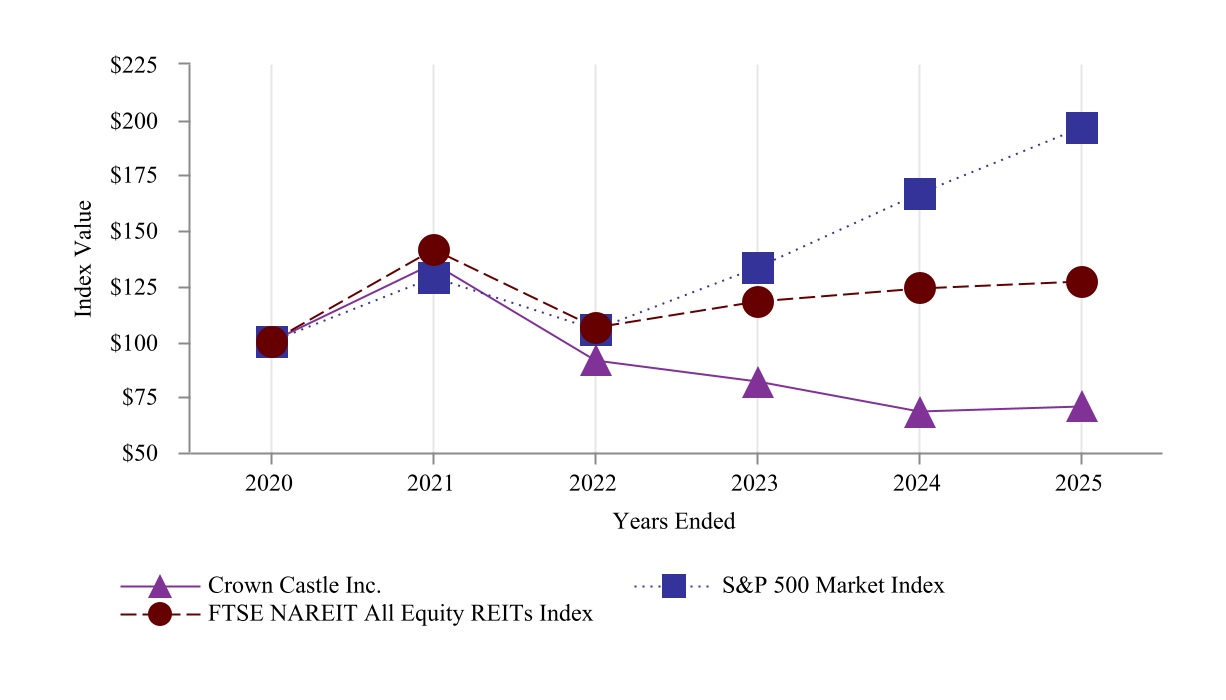
| Years Ended December 31, | ||||||||||||||||||||||||||||||||||||||
| Company/Market/Index | 2020 | 2021 | 2022 | 2023 | 2024 | 2025 | ||||||||||||||||||||||||||||||||
| Crown Castle Inc. | $ | 100.00 | $ | 135.08 | $ | 91.08 | $ | 81.75 | $ | 68.35 | $ | 70.38 | ||||||||||||||||||||||||||
| S&P 500 Market Index | 100.00 | 128.71 | 105.40 | 133.10 | 166.40 | 196.16 | ||||||||||||||||||||||||||||||||
| FTSE NAREIT All Equity REITs Index | 100.00 | 141.30 | 106.05 | 118.09 | 123.90 | 126.71 | ||||||||||||||||||||||||||||||||
The performance graph above and related text are being furnished solely to accompany this 2025 Form 10-K pursuant to Item 201(e) of Regulation S-K, and are not being filed for purposes of Section 18 of the Exchange Act, and are not to be incorporated by reference into any filing of ours, whether made before or after the date hereof, regardless of any general incorporation language in such filing.
33
Item 6. [Reserved]
Item 7. Management's Discussion and Analysis of Financial Condition and Results of Operations
General Overview
Overview
We own, operate and lease shared communications infrastructure. See "Item 1. Business" for a further discussion of our business, including our long-term strategy, our REIT status, certain key terms of our tenant contracts and growth trends in the demand for data.
On March 13, 2025, management signed the Strategic Fiber Agreement to sell our Fiber Business, with Zayo acquiring the fiber solutions business and EQT acquiring the small cell business. Under the Strategic Fiber Agreement, we will receive $8.5 billion in aggregate, subject to certain closing adjustments. The Strategic Fiber Transaction is expected to close in the first half of 2026, subject to certain closing conditions and regulatory approvals. See "Item 1. Business—Overview" for further discussion of the pending sale of the Fiber Business.
As the aforementioned sale represents a material strategic shift for the Company, the Fiber Business' results and net assets are presented herein as discontinued operations and comparable prior periods have been recast to reflect this change. Related to the classification of the Fiber Business as "held for sale", we have recognized a loss from disposal of discontinued operations of approximately $1.6 billion, inclusive of estimated transaction fees, for the year ended December 31, 2025.
Following the classification of the Fiber Business as discontinued operations, we have one reportable segment that constitutes consolidated results of our tower operations. See notes 3 and 15 to our consolidated financial statements for a discussion of discontinued operations and our operating segment. Unless otherwise noted, all activities and amounts reported in this document relate to continuing operations and exclude activities and amounts related to discontinued operations.
Highlights of Business Fundamentals and Results
•Site rental revenues represented 95% of our 2025 net revenues. The vast majority of our site rental revenues is of a recurring nature and has been contracted for in prior years.
•We operate as a REIT for U.S. federal income tax purposes (see "Item 1. Business—REIT Status" and notes 2 and 10 to our consolidated financial statements)
•Potential growth resulting from the increasing demand for data
◦We expect existing and potential new tenant demand for our towers will result from (1) new technologies, (2) increased usage of mobile entertainment, mobile internet, and machine-to-machine applications, (3) adoption of other emerging and embedded wireless devices (including smartphones, laptops, tablets, wearables and other devices), (4) increasing smartphone penetration, (5) wireless carrier focus on expanding both network quality and capacity, (6) the adoption of other bandwidth-intensive applications (such as cloud services, artificial intelligence and video communications), (7) the availability of additional spectrum and (8) increased government initiatives to support connectivity throughout the U.S.
◦We expect U.S. wireless carriers will continue to focus on improving network quality and expanding capacity (including through 5G initiatives). We believe our towers provide an efficient and cost-effective solution to our wireless tenants' growing infrastructure needs.
◦Tenant additions on our towers are achieved at a low incremental operating cost, delivering high incremental returns.
◦Substantially all of our towers can accommodate additional tenancy, either as currently constructed or with appropriate modifications.
•Returning cash flows provided by operations to stockholders in the form of dividends (see also "Item 1. Business—Strategy")
◦During 2025, we paid common stock dividends totaling approximately $2.1 billion.
•Investing capital efficiently to grow cash flows
◦We had discretionary capital expenditures of $149 million for the year ended December 31, 2025, predominately related to improvements to existing towers to support additional tenants and purchases of land underneath our towers.
◦We expect to continue to construct and acquire new towers that we expect will generate future cash flow growth and attractive long-term returns by adding tenants to those assets over time.
◦We expect to continue to acquire land interests relating to land under our towers.
•Site rental revenues under long-term tenant contracts
34
◦Our tenant contracts have initial terms generally between five to 15 years with contractual escalators and multiple renewal periods generally between five to 10 years each, exercisable at the option of the tenant.
◦As of December 31, 2025, our weighted-average remaining term was approximately six years, exclusive of renewals exercisable at the tenants' option, currently representing approximately $23.7 billion of expected future cash inflows, exclusive of amounts due under the Master Lease Agreement and underlying agreements with DISH. See "Item 7. MD&A—General Overview—Outlook Highlights" for further discussion.
•Majority of our revenues from large wireless carriers
◦For the year ended December 31, 2025, approximately 90% of our site rental revenues were derived from T-Mobile, AT&T and Verizon Wireless. See "Item 1A. Risk Factors" and note 15 to our consolidated financial statements for a further discussion of our largest customers.
◦During 2025, our site rental revenues decreased approximately $200 million as a result of non-renewals related to the network consolidation of T-Mobile and Sprint.
•Majority of land under our towers under long-term control
◦For the year ended December 31, 2025, approximately 90% of our towers Adjusted Site Rental Gross Margin and approximately 80% of our towers Adjusted Site Rental Gross Margin was derived from towers located on land that we own or control for greater than 10 and 20 years, respectively. The aforementioned percentages include towers located on land that is owned, including through fee interests and perpetual easements, which represented approximately 40% of our towers Adjusted Site Rental Gross Margin.
•Minimal sustaining capital expenditure requirements
◦For the year ended December 31, 2025, sustaining capital expenditures represented less than 1% of net revenues.
•Debt portfolio with long-dated maturities extended over multiple years, with the vast majority of such debt having a fixed rate (see note 8 to our consolidated financial statements and "Item 7A. Quantitative and Qualitative Disclosures About Market Risk" for a further discussion of our debt)
◦As of December 31, 2025, our outstanding debt had a weighted average interest rate of 3.9% and weighted average maturity of approximately six years (assuming anticipated repayment dates on certain debt).
◦As of December 31, 2025, 84% of our debt has fixed rate coupons.
◦Our debt service coverage and leverage ratios are within their respective financial maintenance covenants. See "Item 7. MD&A—Liquidity and Capital Resources—Debt Covenants" for a further discussion of our debt covenants.
•During 2025, we repaid in full certain of our debt (see note 8 to our consolidated financial statements and "Item 7. MD&A—Liquidity and Capital Resources—Financing Activities" for further discussion of our debt transactions)
•Significant cash flows from operations
◦Net cash provided by operating activities was $3.1 billion for the year ended December 31, 2025.
◦In addition to the positive impact of contractual escalators, we expect to grow our core business of providing access to our towers as a result of future anticipated additional demand.
•2023 and 2024 Restructuring Plans
◦There were no restructuring charges in 2025 relating to either the 2023 Restructuring Plan or the 2024 Restructuring Plan. See note 17 to our consolidated financial statements for further discussion of the 2023 Restructuring Plan and 2024 Restructuring Plan.
Common Stock Dividend
During the first quarter of the year ended 2025, we paid a common stock dividend of $1.565 per share and during each of the following three quarters, we paid a common stock dividend of $1.0625 per share, totaling approximately $2.1 billion. We have updated our capital allocation framework to focus more on free cash flow generation and financial flexibility, which primarily drove our decision to reduce our dividend in the second quarter of 2025. As we grow cash flows, we expect to increase our dividend per share. Whether dividends are to be declared and the amount and timing thereof remain subject to the discretion of our board of directors. See note 11 to our consolidated financial statements.
Outlook Highlights
The following are certain highlights of our outlook that impact our business fundamentals described above.
•In January 2026, we delivered a notice of default and termination to DISH relating to our Master Lease Agreement and underlying agreements with DISH as a result of DISH failing to make required payments and defaulting on its obligations under the agreements. As a result of the termination, we assert in the notice that DISH owes us all remaining payments under the agreements, which total in excess of $3.5 billion. Our 2026 Outlook does not include any revenues from DISH.
35
•We expect a year over year reduction in site rental revenues related to (1) approximately $220 million from the aforementioned DISH termination, and (2) a decline in long-term deferred revenue amortization.
•In February 2026, we initiated a restructuring plan ("2026 Restructuring Plan") as part of our efforts to enhance the efficiency and effectiveness of our tower business.
◦We expect to realize approximately $65 million annualized run-rate savings in operating costs, of which approximately $55 million will be realized in 2026 due to timing. The remaining savings of approximately $10 million will be realized in 2027. We expect to incur aggregate restructuring charges of approximately $30 million in 2026 as a result of the 2026 Restructuring Plan, most of which we expect to incur in the first and second quarters of 2026. See "Item 1A. Risk Factors" for a discussion of risks related to our restructuring activities.
•Following the closure of the Strategic Fiber Transaction, which is expected to occur in the first half of 2026, we expect to use the proceeds from the sale to repurchase approximately $1 billion of shares and approximately $7 billion of debt.
◦As a result of the expected $7 billion repayment of debt, our 2026 interest expense is expected to decrease.
•Notwithstanding the plan to sell our Fiber Business, we expect to continue to invest a significant amount of our available capital in the form of discretionary capital expenditures in the Fiber Business until the closing of the Strategic Fiber Transaction.
36
Results of Operations
The following discussion of our results of operations for 2025 compared to 2024 should be read in conjunction with "Item 1. Business," "Item 7. MD&A—Liquidity and Capital Resources" and our consolidated financial statements. For a discussion of our results of operations and financial condition for 2024 compared to 2023 that is not included in this 2025 Form 10-K, see "Part II, Item 7. Management's Discussion and Analysis of Financial Condition and Results of Operations" in our Annual Report on Form 10-K for the year ended December 31, 2024, which was filed with the SEC on March 14, 2025.
The following discussion of our results of operations is based on our consolidated financial statements prepared in accordance with GAAP, which requires us to make estimates and judgments that affect the reported amounts (see "Item 7. MD&A—Accounting and Reporting Matters—Critical Accounting Policies and Estimates" and note 2 to our consolidated financial statements). See "Item 7. MD&A—Accounting and Reporting Matters—Non-GAAP Financial Measures" for a discussion of our use of (1) Adjusted Site Rental Gross Margin and (2) Adjusted Services and Other Gross Margin, including their respective definitions and (3) Adjusted EBITDA, including its definition and a reconciliation to net income (loss).
Highlights of our results of operations for 2025, 2024 and 2023 are depicted below:
| Years Ended December 31, | Percent Change | ||||||||||||||||||||||||||||
| (In millions of dollars) | 2025 | 2024 | 2023 | 2025 vs. 2024 | 2024 vs. 2023 | ||||||||||||||||||||||||
| Site rental revenues: | $ | 4,049 | $ | 4,268 | $ | 4,313 | (5) | % | (1) | % | |||||||||||||||||||
| Income (loss) from continuing operations | 1,103 | 1,162 | 1,237 | (5) | % | (6) | % | ||||||||||||||||||||||
| Net income (loss) | 444 | (3,903) | 1,502 | 111 | % | (360) | % | ||||||||||||||||||||||
Adjusted EBITDA(a) | 2,863 | 3,035 | 3,084 | (6) | % | (2) | % | ||||||||||||||||||||||
Adjusted Site Rental Gross Margin(a) | 3,076 | 3,307 | 3,370 | (7) | % | (2) | % | ||||||||||||||||||||||
Adjusted Services and Other Gross Margin(a) | 107 | 91 | 127 | 18 | % | (28) | % | ||||||||||||||||||||||
(a)See reconciliations of these non-GAAP financial measures to net income (loss) and definitions included in "Item 7. MD&A—Accounting and Reporting Matters—Non-GAAP.
37
2025 and 2024
Total site rental revenues for 2025 decreased by $219 million, or 5%, from 2024. This decrease was predominately comprised of the factors depicted in the chart below:
(In millions of dollars; components may not sum to totals due to rounding)
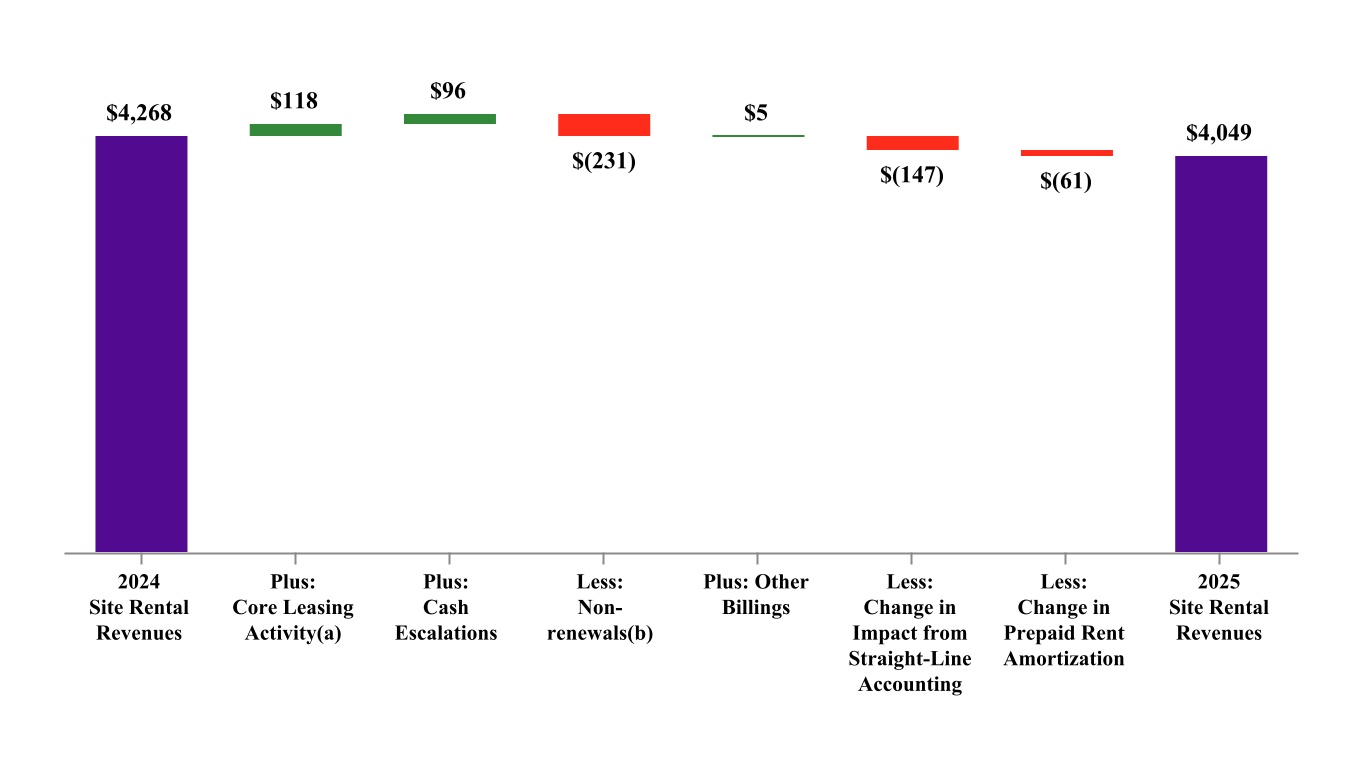
(a)Represents site rental revenues growth from tenant additions across our entire portfolio and renewals or extensions of tenant contracts, exclusive of the impacts from both straight-line accounting and amortization of prepaid rent in accordance with GAAP.
(b)Includes $204 million of non-renewals associated with the T-Mobile and Sprint network consolidation.
Site rental revenues and Adjusted Site Rental Gross Margin for 2025 were $4.0 billion and $3.1 billion, respectively, compared to $4.3 billion and $3.3 billion, respectively, for 2024. The decrease of $219 million and $231 million in site rental revenue and Adjusted Site Rental Gross Margin, respectively, was primarily due to higher non-renewals of $204 million as a result of the T-Mobile and Sprint network consolidation, as well as a decrease in prepaid rent amortization of $61 million, as new leasing activity and contractual cash escalators were substantially offset by a decline in the associated straight-line accounting adjustment.
Adjusted Services and Other Gross Margin was $107 million for 2025 and increased by $16 million from $91 million from 2024, which is a reflection of the volume and mix of services and other offerings. Our services and other offerings are of a variable nature as these revenues are not under long-term tenant contracts.
Selling, general and administrative expenses for 2025 were $383 million and decreased by $52 million, or 12%, from $435 million from 2024. The decrease in selling, general and administrative expenses was related to a decrease in legal and consulting expense, primarily related to our recent proxy contest in 2024, and a decrease in employee- and facility-related costs as a result of our aforementioned restructuring activities of the 2023 and 2024 Restructuring Plans.
Depreciation, amortization and accretion was approximately $690 million for 2025 and decreased by $46 million, or 6%, from 2024. This decrease predominately resulted from certain fixed assets and site rental contracts and tenant relationships intangible assets becoming fully depreciated or amortized, respectively.
There were no restructuring charges recorded in connection with the 2023 and 2024 Restructuring Plans during 2025 compared to $70 million recorded during 2024. The actions associated with the 2023 and 2024 Restructuring Plans were substantially completed and the related charges were recorded by December 31, 2024. See note 17 to our consolidated financial statements for further discussion of our 2023 and 2024 Restructuring Plans.
Interest expense and amortization of deferred financing costs, net was $972 million for 2025 and increased by $40 million, or 4%, from $932 million during 2024. The increase predominately resulted from an increase in our outstanding
38
indebtedness due to the financing of our discretionary capital expenditures, including those presented within discontinued operations. See note 8 to our consolidated financial statements, "Item 1A. Risk Factors" and "Item 7A. Quantitative and Qualitative Disclosures About Market Risk" for a further discussion of our debt and interest rate exposure.
The provision for income taxes for 2025 and 2024 were $16 million and $18 million, respectively. For both 2025 and 2024, the effective tax rate differs from the federal statutory rate predominately due to our REIT status, including the dividends paid deduction. See "Item 1. Business—REIT Status," "Item 7. MD&A—Accounting and Reporting Matters—Critical Accounting Policies and Estimates" and note 10 to our consolidated financial statements.
Income (loss) from continuing operations was $1.1 billion during 2025 compared to $1.2 billion during 2024. The decrease was related to the previously-mentioned decreases in site rental revenues, the previously-mentioned increases in interest expense and amortization of deferred financing costs, net, while being partially offset by a decrease in restructuring charges, depreciation, amortization and accretion expense and selling, general, and administrative expenses.
Income (loss) from discontinuing operations before gain (loss) from disposal, net of tax, was $916 million during 2025 compared to $(5,065) million during 2024. The increase was primarily driven by the absence of a $106 million asset write-down charge and $5.0 billion goodwill impairment charge, both of which occurred in 2024. In addition, there was a decrease in depreciation, amortization and accretion related to the ceasing of depreciation and amortization of the Fiber Business long-lived assets classified as "held for sale."
Gain (loss) from disposal of discontinued operations was $(1.6) billion during 2025. The loss was primarily related to the classification during the first quarter of 2025 of the Fiber Business as "held for sale" and the additional investment in the Fiber Business during the remainder of 2025. The loss represents the excess of the carrying value of the Fiber Business over the purchase price, less estimated costs to sell.
Net income (loss) was $444 million during 2025 compared to $(3,903) million during 2024. The increase was primarily due to the change in income (loss) from discontinued operations, net of tax of $4.4 billion, primarily due to the absence of the previously mentioned $5.0 billion goodwill impairment charge recorded in 2024.
Adjusted EBITDA decreased by $172 million, or 6%, from 2024 to 2025, reflecting the previously mentioned decreases in site rental revenue, partially offset by previously mentioned decreases in selling, general, and administrative expenses and increase in Adjusted Services and Other Gross Margin.
39
Liquidity and Capital Resources
Overview
General. Our core business generates revenues under long-term tenant contracts (see "Item 1. Business—Overview" and "Item 7. MD&A—General Overview—Overview") from the largest U.S. wireless carriers and other towers tenants. As a leading provider of towers in the U.S., our strategy is to create long-term stockholder value via a combination of (1) growing cash flows generated from our existing towers, (2) returning a meaningful portion of our cash generated by operating activities to our stockholders in the form of dividends and share repurchases, and (3) investing capital efficiently to grow cash flows. Our strategy is based, in part, on our belief that the U.S. is the most attractive market for towers investment with the greatest long-term growth potential. We measure our efforts to create "long-term stockholder value" by the growth in our per share results. See "Item 1. Business—Strategy" for a further discussion of our strategy.
We have engaged, and expect to continue to engage, in discretionary investments that we believe will maximize long-term stockholder value. These investments include the acquisition of land interests, making improvements, structural enhancements to our existing towers, and constructing and acquiring new towers that we expect will generate future cash flow growth and attractive long-term returns by adding tenants to those assets over time. We have recently spent, and expect to continue to spend, a significant percentage of our discretionary investments on the construction of small cells and fiber until the closing of the sale of the Fiber Business. See note 3 to our consolidated financial statements and "Item 7. MD&A—General Overview" for further discussion of the pending sale of the Fiber Business. We seek to fund our discretionary investments with both cash generated by operating activities and cash available from financing capacity, such as the use of our availability under our 2016 Revolver, issuances under our CP Program, debt financings and issuances of equity or equity-related securities, including under our 2024 ATM Program or any similar successor program.
We seek to maintain a capital structure that we believe drives long-term stockholder value and optimizes our weighted-average cost of capital. Additionally, we expect to maintain an investment grade credit profile. As of December 31, 2025, our contractual debt maturities over the next 12 months consist of (1) Commercial Paper Notes, of which we had $1.9 billion outstanding as of February 19, 2026, (2) the 4.450%, 3.700%, and 1.050% senior unsecured notes due February, June and July 2026, respectively ("4.450% Senior Notes", "3.700% Senior Notes", and "1.050% Senior Notes") and (3) principal payments on certain outstanding debt. Amounts available under our CP Program may be repaid and re-issued from time to time and we intend to maintain available commitments under our 2016 Revolver in an amount at least equal to the amount of Commercial Paper Notes outstanding.
We operate as a REIT for U.S. federal income tax purposes. We expect to continue to pay minimal cash income taxes as a result of our REIT status and our NOLs. See "Item 1. Business—REIT Status," "Item 7. MD&A—General Overview" and note 10 to our consolidated financial statements.
Liquidity Position. The following is a summary of our capitalization and liquidity position as of December 31, 2025. See "Item 7A. Quantitative and Qualitative Disclosures About Market Risk" and note 8 to our consolidated financial statements for additional information regarding our debt as well as note 11 to our consolidated financial statements for additional information regarding our 2024 ATM Program.
| (In millions of dollars) | |||||
Cash and cash equivalents and restricted cash and cash equivalents(a) | $ | 274 | |||
Undrawn 2016 Revolver availability(b) | 6,015 | ||||
| Total debt and other obligations (current and non-current) | 24,337 | ||||
Total deficit | (1,635) | ||||
(a)Inclusive of $5 million included within "Other assets, net" on our consolidated balance sheet.
(b)Availability at any point in time is subject to certain restrictions based on the maintenance of financial covenants contained in our 2016 Credit Facility. At any point in time, we intend to maintain available commitments under our 2016 Revolver in an amount at least equal to the amount of outstanding Commercial Paper Notes. See note 8 to our consolidated financial statements.
As of December 31, 2025, over the next 12 months:
•Following the closure of the Strategic Fiber Transaction, which is expected to occur in the first half of 2026, we expect to use the proceeds from the sale to repurchase approximately $1 billion of shares and repay approximately $7 billion of debt. Future share repurchases are subject to the discretion and approval of our board of directors.
◦Upon closure, we do not expect that the absence of cash flows from the Fiber Business will have an adverse impact on our liquidity position. While the Fiber Business generated cash inflows from operating activities, such cash inflows were generally offset by cash used for investing activities due to significant discretionary capital expenditures. As a result, the Fiber Business did not historically provide net liquidity to our Company.
40
•In addition to the aforementioned proceeds from the sale, our liquidity sources may include (1) cash on hand, (2) cash generated by our operating activities, (3) availability under our 2016 Revolver, (4) issuances under our CP Program, and (5) issuances of equity pursuant to our 2024 ATM Program or any similar successor program. Our liquidity uses are expected to include (1) maturing debt obligations of $4.7 billion (consisting of Commercial Paper Notes, the 4.450% Senior Notes, the 3.700% Senior Notes, the 1.050% Senior Notes and principal payments on certain outstanding debt), (2) additional debt paydowns using the proceeds from the sale discussed above, (3) share repurchases as discussed above, (4) common stock dividend payments, subject to declaration by our board of directors (see "Item 7. MD&A—General Overview—Common Stock Dividend"), and (5) capital expenditures.
•Amounts available under our CP Program may be repaid and re-issued from time to time and we intend to maintain available commitments under our 2016 Revolver in an amount at least equal to the amount of Commercial Paper Notes outstanding. Historically, from time to time, we have accessed the capital markets to issue debt and equity.
•See "Item 7A. Quantitative and Qualitative Disclosures About Market Risk" for a discussion of interest rate risk and note 8 to our consolidated financial statements for a tabular presentation of our debt maturities and a discussion of anticipated repayment dates.
Summary Cash Flows Information
| Years Ended December 31, | |||||||||||||||||
| (In millions of dollars) | 2025 | 2024 | 2023 | ||||||||||||||
| Operating activities | $ | 3,057 | $ | 2,943 | $ | 3,126 | |||||||||||
| Investing activities | (1,158) | (1,220) | (1,519) | ||||||||||||||
| Financing activities | (1,886) | (1,708) | (1,654) | ||||||||||||||
Net increase (decrease) in cash and cash equivalents and restricted cash and cash equivalents | 13 | 15 | (47) | ||||||||||||||
| Effect of exchange rate changes on cash | — | (1) | 1 | ||||||||||||||
Net increase (decrease) in cash and cash equivalents and restricted cash and cash equivalents | $ | 13 | $ | 14 | $ | (46) | |||||||||||
Operating Activities
The increase in net cash provided by operating activities of $114 million from 2024 to 2025 was driven by a $52 million increase in net cash provided by continuing operations and $62 million increase in net cash provided by discontinued operations. The $52 million increase in net cash provided by continuing operations is due primarily to a net increase from changes in working capital partially offset by the aforementioned decrease in Adjusted Site Rental Gross Margin. Changes in working capital contribute to variability in net cash provided by operating activities, largely due to the timing of advanced payments by us and advanced receipts from tenants. We expect to grow our net cash provided by operating activities in the future (exclusive of changes in working capital) if we realize expected growth in our core business.
The increase of $62 million in net cash provided by discontinued operations is due primarily to increased operating profit of our Fiber Business and a net increase from changes in working capital.
Investing Activities
Net cash used for investing activities for 2025 decreased by $62 million from 2024, driven by a $3 million increase in net cash used for investing by continuing operations and $65 million decrease in net cash used for discontinuing operations.
Our capital expenditures are categorized as discretionary or sustaining as described below.
•Discretionary capital expenditures relating to continuing operations are those made with respect to activities which we believe exhibit sufficient potential to enhance long-term stockholder value. Discretionary capital expenditures, including with respect to discontinued operations, primarily consist of expansion or development of our communications infrastructure (including capital expenditures related to (1) enhancing communications infrastructure in order to add new tenants for the first time or support subsequent tenant equipment augmentations or (2) modifying the structure of a communications infrastructure asset to accommodate additional tenants) and construction of new communications infrastructure. Discretionary capital expenditures also include purchases of land interests (which primarily relate to land assets under towers as we seek to manage our interests in the land beneath our towers), certain technology-related investments necessary to support and scale future customer demand for our communications infrastructure, and other capital projects. The expansion or development of existing communications infrastructure to accommodate new leasing typically varies based on, among other factors: (1) the type of communications infrastructure, (2) the scope, volume, and mix of work performed on the communications infrastructure, (3) existing capacity prior to installation, or (4) changes in structural engineering regulations and standards. Currently, construction of new communications infrastructure is predominately comprised of the construction of small cells and fiber (including certain construction projects that may take 18 to 36 months to complete). Our decisions regarding
41
discretionary capital expenditures are influenced by the availability and cost of capital and expected returns on alternative uses of cash, such as payments of dividends and investments.
•Sustaining capital expenditures consist of those capital expenditures (including with respect to discontinued operations) not otherwise categorized as discretionary capital expenditures, such as (1) maintenance capital expenditures on our communications infrastructure assets that enable our tenants' ongoing quiet enjoyment of the communications infrastructure and (2) ordinary corporate capital expenditures.
A summary of our capital expenditures for continuing operations for the last three years is as follows:
| For the Years Ended | |||||||||||||||||
| December 31, | |||||||||||||||||
| (In millions of dollars) | 2025 | 2024 | 2023 | ||||||||||||||
| Discretionary: | |||||||||||||||||
Tower improvements and other capital projects(a) | $ | 72 | $ | 84 | $ | 146 | |||||||||||
| Purchases of land interests | 77 | 58 | 64 | ||||||||||||||
| Sustaining | 33 | 34 | 33 | ||||||||||||||
| Total | $ | 182 | $ | 176 | $ | 243 | |||||||||||
(a)Includes $7 million, $12 million and $32 million of capital expenditures incurred during the years ended December 31, 2025, 2024 and 2023, respectively, in connection with tenant installations and upgrades on our towers.
The $65 million reduction in discretionary capital expenditures for our discontinued operations during 2025 compared to the same period in 2024 was primarily related to the higher return thresholds on new growth opportunities as a result of the review of the Fiber Business completed in the second quarter of 2024. The discretionary capital expenditures for our continuing operations were relatively stable as tower investments related to tenant activity were offset by an increase in land purchases under our towers.
Financing Activities
We seek to allocate cash generated by our operations in a manner that will enhance long-term stockholder value, which may include various financing activities such as (in no particular order): (1) paying dividends on our common stock, subject to declaration by our board of directors, (2) purchasing our common stock or (3) purchasing, repaying, or redeeming our debt. See "Item 7. MD&A—General Overview—Common Stock Dividend," "Item 7. MD&A—Liquidity and Capital Resources—Overview" and notes 8 and 11 to our consolidated financial statements.
In 2025, our financing activities predominately related to the following:
•paying an aggregate of $2.1 billion in dividends on our common stock;
•repaying in full the previously outstanding Tower Revenue Notes, Series 2015-2 on the anticipated repayment date in May 2025;
•repaying in full the previously outstanding 1.350% senior unsecured notes on the contractual maturity date in July 2025; and
•net borrowings under our revolving credit facility and net issuances under our commercial paper program, which collectively were used for general corporate purposes.
In 2024, our financing activities predominately related to the following:
•paying an aggregate of $2.7 billion in dividends on our common stock;
•repaying in full the previously outstanding 3.200% senior unsecured notes on the contractual maturity date in September 2024; and
•issuing $550 million aggregate principal amount of 4.900% senior unsecured notes and $700 million aggregate principal amount of 5.200% senior unsecured notes in August 2024, the net proceeds of which were used to repay a portion of the outstanding indebtedness under our CP Program and pay related fees and expenses.
Incurrence, Purchases and Repayments of Debt. See note 8 to our consolidated financial statements, "Item 7. MD&A—General Overview" and "Item 7. MD&A—Liquidity and Capital Resources—Overview—Liquidity Position" for further discussion of our recent issuances, purchases, redemptions and repayments of debt.
Common Stock. See note 11 to our consolidated financial statements for further information regarding our common stock as well as dividends declared and paid.
42
ATM Program. We previously maintained a 2021 ATM Program through which we had the right to issue and sell shares of our common stock having an aggregate gross sales price of up to $750 million to or through sales agents. In March 2024, we terminated the formerly outstanding 2021 ATM Program with the entire gross sales price of $750 million remaining unsold.
In March 2024, we established the 2024 ATM Program through which we may issue and sell shares of our common stock having an aggregate gross sales price of up to $750 million. Sales under the 2024 ATM Program, or any similar successor program, may be made by means of ordinary brokers' transactions on the New York Stock Exchange ("NYSE") or otherwise at market prices prevailing at the time of sale, at prices related to prevailing market prices or, subject to our specific instructions, at negotiated prices. We intend to use the net proceeds from any sales under the 2024 ATM Program, or any similar successor program, for general corporate purposes, which may include (1) the funding of future acquisitions or investments or (2) the repayment or repurchase of any outstanding indebtedness. We have not sold any shares of common stock under the 2024 ATM Program. See also note 11 to our consolidated financial statements. As of February 19, 2026, we had $750 million of gross sales of common stock availability remaining on our 2024 ATM Program.
Credit Facility. See note 8 to our consolidated financial statements for further information regarding our 2016 Credit Facility. As of February 19, 2026, we had an outstanding balance under our 2016 Revolver of $1.8 billion and maintained $5.2 billion in undrawn availability. The proceeds from our 2016 Revolver may be used for general corporate purposes, which may include the financing of capital expenditures, acquisitions, the repayment or repurchase of any outstanding indebtedness and purchases of our common stock.
Commercial Paper Program. See note 8 to our consolidated financial statements for further information regarding our CP Program. As of February 19, 2026, there was $1.9 billion outstanding under our CP Program. The proceeds from our Commercial Paper Notes may be used for general corporate purposes, which may include the financing of capital expenditures, acquisitions, the repayment or repurchase of any outstanding indebtedness and purchases of our common stock.
Restricted Cash and Cash Equivalents. Pursuant to the indentures governing certain of our operating companies' debt securities, all rental cash receipts of the issuers of these debt instruments and their subsidiaries are restricted and held by an indenture trustee. The restricted cash and cash equivalents in excess of required reserve balances is subsequently released to us in accordance with the terms of the indentures. See also note 2 to our consolidated financial statements.
43
Material Cash Requirements
The following table summarizes our material cash requirements as of December 31, 2025. These material cash requirements relate primarily to our outstanding borrowings or lease obligations for land interests under our towers. The debt maturities reflect contractual maturity dates and do not consider the impact of the principal payments that will commence following the anticipated repayment dates of certain debt (see footnote (b)). The debt and interest payments on debt below do not consider the aforementioned expected use of proceeds from the closure of the Strategic Fiber Transaction.
| (In millions of dollars) | Years Ending December 31, | ||||||||||||||||||||||||||||||||||||||||
| Material Cash Requirements | 2026 | 2027 | 2028 | 2029 | 2030 | Thereafter | Totals | ||||||||||||||||||||||||||||||||||
Debt and other long-term obligations(a) | $ | 4,714 | $ | 4,199 | $ | 2,634 | $ | 2,479 | $ | 772 | $ | 9,669 | $ | 24,467 | |||||||||||||||||||||||||||
Interest payments on debt and other long-term obligations(b)(c) | 905 | 865 | 765 | 651 | 562 | 5,360 | 9,108 | ||||||||||||||||||||||||||||||||||
Lease obligations(d) | 521 | 523 | 526 | 527 | 524 | 5,108 | 7,729 | ||||||||||||||||||||||||||||||||||
| Total material cash requirements | $ | 6,140 | $ | 5,587 | $ | 3,925 | $ | 3,657 | $ | 1,858 | $ | 20,137 | $ | 41,304 | |||||||||||||||||||||||||||
(a)The impact of principal payments that will commence following the anticipated repayment date of our Tower Revenue Notes, Series 2018-2 is not considered. The Tower Revenue Notes, Series 2018-2 has a principal amount of $750 million, with an anticipated repayment date in 2028. See note 8 to our consolidated financial statements for our definition of and additional information regarding the 2018 Tower Revenue Notes.
(b)If the Tower Revenue Notes, Series 2018-2 are not repaid in full by the anticipated repayment date, the interest rate increases by approximately 5% per annum and monthly principal payments commence using the Excess Cash Flow (as defined in the indenture governing the Tower Revenue Notes, Series 2018-2) of the issuers of the Tower Revenue Notes, Series 2018-2. The Tower Revenue Notes, Series 2018-2 are presented based on their contractual maturity date in 2048 and include the impact of an assumed 5% increase in interest rate that would occur following the anticipated repayment date but exclude the impact of monthly principal payments that would commence using Excess Cash Flow of the issuers of the Tower Revenue Notes, Series 2018-2. The full year 2025 Excess Cash Flow of the issuers of the Tower Revenue Notes, Series 2018-2 was approximately $1.0 billion. We currently expect to refinance or repay these notes on or prior to the anticipated repayment date.
(c)Includes the unused commitment fees on our 2016 Credit Facility. Interest payments on the variable rate debt are based on estimated rates currently in effect. See note 8 to our consolidated financial statements for information regarding potential upward or downward adjustments to the interest rate spread and unused commitment fee percentage on our 2016 Credit Facility if we achieve specified annual sustainability targets or fail to meet annual sustainability thresholds. Each annual period presented assumes the downward adjustments in the interest rate spread and unused commitment fee percentage on our 2016 Credit Facility. See "Item 7A. Quantitative and Qualitative Disclosures About Market Risk" for a discussion of our interest rate risk.
(d)Amounts relate primarily to lease obligations for the land on which our towers are located and are based on the assumption that payments will be made for certain renewal periods exercisable at our option that are reasonably certain to be exercised and excludes our contingent payments for operating leases (such as payments based on revenues derived from the tower located on the leased asset) as such arrangements are excluded from our operating lease liability. See note 14 to our consolidated financial statements for further discussion of our operating lease obligations. See also the table below summarizing remaining terms to expiration.
44
The following chart summarizes our rights to the land interests under our towers, including renewal terms exercisable at our option, as of December 31, 2025. As of December 31, 2025, the leases for land interests under our towers had an average remaining life of approximately 35 years, weighted based on towers Adjusted Site Rental Gross Margin. See "Item 1A. Risk Factors" for a discussion of retaining the rights to land under our towers.
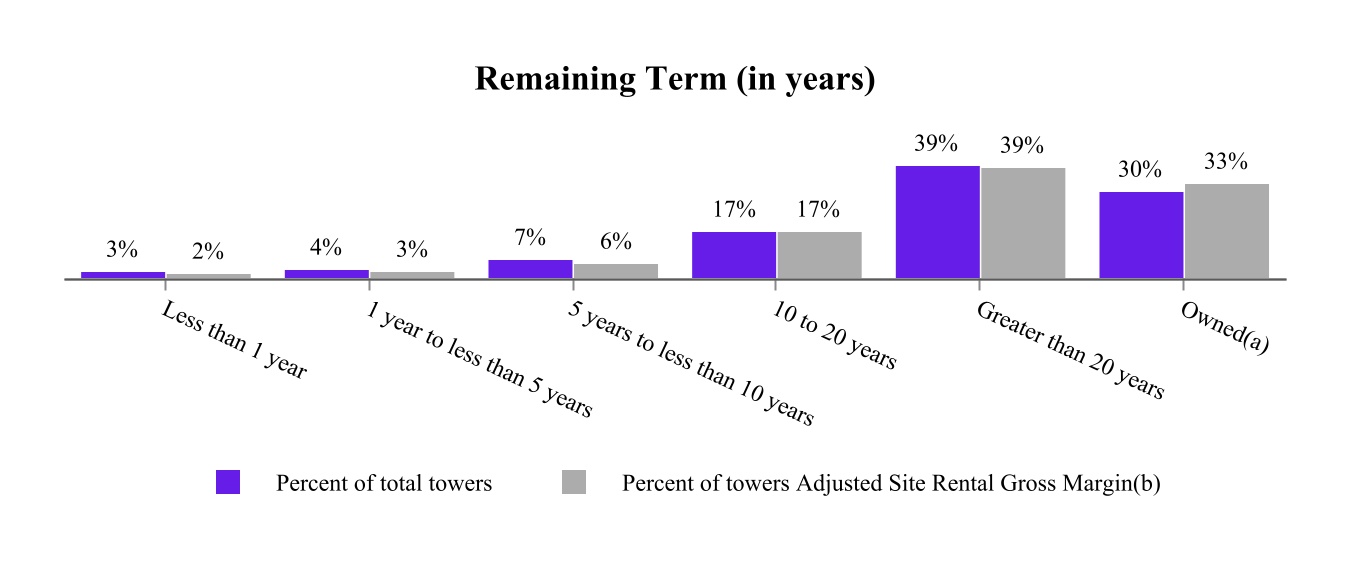
(a)Inclusive of land owned through fee interests and perpetual easements.
(b)For the three months ended December 31, 2025, without consideration of the term of the tenant contract.
Debt Covenants
Our 2016 Credit Agreement contains financial maintenance covenants. We are currently in compliance with these financial maintenance covenants and, based upon our current expectations, we believe we will continue to comply with our financial maintenance covenants. In addition, certain of our debt agreements contain restrictive covenants that place restrictions on us and may limit our ability to, among other things, incur additional debt and liens, purchase our securities, make capital expenditures, dispose of assets, undertake transactions with affiliates, make other investments, pay dividends or distribute excess cash flow. See note 8 to our consolidated financial statements for further discussion of our debt covenants. See also "Item 1A. Risk Factors" for a discussion of compliance with our debt covenants. The following are ratios applicable to the financial maintenance covenants under the 2016 Credit Agreement as of December 31, 2025.
| Borrower / Issuer | Financial Maintenance Covenant(a)(b) | Covenant Level Requirement | As of December 31, 2025 | ||||||||
| CCI | Total Net Leverage Ratio | ≤ 6.50x | 5.9x | ||||||||
| CCI | Total Senior Secured Leverage Ratio | ≤ 3.50x | 0.2x | ||||||||
| CCI | Consolidated Interest Coverage Ratio(c) | N/A | N/A | ||||||||
(a)Failure to comply with the financial maintenance covenants would, absent a waiver, result in an event of default under the 2016 Credit Agreement.
(b)As defined in the 2016 Credit Agreement.
(c)Applicable solely to the extent that the senior unsecured debt rating by any two of S&P, Moody's and Fitch is lower than BBB-, Baa3 or BBB-, respectively. If applicable, the consolidated interest coverage ratio must be greater than or equal to 2.50.
45
Accounting and Reporting Matters
Critical Accounting Policies and Estimates
Our critical accounting policies and estimates are those that we believe (1) are most important to the portrayal of our financial condition and results of operations or (2) require our most difficult, subjective or complex judgments, often as a result of the need to make estimates about the effect of matters that are inherently uncertain. In many cases, the accounting treatment of a particular transaction is specifically prescribed by GAAP. In other cases, management is required to exercise judgment in the application of accounting principles with respect to particular transactions. Accordingly, actual results could differ materially from our estimates. The critical accounting policies and estimates for 2025 are not intended to be a comprehensive list of our accounting policies and estimates. See note 2 to our consolidated financial statements for a summary of our significant accounting policies.
Lease Accounting—Lessee. Our lessee arrangements primarily consist of ground leases for land under our towers and are for an initial term generally between five to 15 years. We also enter into ground leases, such as term easements, in which we prepay the entire term. The majority of our lease agreements have certain termination rights that provide for cancellation after a notice period and multiple renewal options exercisable at our option. We include certain renewal option periods in the lease term when we determine that the options are reasonably certain to be exercised.
Operating lease expense is recognized on a ratable basis, regardless of whether the payment terms require us to make payments annually, semi-annually, quarterly, monthly, or for the entire term in advance. Certain of our ground lease agreements contain fixed escalation clauses (such as fixed dollar or fixed percentage increases) or inflation-based escalation clauses (such as those tied to the change in consumer price index ("CPI")). If the payment terms include fixed escalators, upfront payments, or rent-free periods, the effect of such increases is recognized on a straight-line basis. When calculating straight-line ground lease expense, we consider all fixed elements of contractual escalation provisions, even if such escalation provisions contain a variable element in addition to a minimum. We calculate the straight-line expense over the contract's estimated lease term, including any renewal option periods that we deem reasonably certain to be exercised.
We recognize a right-of-use ("ROU") asset (and, as applicable, a corresponding lease liability) for each of our operating leases. ROU assets represent our right to use an underlying asset for the estimated lease term, and lease liabilities represent the present value of our future lease payments. In assessing our leases and determining our lease liability at lease commencement or upon modification, we are not able to readily determine the rate implicit for our lessee arrangements and thus use our incremental borrowing rate on a collateralized basis to determine the present value of our lease payments. Our ROU assets are measured as the balance of the lease liability plus any prepaid or accrued lease payments and any unamortized initial direct costs.
We review the carrying value of our ROU assets for impairment, similar to our other long-lived assets, whenever events or changes in circumstances indicate that the carrying amounts may not be recoverable. We could record impairments in the future if there are changes in (1) long-term market conditions, (2) expected future operating results or (3) the utility of the assets that negatively impact the fair value of our ROU assets.
Revenue Recognition. 95% of our total revenue for 2025 consisted of site rental revenues, which are recognized on a ratable basis over the fixed, non-cancelable term of the relevant tenant contract, generally between five to 15 years, regardless of whether the payments from the tenant are received in equal monthly amounts during the life of a tenant contract. Certain of our tenant contracts contain (1) fixed escalation clauses (such as fixed-dollar or fixed-percentage increases) or inflation-based escalation clauses (such as those tied to the change in CPI), (2) multiple renewal periods exercisable at the tenant's option and (3) only limited termination rights at the applicable tenant's option through the current term. If the payment terms call for fixed escalators, upfront payments, or rent-free periods, the revenue is recognized on a straight-line basis over the fixed, non-cancelable term of the tenant contract. When calculating our straight-line rental revenues, we consider all fixed elements of tenant contractual escalation provisions, even if such escalation provisions contain a variable element (such as an escalator tied to an inflation-based index) in addition to a minimum. Since we recognize revenue on a straight-line basis, a portion of the site rental revenues in a given period represents cash collected or contractually collectible in other periods. Our assets related to straight-line site rental revenues are recorded within "Current portion of deferred site rental receivables" and "Deferred site rental receivables" on the consolidated balance sheet. Amounts billed or received prior to being earned are deferred and reflected in "Deferred revenues" and "Other long-term liabilities" on the consolidated balance sheet. Amounts to which we have an unconditional right to payment, which are related to both satisfied or partially satisfied performance obligations, are recorded within "Receivables, net" on the consolidated balance sheet.
As part of our effort to provide comprehensive tower solutions, as an ancillary business, we also offer certain services, which represented 5% of our total revenues for 2025. For the periods presented, such services and other revenues consisted predominately of (1) site development services relating to existing or new tenant equipment installations, including: site
46
acquisition, architectural and engineering, or zoning and permitting (collectively, "site development services") and (2) installation services. See note 17 to our consolidated financial statements for a discussion of the 2023 Restructuring Plan, which included discontinuing installation services as a towers product offering. Our services generally have a duration of one year or less. Upon contract commencement, we assess our services to tenants and identify performance obligations for each promise to provide a distinct service.
We may have multiple performance obligations for site development services, which primarily include: structural analysis, zoning, permitting and construction drawings. For each of the above performance obligations, services revenues are recognized at completion of the applicable performance obligation, which represents the point at which we believe we have transferred goods or services to the tenant. The revenue recognized is based on an allocation of the transaction price among the performance obligations in a respective contract based on estimated standalone selling price.
The transaction price for tower installation services consists of amounts for (1) permanent improvements to our towers that represent a lease component and (2) the performance of the service. Amounts under our tower installation services agreements that represent a lease component are recognized as site rental revenues on a ratable basis over the length of the associated estimated lease term. For the performance of the tower installation service, we have one performance obligation, which is satisfied at the time of the applicable installation or augmentation and recognized as services and other revenues.
Since performance obligations are typically satisfied prior to receiving payment from tenants, the unconditional right to payment is recorded within "Receivables, net" on our consolidated balance sheet.
Accounting for Long-Lived Assets—Useful Lives. We are required to make subjective assessments as to the useful lives of our tangible and intangible assets for purposes of determining depreciation, amortization and accretion expense that, if incorrectly estimated, could be material to our consolidated financial statements. Depreciation expense for our property and equipment is computed using the straight-line method over the estimated useful lives of our various classes of tangible assets. A substantial portion of our property and equipment represents the cost of our towers, the majority of which is depreciated with an estimated useful life equal to the shorter of 20 years or the term of the underlying ground lease (where applicable and including optional renewals).
The useful lives of our intangible assets are estimated based on the period over which the intangible asset is expected to benefit us and gives consideration to the expected useful life of other assets to which the useful life may relate. We review the expected useful lives of our intangible assets on an ongoing basis and adjust if necessary. Amortization expense for intangible assets is computed using the straight-line method over the estimated useful life of each of the intangible assets. The useful lives of site rental contracts and tenant relationships intangible assets are limited by the maximum depreciable life of the tower (20 years), as a result of the interdependency of the tower and the site rental contracts and tenant relationships. In contrast, the site rental contracts and tenant relationships are estimated to provide economic benefits for several decades because of the low rate of tenant cancellations and high rate of tenant retention experienced to date. Thus, while site rental contracts and tenant relationships intangible assets are valued based upon the fair value of the site rental contracts and tenant relationships which includes assumptions regarding both (1) tenants' exercise of optional renewals contained in the acquired leases and (2) renewals of the acquired leases past the contractual term including exercisable options, site rental contracts and tenant relationships intangible assets are amortized over a period not to exceed 20 years as a result of the useful life being limited by the depreciable life of the tower.
Accounting for Long-Lived Assets—Impairment Evaluation. We review the carrying values of property and equipment, intangible assets, or other long-lived assets for impairment whenever events or changes in circumstances indicate that the carrying amounts may not be recoverable.
We utilize the following dual grouping policy for purposes of determining the unit of account for testing impairment of site rental contracts and tenant relationships intangible assets:
(1)we pool site rental contracts and tenant relationships intangible assets and property and equipment into portfolio groups; and
(2)we separately pool the site rental contracts and tenant relationships by significant tenant or by tenant grouping for individually insignificant tenants, as appropriate.
We first pool site rental contracts and tenant relationships intangible assets and property and equipment into portfolio groups for purposes of determining the unit of account for impairment testing, because we view towers as portfolios and towers in a given portfolio and its related tenant contracts are not largely independent of the other towers in the portfolio. We re-evaluate the appropriateness of the pooled groups at least annually. This use of grouping is based in part on (1) our limitations regarding disposal of towers, (2) the interdependencies of tower portfolios, and (3) the manner in which towers are traded in the marketplace. The vast majority of our site rental contracts and tenant relationships intangible assets and property and equipment
47
are pooled into the U.S. owned tower group. Secondly, and separately, we pool the site rental contracts and tenant relationships by significant tenant or by tenant grouping for individually insignificant tenants, as appropriate, for purposes of determining the unit of account for impairment testing because we associate the value ascribed to site rental contracts and tenant relationships intangible assets to the underlying contracts and related tenant relationships acquired.
Our determination that an adverse event or change in circumstance has occurred that indicates that the carrying amounts may not be recoverable will generally involve (1) a deterioration in an asset's financial performance compared to historical results, (2) a shortfall in an asset's financial performance compared to forecasted results, or (3) changes affecting the utility and estimated future demands for the asset. When considering the utility of our assets, we consider events that would meaningfully impact (1) our towers or (2) our tenant relationships. For example, consideration would be given to events that impact (1) the structural integrity and longevity of our towers or (2) our ability to derive benefit from our existing tenant relationships, including events such as tenant's bankruptcy or insolvency or loss of a significant tenant.
If the sum of the associated estimated future cash flows (undiscounted) from an asset group is less than its carrying amount, an impairment loss may be recognized. If the carrying value were to exceed the undiscounted cash flows, measurement of an impairment loss would be based on the fair value of the asset, which is based on an estimate of discounted future cash flows. The most important estimates for such calculations of undiscounted cash flows are (1) the expected additions of new tenants and equipment on our towers and (2) estimates regarding tenant cancellations and renewals of tenant contracts. We could record impairments in the future if changes in long-term market conditions, expected future operating results or the utility of the assets results in changes for our impairment test calculations which negatively impact the fair value of our property and equipment and intangible assets, or if we changed our unit of account in the future.
There were no events or circumstances that caused us to review the carrying value of our intangible assets or property and equipment due in part to our assets performing consistently with or better than our expectations.
Approximately 5% of our total towers currently have no tenants. We continue to pay operating expenses on these towers in anticipation of obtaining tenants on these towers in the future, primarily because of the demographics and continuing increase in demand for data in the areas around these individual towers. To the extent we do not believe there are long-term prospects of obtaining tenants on an individual asset and all other possible avenues for recovering the carrying value have been exhausted, including sale of the asset, we appropriately reduce the carrying value of such assets to fair value.
Accounting for Goodwill—Impairment Evaluation. Management tests goodwill for impairment at least annually or whenever events or circumstances indicate the carrying amount may not be recoverable. The annual test begins with goodwill and all intangible assets being allocated to our single reporting unit which is the same as our single operating segment. We then perform a qualitative assessment to determine whether it is "more likely than not" that the fair value of the reporting unit is less than its carrying amount. If we conclude that it is "more likely than not" that the fair value of a reporting unit is less than its carrying amount, we would be required to perform a quantitative goodwill impairment test. The quantitative goodwill impairment test compares the estimated fair value of the reporting unit and the carrying value of the reporting unit. If the carrying amount of a reporting unit is greater than its fair value, an impairment loss shall be recognized in an amount equal to such excess, limited to the total amount of goodwill allocated to the reporting unit. See note 6 to our consolidated financial statements. We performed our most recent annual goodwill impairment test as of October 1, 2025, which resulted in no impairment.
Deferred Income Taxes. We operate as a REIT for U.S. federal income tax purposes. Our REIT taxable income is generally not subject to federal and state income taxes as a result of the deduction for dividends paid and any usage of our remaining NOLs. Accordingly, the only provision or benefit for federal income taxes for the year ended December 31, 2025 relates to TRSs. Furthermore, as a result of the deduction for dividends paid, some or all of our NOLs related to our REIT may expire without utilization. See "Item 1. Business—REIT Status" for a discussion of the impact of our REIT status.
Our TRSs will continue to be subject, as applicable, to federal and state income taxes and foreign taxes in the jurisdictions in which such assets and operations are located. Our foreign assets and operations (including our tower operations in Puerto Rico) are subject to foreign income taxes in the jurisdictions in which such assets and operations are located, regardless of whether they are included in a TRS or not. Our ability to utilize our NOLs is dependent, in part, upon us having sufficient future earnings to utilize our NOLs before they expire. Our federal and state NOLs are valued at a tax rate of 0% for deferred income tax purposes due to our REIT status. Additionally, our foreign NOLs are offset by a valuation allowance. As such, a change to market conditions that impacts our ability to generate sufficient future taxable income to utilize our NOLs would not require us to record an additional valuation allowance. For a further discussion of our benefit (provision) for income taxes, see "Item 7. MD&A—Results of Operations" and note 10 to our consolidated financial statements.
48
Accounting Pronouncements
Recently Adopted Accounting Pronouncements. See note 2 to our consolidated financial statements.
Recent Accounting Pronouncements Not Yet Adopted. See note 2 to our consolidated financial statements.
Non-GAAP Financial Measures
In addition to the financial results we present that have been prepared in accordance with generally accepted accounting principles ("GAAP"), we also provide information about three non-GAAP financial measures: Adjusted Site Rental Gross Margin, Adjusted Services and Other Gross Margin and Adjusted EBITDA..
We define Adjusted Site Rental Gross Margin as net income (loss) plus services and other costs of operations, selling, general and administrative expenses, restructuring charges (credits), asset write-down charges, goodwill impairment, acquisition and integration costs, depreciation, amortization and accretion, amortization of prepaid lease purchase price adjustments, interest expense and amortization of deferred financing costs, net, (gains) losses on retirement of long-term obligations, net (gain) loss on interest rate swaps, (gains) losses on foreign currency swaps, impairment of available-for-sale securities, interest income, other (income) expense, (benefit) provision for income taxes, (income) loss from discontinued operations, net of tax, cumulative effect of a change in accounting principle and stock-based compensation expense, net, recorded in consolidated site rental costs of operations, less services and other revenues.
We define Adjusted Services and Other Gross Margin as net income (loss) plus site rental costs of operations, selling, general and administrative expenses, restructuring charges (credits), asset write-down charges, goodwill impairment, acquisition and integration costs, depreciation, amortization and accretion, interest expense and amortization of deferred financing costs, net, (gains) losses on retirement of long-term obligations, net (gain) loss on interest rate swaps, (gains) losses on foreign currency swaps, impairment of available-for-sale securities, interest income, other (income) expense, (benefit) provision for income taxes, (income) loss from discontinued operations, net of tax, cumulative effect of a change in accounting principle and stock-based compensation expense, net, recorded in consolidated services and other costs of operations, less site rental revenues.
We use Adjusted Site Rental Gross Margin and Adjusted Services and Other Gross Margin, which are non-GAAP financial measures, as indicators of financial performance. Our measures of Adjusted Site Rental Gross Margin and Adjusted Services and Other Gross Margin may not be comparable to similarly titled measures of other companies, including companies in the towers sector or other REITs, and are not measures of performance calculated in accordance with GAAP. There are material limitations to using measures such as Adjusted Site Rental Gross Margin and Adjusted Services and Other Gross Margin, including the difficulty associated with comparing results among more than one company, including our competitors, and the inability to analyze certain significant items, including selling, general and administrative expenses and depreciation, amortization, and accretion, that directly affect our net income (loss). Management compensates for these limitations by considering the economic effect of the excluded expense items independently as well as in connection with their analysis of net income (loss). The reconciliations of Adjusted Site Rental Gross Margin and Adjusted Services and Other Gross Margin to our net income (loss) are set forth below:
49
| Years Ended December 31, | |||||||||||||||||
| (In millions of dollars; components may not sum to totals due to rounding) | 2025 | 2024 | 2023 | ||||||||||||||
| Net income (loss) | $ | 444 | $ | (3,903) | $ | 1,502 | |||||||||||
Adjustments to increase (decrease) net income (loss): | |||||||||||||||||
| Services and other revenues | (215) | (192) | $ | (421) | |||||||||||||
| Services and other costs of operations | 113 | 107 | 304 | ||||||||||||||
Selling, general and administrative expenses | 383 | 435 | 502 | ||||||||||||||
| Asset write-down charges | 11 | 11 | 9 | ||||||||||||||
| Acquisition and integration costs | — | — | 1 | ||||||||||||||
| Depreciation, amortization and accretion | 690 | 736 | 787 | ||||||||||||||
| Restructuring charges | — | 70 | 73 | ||||||||||||||
| Amortization of prepaid lease purchase price adjustments | 15 | 16 | 16 | ||||||||||||||
| Interest expense and amortization of deferred financing costs, net | 972 | 932 | 849 | ||||||||||||||
Interest income | (13) | (20) | (15) | ||||||||||||||
Other (income) expense | (3) | 26 | 5 | ||||||||||||||
(Benefit) provision for income taxes | 16 | 18 | 21 | ||||||||||||||
Stock-based compensation expense, net recorded in site rental costs of operations | 4 | 4 | 3 | ||||||||||||||
(Income) loss from discontinued operations, net of tax | 659 | 5,065 | (265) | ||||||||||||||
Adjusted Site Rental Gross Margin | $ | 3,076 | $ | 3,307 | $ | 3,370 | |||||||||||
| Years Ended December 31, | |||||||||||||||||
| (In millions of dollars; components may not sum to totals due to rounding) | 2025 | 2024 | 2023 | ||||||||||||||
| Net income (loss) | $ | 444 | $ | (3,903) | $ | 1,502 | |||||||||||
Adjustments to increase (decrease) net income (loss): | |||||||||||||||||
| Site rental revenues | (4,049) | (4,268) | (4,313) | ||||||||||||||
Site rental costs of operations | 992 | 983 | 961 | ||||||||||||||
Selling, general and administrative expenses | 383 | 435 | 502 | ||||||||||||||
| Asset write-down charges | 11 | 11 | 9 | ||||||||||||||
| Acquisition and integration costs | — | — | 1 | ||||||||||||||
| Depreciation, amortization and accretion | 690 | 736 | 787 | ||||||||||||||
| Restructuring charges | — | 70 | 73 | ||||||||||||||
| Interest expense and amortization of deferred financing costs, net | 972 | 932 | 849 | ||||||||||||||
| Interest income | (13) | (20) | (15) | ||||||||||||||
Other (income) expense | (3) | 26 | 5 | ||||||||||||||
| (Benefit) provision for income taxes | 16 | 18 | 21 | ||||||||||||||
Stock-based compensation expense, net recorded in services and other costs of operations | 5 | 6 | 10 | ||||||||||||||
(Income) loss from discontinued operations, net of tax | 659 | 5,065 | (265) | ||||||||||||||
Adjusted Services and Other Gross Margin | $ | 107 | $ | 91 | $ | 127 | |||||||||||
We believe Adjusted Site Rental Gross Margin and Adjusted Services and Other Gross Margin are useful to investors or other interested parties in evaluating our financial performance because:
i.they are measures used by our management (1) to evaluate the economic productivity of our business, (2) to identify underlying business trends that are impacting our performance, and (3) for purposes of making decisions about allocating resources to, and assessing the performance of, our business; and
ii.we believe it helps investors and other interested parties meaningfully evaluate and compare the results of our operations from period to period.
Our management uses Adjusted Site Rental Gross Margin and Adjusted Services and Other Gross Margin:
i.as a measurement of financial performance because it assists us in comparing our financial performance excluding the impact of certain non-cash items such as stock-based compensation expense, net and amortization of prepaid lease purchase price adjustments and asset base (primarily depreciation, amortization and accretion) from our operating results and before consideration of selling, general and administrative expenses;
ii.in the evaluation pricing of new projects and new tenant agreements; and
iii.for planning purposes, including preparation of our annual operating budget.
50
We define earnings before interest, taxes, depreciation, amortization and accretion, as adjusted ("Adjusted EBITDA") as net income (loss) plus restructuring charges (credits), asset write-down charges, goodwill impairment, acquisition and integration costs, depreciation, amortization and accretion, amortization of prepaid lease purchase price adjustments, interest expense and amortization of deferred financing costs, net, (gains) losses on retirement of long-term obligations, net (gain) loss on interest rate swaps, (gains) losses on foreign currency swaps, impairment of available-for-sale securities, interest income, other (income) expense, (benefit) provision for income taxes, net (income) loss from discontinued operations, (gain) loss on sale of discontinued operations, cumulative effect of a change in accounting principle, stock-based compensation expense, net and net (gain) loss from disposal of discontinued operations, net of tax.
We use Adjusted EBITDA, which is a non-GAAP financial measure, as an indicator of consolidated financial performance. Our measure of Adjusted EBITDA may not be comparable to similarly titled measures of other companies, including companies in the tower sector or other REITs, and is not a measure of performance calculated in accordance with GAAP. Adjusted EBITDA should not be considered in isolation or as a substitute for operating income (loss), net income (loss), net cash provided by (used for) operating, investing and financing activities or other income statement or cash flow statement data prepared in accordance with GAAP and should be considered only as a supplement to net income (loss) computed in accordance with GAAP as a measure of our performance. There are material limitations to using a measure such as Adjusted EBITDA, including the difficulty associated with comparing results among more than one company, including our competitors, and the inability to analyze certain significant items, including depreciation and interest expense, that directly affect our net income (loss). Management compensates for these limitations by considering the economic effect of the excluded expense items independently as well as in connection with their analysis of net income (loss). The reconciliation of Adjusted EBITDA to our net income (loss) is set forth below:
| Years Ended December 31, | |||||||||||||||||
(In millions of dollars; components may not sum to totals due to rounding) | 2025 | 2024 | 2023 | ||||||||||||||
| Net income (loss) | $ | 444 | $ | (3,903) | $ | 1,502 | |||||||||||
| Adjustments to increase (decrease) net income (loss): | |||||||||||||||||
| Asset write-down charges | 11 | 11 | 9 | ||||||||||||||
| Acquisition and integration costs | — | — | 1 | ||||||||||||||
Depreciation, amortization and accretion | 690 | 736 | 787 | ||||||||||||||
Restructuring charges | — | 70 | 73 | ||||||||||||||
Amortization of prepaid lease purchase price adjustments | 15 | 16 | 16 | ||||||||||||||
| Interest expense and amortization of deferred financing costs, net | 972 | 932 | 849 | ||||||||||||||
| Interest income | (13) | (20) | (15) | ||||||||||||||
| Other (income) expense | (3) | 26 | 5 | ||||||||||||||
| (Benefit) provision for income taxes | 16 | 18 | 21 | ||||||||||||||
| Stock-based compensation expense, net | 73 | 84 | 102 | ||||||||||||||
| Net (gain) loss from disposal of discontinued operations, net of tax | 659 | 5,065 | (265) | ||||||||||||||
Adjusted EBITDA(a) | $ | 2,863 | $ | 3,035 | $ | 3,084 | |||||||||||
(a)The above reconciliation excludes the items included in our Adjusted EBITDA definition which are not applicable to the periods shown.
We believe Adjusted EBITDA is useful to investors or other interested parties in evaluating our financial performance because:
•they are frequently used by our management (1) to evaluate the economic productivity of our operations and (2) for purposes of making decisions about allocating resources to, and assessing the performance of, our operations;
•although specific definitions may vary, it is widely used by investors or other interested parties in evaluation of the tower sector and other REITs to measure financial performance without regard to items such as depreciation, amortization and accretion, which can vary depending upon accounting methods and the book value of assets;
•we believe it helps investors and other interested parties meaningfully evaluate and compare the results of our operations (1) from period to period and (2) to our competitors by removing the impact of our capital structure (primarily interest charges from our outstanding debt) and asset base (primarily depreciation, amortization and accretion) from our financial results; and
•they are similar to the measure of current financial performance generally used in our debt covenant calculations.
Our management uses Adjusted EBITDA:
•as a component in the employee annual incentive compensation calculation;
51
•as a measurement of financial performance because it assists us in comparing our financial performance on a consistent basis as it removes the impact of our capital structure (primarily interest charges from our outstanding debt) and asset base (primarily depreciation, amortization and accretion) from our operating results;
•in presentations to our board of directors to enable it to have the same measurement of financial performance used by management;
•for planning purposes, including preparation of our annual operating budget;
•as a valuation measure in strategic analyses in connection with the purchase and sale of assets;
•in determining self-imposed limits on our debt levels, including the evaluation of our leverage ratio; and
•with respect to compliance with our debt covenants, which require us to maintain certain financial ratios that incorporate concepts such as, or similar to, Adjusted EBITDA.
52
Item 7A. Quantitative and Qualitative Disclosures About Market Risk
Our primary exposures to market risks are related to changes in interest rates, which may adversely affect our results of operations and financial position. We seek to manage exposure to changes in interest rates where economically prudent to do so by utilizing fixed rate debt. As of December 31, 2025 and December 31, 2024 we had no interest rate swaps.
Interest Rate Risk
Our interest rate risk as of December 31, 2025 relates primarily to the impact of interest rate movements on the following:
•the potential refinancing of our $24.3 billion in existing debt, compared to $24.1 billion as of December 31, 2024;
•our $3.9 billion of floating rate debt, compared to $2.5 billion as of December 31, 2024, representing approximately 16% and 10% of total debt respectively; potential future borrowings of incremental debt, including borrowings under our 2016 Credit Facility and issuances under our CP Program; and
•potential future borrowings of incremental debt, including borrowings under our 2016 Credit Facility and issuances under our CP Program.
See "Item 1a. Risk Factors" for a further discussion of risks stemming from interest rate increases.
Sensitivity Analysis. We manage our exposure to market interest rates on our existing debt by controlling the mix of fixed and floating rate debt. As of December 31, 2025, we had $3.9 billion of floating rate debt. A hypothetical unfavorable fluctuation in market interest rates on our existing floating rate debt of 1/4 of a percentage point over a 12-month period would increase our interest expense by approximately $10 million.
Potential Future Borrowings of Incremental Debt. We typically do not hedge our exposure to interest rates on potential future borrowings of incremental debt for a substantial period prior to issuance. See "Item 7. MD&A—Liquidity and Capital Resources" regarding our liquidity strategy.
Potential Refinancing of Existing Debt. Our contractual debt maturities over the next 12 months consist of Commercial Paper Notes that may be outstanding from time to time, the 4.450%, 3.700%, and 1.050% Senior Notes and principal payments on certain outstanding debt. See below for additional discussion as well as a tabular presentation of our scheduled contractual debt maturities as of December 31, 2025.
53
Future Principal Payments and Interest Rates
The following table provides information about our market risk related to changes in interest rates relating to the Company's continuing operations. The future principal payments and weighted-average interest rates are presented as of December 31, 2025. These debt maturities reflect final maturity dates, and do not consider the impact of the principal payments that will commence following the anticipated repayment dates of certain debt (see footnotes (b) and (d)). The information presented below regarding the variable rate debt is supplementary to our sensitivity analysis regarding the impact of changes in the interest rates. See note 8 to our consolidated financial statements for additional information regarding our debt.
| Future Principal Payments and Interest Rates by the Debt Instruments' Contractual Year of Maturity | |||||||||||||||||||||||||||||||||||||||||||||||
| (In millions of dollars) | 2026 | 2027 | 2028 | 2029 | 2030 | Thereafter | Total | Fair Value(a) | |||||||||||||||||||||||||||||||||||||||
Fixed rate debt(b) | $ | 2,693 | $ | 2,288 | $ | 2,634 | $ | 2,479 | $ | 772 | $ | 9,669 | $ | 20,535 | $ | 19,274 | |||||||||||||||||||||||||||||||
Average interest rate(b)(c)(d) | 3.0 | % | 3.5 | % | 4.5 | % | 4.6 | % | 3.3 | % | 3.7 | % | 3.8 | % | |||||||||||||||||||||||||||||||||
Variable rate debt(e) | $ | 2,021 | (f) | $ | 1,911 | $ | — | $ | — | $ | — | $ | — | $ | 3,932 | $ | 3,932 | ||||||||||||||||||||||||||||||
Average interest rate(e) | 4.2 | % | 4.3 | % | — | % | — | % | — | % | — | % | 4.3 | % | |||||||||||||||||||||||||||||||||
(a)The fair value of our debt is based on indicative quotes, non-binding quotes from brokers that require judgment to interpret market information, including implied credit spreads for similar borrowings on recent trades or bid/ask offers. These fair values are not necessarily indicative of the amount, which could be realized in a current market exchange.
(b)The impact of principal payments that will commence following an anticipated repayment date is not considered (see footnote (d) below). The Tower Revenue Notes, Series 2018-2 have a principal amount of $750 million, with an anticipated repayment date in 2028.
(c)The average interest rate represents the weighted-average stated coupon rate (see also footnote (d)).
(d) If the Tower Revenue Notes, Series 2018-2 are not repaid in full by the anticipated repayment date, the interest rate increases by approximately 5% per annum and monthly principal payments commence using the Excess Cash Flow (as defined in the indenture governing the Tower Revenue Notes, Series 2018-2) of the issuers of the Tower Revenue Notes, Series 2018-2. The Tower Revenue Notes, Series 2018-2 are presented based on their contractual maturity date in 2048 and include the impact of an assumed 5% increase in interest rate that would occur following the anticipated repayment date but exclude the impact of monthly principal payments that would commence using Excess Cash Flow of the issuers of the Tower Revenue Notes, Series 2018-2. The full year 2025 Excess Cash Flow of the issuers of the Tower Revenue Notes, Series 2018-2 was approximately $1.0 billion. We currently expect to refinance or repay these notes on or prior to the anticipated repayment date.
(e) Consists of our 2016 Revolver and senior unsecured term loan A facility ("2016 Term Loan A" and, collectively, "2016 Credit Facility"), which mature in 2027, and issuances under our CP Program. See note 8 to our consolidated financial statements for information regarding potential upward or downward adjustments to the interest rate spread and unused commitment fee percentage on our 2016 Credit Facility if we achieve specified annual sustainability targets or fail to meet annual sustainability thresholds. Each annual period presented assumes the downward adjustments in the interest rate spread and unused commitment fee percentage on our 2016 Credit Facility.
(f) Predominately consists of outstanding indebtedness under our CP Program. Such amounts may be issued, repaid or re-issued from time to time.
54
Item 8. Financial Statements and Supplementary Data
Crown Castle Inc. and Subsidiaries
Index to Consolidated Financial Statements and Financial Statement Schedules
| Page | |||||
Report of Independent Registered Public Accounting Firm (PCAOB ID | |||||
Consolidated Balance Sheet as of December 31, 2025 and 2024 | |||||
Consolidated Statement of Equity (Deficit) for each of the three years in the period ended December 31, 2025 | |||||
Schedule II - Valuation and Qualifying Accounts for the years ended December 31, 2025, 2024 and 2023 | |||||
Schedule III - Schedule of Real Estate and Accumulated Depreciation for the years ended December 31, 2025, 2024 and 2023 | |||||
55
Report of Independent Registered Public Accounting Firm
To the Board of Directors and Stockholders of
Crown Castle Inc.
Opinions on the Financial Statements and Internal Control over Financial Reporting
We have audited the accompanying consolidated balance sheet of Crown Castle Inc. and its subsidiaries (the “Company”) as of December 31, 2025 and 2024, and the related consolidated statements of operations and comprehensive income (loss), of equity (deficit) and of cash flows for each of the three years in the period ended December 31, 2025, including the related notes and financial statement schedules listed in the index appearing under Item 15(a)(2) (collectively referred to as the “consolidated financial statements”). We also have audited the Company's internal control over financial reporting as of December 31, 2025, based on criteria established in Internal Control - Integrated Framework (2013) issued by the Committee of Sponsoring Organizations of the Treadway Commission (COSO).
In our opinion, the consolidated financial statements referred to above present fairly, in all material respects, the financial position of the Company as of December 31, 2025 and 2024, and the results of its operations and its cash flows for each of the three years in the period ended December 31, 2025 in conformity with accounting principles generally accepted in the United States of America. Also in our opinion, the Company maintained, in all material respects, effective internal control over financial reporting as of December 31, 2025, based on criteria established in Internal Control - Integrated Framework (2013) issued by the COSO.
Basis for Opinions
The Company's management is responsible for these consolidated financial statements, for maintaining effective internal control over financial reporting, and for its assessment of the effectiveness of internal control over financial reporting, included in Management’s Report on Internal Control Over Financial Reporting appearing under Item 9A. Our responsibility is to express opinions on the Company’s consolidated financial statements and on the Company's internal control over financial reporting based on our audits. We are a public accounting firm registered with the Public Company Accounting Oversight Board (United States) (PCAOB) and are required to be independent with respect to the Company in accordance with the U.S. federal securities laws and the applicable rules and regulations of the Securities and Exchange Commission and the PCAOB.
We conducted our audits in accordance with the standards of the PCAOB. Those standards require that we plan and perform the audits to obtain reasonable assurance about whether the consolidated financial statements are free of material misstatement, whether due to error or fraud, and whether effective internal control over financial reporting was maintained in all material respects.
Our audits of the consolidated financial statements included performing procedures to assess the risks of material misstatement of the consolidated financial statements, whether due to error or fraud, and performing procedures that respond to those risks. Such procedures included examining, on a test basis, evidence regarding the amounts and disclosures in the consolidated financial statements. Our audits also included evaluating the accounting principles used and significant estimates made by management, as well as evaluating the overall presentation of the consolidated financial statements. Our audit of internal control over financial reporting included obtaining an understanding of internal control over financial reporting, assessing the risk that a material weakness exists, and testing and evaluating the design and operating effectiveness of internal control based on the assessed risk. Our audits also included performing such other procedures as we considered necessary in the circumstances. We believe that our audits provide a reasonable basis for our opinions.
Definition and Limitations of Internal Control over Financial Reporting
A company’s internal control over financial reporting is a process designed to provide reasonable assurance regarding the reliability of financial reporting and the preparation of financial statements for external purposes in accordance with generally accepted accounting principles. A company’s internal control over financial reporting includes those policies and procedures that (i) pertain to the maintenance of records that, in reasonable detail, accurately and fairly reflect the transactions and dispositions of the assets of the company; (ii) provide reasonable assurance that transactions are recorded as necessary to permit preparation of financial statements in accordance with generally accepted accounting principles, and that receipts and expenditures of the company are being made only in accordance with authorizations of management and directors of the company; and (iii) provide reasonable assurance regarding prevention or timely detection of unauthorized acquisition, use, or disposition of the company’s assets that could have a material effect on the financial statements.
56
Because of its inherent limitations, internal control over financial reporting may not prevent or detect misstatements. Also, projections of any evaluation of effectiveness to future periods are subject to the risk that controls may become inadequate because of changes in conditions, or that the degree of compliance with the policies or procedures may deteriorate.
Critical Audit Matters
The critical audit matters communicated below are matters arising from the current period audit of the consolidated financial statements that were communicated or required to be communicated to the audit committee and that (i) relate to accounts or disclosures that are material to the consolidated financial statements and (ii) involved our especially challenging, subjective, or complex judgments. The communication of critical audit matters does not alter in any way our opinion on the consolidated financial statements, taken as a whole, and we are not, by communicating the critical audit matters below, providing separate opinions on the critical audit matters or on the accounts or disclosures to which they relate.
Revenue Recognition - Site Rental Revenues
As described in Note 2 to the consolidated financial statements, the Company generates site rental revenues from its core business by providing tenants with access to its towers via long-term tenant contracts in various forms, including lease, license and sublease agreements. Typically, providing such access over the length of the tenant contract term represents the Company’s sole performance obligation under its tenant contracts. Site rental revenues from the Company's tenant contracts are recognized on a straight-line, ratable basis over the fixed, non-cancelable term of the relevant tenant contract. The Company recognized $4,049 million in site rental revenues for the year ended December 31, 2025.
The principal considerations for our determination that performing procedures relating to revenue recognition for site rental revenues is a critical audit matter are a high degree of auditor effort in performing procedures and evaluating audit evidence related to revenue recognition for site rental revenues.
Addressing the matter involved performing procedures and evaluating audit evidence in connection with forming our overall opinion on the consolidated financial statements. These procedures included testing the effectiveness of controls relating to revenue recognition for site rental revenues. These procedures also included, among others (i) testing management’s identification of the contractual terms by obtaining and inspecting tenant contracts and other relevant source documents on a test basis and (ii) testing the appropriateness of the amount of revenue recognized based on contractual terms on a test basis.
Discontinued Operations – Sale of the Fiber Business
As described in Notes 1 and 3 to the consolidated financial statements, on March 13, 2025, the Company signed an agreement to sell its fiber solutions and small cell businesses (“Fiber Business”). Under the agreement, the Company will receive $8.5 billion in aggregate cash proceeds, subject to certain closing adjustments. The Company recorded a loss from disposal of discontinued operations of $1.6 billion for the year ended December 31, 2025 related to the classification of the Fiber Business as “held for sale”, which represents the excess of the carrying value of the Fiber Business over the purchase price, less estimated costs to sell. As the sale represents a material strategic shift for the Company, the Fiber Business’ results and net assets are presented as discontinued operations and comparable prior periods have been recast to reflect this change.
The principal consideration for our determination that performing procedures relating to discontinued operations associated with the sale of the Fiber Business is a critical audit matter is a high degree of auditor effort in performing procedures related to management’s calculation of the loss from disposal of discontinued operations and the presentation of the Fiber Business as discontinued operations in the consolidated financial statements and related disclosures.
Addressing the matter involved performing procedures and evaluating audit evidence in connection with forming our overall opinion on the consolidated financial statements. These procedures included testing the effectiveness of controls relating to management’s calculation of the loss from disposal of discontinued operations and the presentation of the Fiber Business as discontinued operations in the consolidated financial statements and related disclosures. These procedures also included, among others (i) reading the agreement; (ii) testing management’s calculation of the loss from disposal of discontinued operations; (iii) evaluating the presentation of amounts included in discontinued operations, which included agreeing such amounts to the Company’s historical accounting records; and (iv) evaluating the sufficiency of the disclosures in the consolidated financial statements.
/s/ PricewaterhouseCoopers LLP
February 23, 2026
We have served as the Company’s auditor since 2011.
57
CROWN CASTLE INC. AND SUBSIDIARIES
CONSOLIDATED BALANCE SHEET
(In millions of dollars, except par values)
| December 31, | |||||||||||
| 2025 | 2024 | ||||||||||
| ASSETS | |||||||||||
| Current assets: | |||||||||||
| Cash and cash equivalents | $ | $ | |||||||||
Restricted cash and cash equivalents | |||||||||||
Receivables, net of allowance of $9 and $9, respectively | |||||||||||
| Prepaid expenses | |||||||||||
| Current portion of deferred site rental receivables | |||||||||||
| Other current assets | |||||||||||
| Current assets of discontinued operations (note 3) | |||||||||||
| Total current assets | |||||||||||
| Deferred site rental receivables | |||||||||||
| Property and equipment, net | |||||||||||
| Operating lease right-of-use assets | |||||||||||
| Goodwill | |||||||||||
| Site rental contracts and tenant relationships, net | |||||||||||
| Other intangible assets, net | |||||||||||
| Other assets, net | |||||||||||
| Non-current assets of discontinued operations (note 3) | |||||||||||
| Total assets | $ | $ | |||||||||
LIABILITIES AND EQUITY (DEFICIT) | |||||||||||
| Current liabilities: | |||||||||||
| Accounts payable | $ | $ | |||||||||
| Accrued interest | |||||||||||
| Deferred revenues | |||||||||||
| Other accrued liabilities | |||||||||||
| Current maturities of debt and other obligations | |||||||||||
| Current portion of operating lease liabilities | |||||||||||
| Current liabilities of discontinued operations (note 3) | |||||||||||
| Total current liabilities | |||||||||||
| Debt and other long-term obligations | |||||||||||
| Operating lease liabilities | |||||||||||
| Other long-term liabilities | |||||||||||
| Non-current liabilities of discontinued operations (note 3) | |||||||||||
| Total liabilities | |||||||||||
Commitments and contingencies (see note 13) | |||||||||||
CCI stockholders' equity (deficit): | |||||||||||
Common stock, $ | |||||||||||
| Additional paid-in capital | |||||||||||
| Accumulated other comprehensive income (loss) | ( | ( | |||||||||
| Dividends/distributions in excess of earnings | ( | ( | |||||||||
Total equity (deficit) | ( | ( | |||||||||
Total liabilities and equity (deficit) | $ | $ | |||||||||
See accompanying notes to consolidated financial statements.
58
CROWN CASTLE INC. AND SUBSIDIARIES
CONSOLIDATED STATEMENT OF OPERATIONS AND COMPREHENSIVE INCOME (LOSS)
(In millions of dollars, except per share amounts)
| Years Ended December 31, | |||||||||||||||||
| 2025 | 2024 | 2023 | |||||||||||||||
| Net revenues: | |||||||||||||||||
| Site rental | $ | $ | $ | ||||||||||||||
| Services and other | |||||||||||||||||
| Net revenues | |||||||||||||||||
| Operating expenses: | |||||||||||||||||
Costs of operations:(a) | |||||||||||||||||
| Site rental | |||||||||||||||||
| Services and other | |||||||||||||||||
| Selling, general and administrative | |||||||||||||||||
| Asset write-down charges | |||||||||||||||||
| Acquisition and integration costs | |||||||||||||||||
| Depreciation, amortization and accretion | |||||||||||||||||
Restructuring charges | |||||||||||||||||
| Total operating expenses | |||||||||||||||||
| Operating income (loss) | |||||||||||||||||
| Interest expense and amortization of deferred financing costs, net | ( | ( | ( | ||||||||||||||
| Interest income | |||||||||||||||||
| Other income (expense) | ( | ( | |||||||||||||||
Income (loss) from continuing operations before income taxes | |||||||||||||||||
| Benefit (provision) for income taxes | ( | ( | ( | ||||||||||||||
| Income (loss) from continuing operations | |||||||||||||||||
Discontinued operations (see note 3): | |||||||||||||||||
| Income (loss) from discontinued operations before gain (loss) from disposal, net of tax | ( | ||||||||||||||||
| Gain (loss) from disposal of discontinued operations | ( | ||||||||||||||||
| Income (loss) from discontinued operations, net of tax | ( | ( | |||||||||||||||
| Net income (loss) | $ | $ | ( | $ | |||||||||||||
| Other comprehensive income (loss): | |||||||||||||||||
| Foreign currency translation adjustments | ( | ||||||||||||||||
| Total other comprehensive income (loss) | ( | ||||||||||||||||
| Comprehensive income (loss) | $ | $ | ( | $ | |||||||||||||
| Net income (loss), per common share: | |||||||||||||||||
| Income (loss) from continuing operations, basic | $ | $ | $ | ||||||||||||||
| Income (loss) from discontinued operations, basic | ( | ( | |||||||||||||||
| Net income (loss)—basic | $ | $ | ( | $ | |||||||||||||
| Income (loss) from continuing operations, diluted | $ | $ | $ | ||||||||||||||
| Income (loss) from discontinued operations, diluted | ( | ( | |||||||||||||||
| Net income (loss)—diluted | $ | $ | ( | $ | |||||||||||||
| Weighted-average common shares outstanding: | |||||||||||||||||
| Basic | |||||||||||||||||
| Diluted | |||||||||||||||||
(a)Exclusive of depreciation, amortization and accretion shown separately.
See accompanying notes to consolidated financial statements.
59
CROWN CASTLE INC. AND SUBSIDIARIES
CONSOLIDATED STATEMENT OF CASH FLOWS
(In millions of dollars)
| Years Ended December 31, | |||||||||||||||||
| 2025 | 2024 | 2023 | |||||||||||||||
| Cash flows from operating activities: | |||||||||||||||||
Net Income (loss) | $ | $ | ( | $ | |||||||||||||
| (Income) loss from discontinued operations before (gain) loss from disposal, net of tax | ( | ( | |||||||||||||||
| (Gain) loss from disposal of discontinued operations | |||||||||||||||||
| Income (loss) from continuing operations | |||||||||||||||||
Adjustments to reconcile net income (loss) to net cash provided by (used for) operating activities: | |||||||||||||||||
| Depreciation, amortization and accretion | |||||||||||||||||
| Amortization of deferred financing costs and other non-cash interest | |||||||||||||||||
| Stock-based compensation expense, net | |||||||||||||||||
| Asset write-down charges | |||||||||||||||||
| Deferred income tax (benefit) provision | |||||||||||||||||
Restructuring charges, non-cash | |||||||||||||||||
| Other non-cash adjustments, net | ( | ||||||||||||||||
Net cash provided by (used for) operating activities from discontinued operations | |||||||||||||||||
| Changes in assets and liabilities, excluding the effects of acquisitions: | |||||||||||||||||
| Increase (decrease) in accrued interest | ( | ||||||||||||||||
| Increase (decrease) in accounts payable | ( | ( | |||||||||||||||
Increase (decrease) in other liabilities | ( | ( | ( | ||||||||||||||
| Decrease (increase) in receivables | |||||||||||||||||
Decrease (increase) in other assets | ( | ( | |||||||||||||||
| Net cash provided by (used for) operating activities | |||||||||||||||||
| Cash flows from investing activities: | |||||||||||||||||
| Capital expenditures | ( | ( | ( | ||||||||||||||
| Payments for acquisitions, net of cash acquired | ( | ( | |||||||||||||||
| Other investing activities, net | |||||||||||||||||
| Net cash provided by (used for) investing activities from discontinued operations | ( | ( | ( | ||||||||||||||
| Net cash provided by (used for) investing activities | ( | ( | ( | ||||||||||||||
| Cash flows from financing activities: | |||||||||||||||||
| Proceeds from issuance of long-term debt | |||||||||||||||||
| Principal payments on debt and other long-term obligations | ( | ( | ( | ||||||||||||||
| Purchases and redemptions of long-term debt | ( | ( | ( | ||||||||||||||
| Borrowings under revolving credit facility | |||||||||||||||||
| Payments under revolving credit facility | ( | ( | ( | ||||||||||||||
| Net issuances (repayments) under commercial paper program | ( | ||||||||||||||||
| Payments for financing costs | ( | ( | |||||||||||||||
| Purchases of common stock | ( | ( | ( | ||||||||||||||
| Dividends/distributions paid on common stock | ( | ( | ( | ||||||||||||||
| Net cash provided by (used for) financing activities | ( | ( | ( | ||||||||||||||
Net increase (decrease) in cash and cash equivalents and restricted cash and cash equivalents | ( | ||||||||||||||||
| Effect of exchange rate changes on cash | ( | ||||||||||||||||
Cash and cash equivalents and restricted cash and cash equivalents at beginning of period(a) | |||||||||||||||||
Cash and cash equivalents and restricted cash and cash equivalents at end of period(a) | $ | $ | $ | ||||||||||||||
(a)Inclusive of cash and cash equivalents and restricted cash and cash equivalents included in discontinued operations. See note 16.
See accompanying notes to consolidated financial statements.
60
CROWN CASTLE INC. AND SUBSIDIARIES
CONSOLIDATED STATEMENT OF EQUITY (DEFICIT)
(Amounts in millions)
| Common Stock | Additional Paid-In Capital | Accumulated Other Comprehensive Income (Loss) | Dividends/Distributions in Excess of Earnings | Total | |||||||||||||||||||||||||||||||
| Shares | ($0.01 Par) | ||||||||||||||||||||||||||||||||||
Balance, December 31, 2022 | $ | $ | $ | ( | $ | ( | $ | ||||||||||||||||||||||||||||
| Stock-based compensation related activity, net of forfeitures | — | — | — | ||||||||||||||||||||||||||||||||
| Purchases and retirement of common stock | — | — | ( | — | — | ( | |||||||||||||||||||||||||||||
Other comprehensive income (loss)(a) | — | — | — | — | |||||||||||||||||||||||||||||||
| Common stock dividends/distributions | — | — | — | — | ( | ( | |||||||||||||||||||||||||||||
| Net income (loss) | — | — | — | — | |||||||||||||||||||||||||||||||
Balance, December 31, 2023 | ( | ( | |||||||||||||||||||||||||||||||||
| Stock-based compensation related activity, net of forfeitures | — | — | — | ||||||||||||||||||||||||||||||||
| Purchases and retirement of common stock | — | — | ( | — | — | ( | |||||||||||||||||||||||||||||
Other comprehensive income (loss)(a) | — | — | — | ( | — | ( | |||||||||||||||||||||||||||||
| Common stock dividends/distributions | — | — | — | — | ( | ( | |||||||||||||||||||||||||||||
| Net income (loss) | — | — | — | — | ( | ( | |||||||||||||||||||||||||||||
Balance, December 31, 2024 | ( | ( | ( | ||||||||||||||||||||||||||||||||
| Stock-based compensation related activity, net of forfeitures | — | — | — | ||||||||||||||||||||||||||||||||
| Purchases and retirement of common stock | — | — | ( | — | — | ( | |||||||||||||||||||||||||||||
Other comprehensive income (loss)(a) | — | — | — | — | |||||||||||||||||||||||||||||||
| Common stock dividends/distributions | — | — | — | — | ( | ( | |||||||||||||||||||||||||||||
| Net income (loss) | — | — | — | — | |||||||||||||||||||||||||||||||
Balance, December 31, 2025 | $ | $ | $ | ( | $ | ( | $ | ( | |||||||||||||||||||||||||||
(a)See the consolidated statement of operations and comprehensive income (loss) for the components of "total other comprehensive income (loss)."
See accompanying notes to consolidated financial statements.
61
NOTES TO CONSOLIDATED FINANCIAL STATEMENTS
(Tabular dollars in millions, except per share amounts)
1. Basis of Presentation
The consolidated financial statements include the accounts of Crown Castle Inc. and its predecessor, as applicable (together, "CCI"), and their subsidiaries, collectively referred to herein as the "Company." All significant intercompany balances and transactions have been eliminated in consolidation. As used herein, the term "including," and any variation thereof, means "including without limitation." The use of the word "or" herein is not exclusive. Unless the context suggests otherwise, references to "U.S." are to the United States of America and Puerto Rico, collectively.
The Company owns, operates and leases towers that are geographically dispersed throughout the U.S., including (1) towers and other structures, such as rooftops (collectively, "towers"), and (2) fiber primarily supporting small cell networks ("small cells") and fiber solutions. The Company's towers, small cells and fiber assets are collectively referred to herein as "communications infrastructure," and the Company's customers on its communications infrastructure are referred to herein as "tenants."
On March 13, 2025, the Company signed a definitive agreement (“Strategic Fiber Agreement”) to sell its Fiber segment, together with certain supporting assets and personnel ("Fiber Business"), with Zayo Group Holdings Inc. ("Zayo") acquiring the fiber solutions business and EQT Active Core Infrastructure fund ("EQT") acquiring the small cell business ("Strategic Fiber Transaction"). Under the Strategic Fiber Agreement, the Company will receive $8.5 billion in aggregate cash proceeds, subject to certain closing adjustments. The Company intends to use a significant portion of the proceeds from the sale to repay outstanding indebtedness. See note 8 to the Company''s consolidated financial statements for a discussion of the Company's indebtedness.
As the aforementioned sale represents a material strategic shift for the Company, the Fiber Business' results and net assets are presented herein as discontinued operations and comparable prior periods have been recast to reflect this change. The Company recorded a loss from disposal of discontinued operations of $1.6 billion for the year ended December 31, 2025 related to the classification of the Fiber Business as "held for sale", which represents the excess of the carrying value of the Fiber Business over the purchase price, less estimated costs to sell. The Strategic Fiber Transaction is expected to close in the first half of 2026, subject to certain closing conditions and required government and regulatory approvals. Pending the closing of the Strategic Fiber Transaction, we will continue to operate the Fiber Business in accordance with the Strategic Fiber Agreement. See note 3 to our consolidated financial statements for a further discussion of discontinued operations.
Following the classification of the Fiber Business as discontinued operations, the Company has one reportable segment that constitutes consolidated results consisting of its towers operations. Unless otherwise noted, all activities and amounts reported in the following notes relate to the continuing operations of the Company and exclude activities and amounts related to discontinued operations. See notes 3 and 15 to the Company's consolidated financial statements for a discussion of discontinued operations and the Company's operating segment.
Approximately 55 % of the Company's towers are leased or subleased or operated and managed under master leases, subleases, and other agreements with AT&T and T-Mobile (including those which T-Mobile assumed in its merger with Sprint). The Company has the option to purchase these towers at the end of their respective lease terms. The Company has no obligation to exercise such purchase options. See notes 5 and 14.
As part of the Company's effort to provide comprehensive tower solutions, as an ancillary business, the Company also offers certain services. For the periods presented, such services predominately consisted of (1) site development services relating to existing or new tenant equipment installations, including: site acquisition, architectural and engineering, or zoning and permitting (collectively, "site development services") and (2) tenant equipment installation and subsequent augmentations (collectively, "installation services").
See note 17 to the Company's consolidated financial statements for a discussion of (1) the Company's July 2023 restructuring plan ("2023 Restructuring Plan"), which included discontinuing installation services as a towers product offering and (2) the Company's June 2024 restructuring plan ("2024 Restructuring Plan," and together with the 2023 Restructuring Plan, "2023 and 2024 Restructuring Plans").
The Company operates as a REIT for U.S. federal income tax purposes. In addition, the Company has certain taxable REIT subsidiaries ("TRSs"). See note 10.
The preparation of financial statements in conformity with GAAP requires management to make estimates and assumptions that affect the reported amounts of assets and liabilities, the disclosure of contingent assets and liabilities as of the
62
NOTES TO CONSOLIDATED FINANCIAL STATEMENTS — (Continued)
(Tabular dollars in millions, except per share amounts)
2. Summary of Significant Accounting Policies
Cash and Cash Equivalents
Restricted Cash and Cash Equivalents
Restricted cash and cash equivalents represents the cash held in reserve by the indenture trustees pursuant to the indenture governing certain of the Company's debt instruments and any other cash whose use is limited by contractual provisions. The restriction of rental cash receipts is a critical feature of certain of the Company's debt instruments due to the applicable indenture trustee's ability to utilize the restricted cash for the payment of (1) debt service costs, (2) ground rents, (3) real estate or personal property taxes, (4) insurance premiums related to towers, (5) other assessments by governmental authorities and potential environmental remediation costs or (6) a portion of advance rents from tenants. The restricted cash in excess of required reserve balances is subsequently released to the Company in accordance with the terms of the indentures. See note 16 for a reconciliation of cash and cash equivalents and restricted cash and cash equivalents.
Receivables Allowance
An allowance for credit losses is recorded as an offset to accounts receivable. The Company uses judgment in estimating this allowance and considers historical collections, current credit status, or contractual provisions. Additions to the allowance for credit losses are charged either to "Site rental costs of operations" or to "Services and other costs of operations," as appropriate, and deductions from the allowance are recorded when specific accounts receivable are written off as uncollectible.
Lease Accounting
General. The Company evaluates whether a contract meets the definition of a lease whenever a contract grants a party the right to control the use of an identified asset for a period of time in exchange for consideration. To the extent the identified asset is able to be shared among multiple parties, the Company has determined that one party does not have control of the identified asset and the contract is not considered a lease. The Company accounts for contracts that do not meet the definition of a lease under other relevant accounting guidance (such as ASC 606 for revenue from contracts with customers).
Lessee. The Company's lessee arrangements primarily consist of ground leases for land under towers. Ground leases for land are specific to each site, generally contain an initial term between five to 15 years and are renewable (and cancellable after a notice period) at the Company's option. The Company also enters into term ground leases, such as term easements, in which it prepays the entire term.
The majority of the Company's lease agreements have certain termination rights that provide for cancellation after a notice period and multiple renewal options exercisable at the Company's option. The Company includes renewal option periods in its calculation of the estimated lease term when it determines the options are reasonably certain to be exercised. When such renewal options are deemed to be reasonably certain, the estimated lease term determined under ASC 842 will be greater than the non-cancelable term of the contractual arrangement. Although certain renewal periods are included in the estimated lease term, the Company would have the ability to terminate or elect to not renew a particular lease if business conditions warrant such a decision.
The Company classifies its lessee arrangements at inception as either operating leases or finance leases. A lease is classified as a finance lease if at least one of the following criteria is met: (1) the lease transfers ownership of the underlying asset to the lessee, (2) the lease grants the lessee an option to purchase the underlying asset that the lessee is reasonably certain to exercise, (3) the lease term is for a major part of the remaining economic life of the underlying asset, (4) the present value of the sum of the lease payments equals or exceeds substantially all of the fair value of the underlying asset, or (5) the underlying asset is of such a specialized nature that it is expected to have no alternative use to the lessor at the end of the lease term. A lease is classified as an operating lease if none of the five criteria described above for finance lease classification is met.
Right-of-use ("ROU") assets associated with operating leases are included in "Operating lease right-of-use assets" on the Company's consolidated balance sheet. Current and long-term portions of lease liabilities related to operating leases are included in "Current portion of operating lease liabilities" and "Operating lease liabilities" on the Company's consolidated
63
NOTES TO CONSOLIDATED FINANCIAL STATEMENTS — (Continued)
(Tabular dollars in millions, except per share amounts)
balance sheet, respectively. ROU assets represent the Company's right to use an underlying asset for the estimated lease term and lease liabilities represent the Company's present value of its future lease payments. In assessing its leases and determining its lease liability at lease commencement or upon modification, the Company is not able to readily determine the rate implicit for its lessee arrangements, and thus uses its incremental borrowing rate on a collateralized basis to determine the present value of the lease payments. The Company's ROU assets are measured as the balance of the lease liability plus any prepaid or accrued lease payments and any unamortized initial direct costs. Operating lease expenses are recognized on a ratable basis, regardless of whether the payment terms require the Company to make payments annually, semi-annually, quarterly, monthly, or for the entire term in advance. Certain of the Company's ground lease agreements contain fixed escalation clauses (such as fixed dollar or fixed percentage increases) or inflation-based escalation clauses (such as those tied to the change in consumer price index ("CPI")). If the payment terms include fixed escalators, upfront payments, or rent-free periods, the effect of such terms are recognized on a straight-line basis. The Company calculates the straight-line expense over the contract's estimated lease term, including any renewal option periods that the Company deems reasonably certain to be exercised.
Lease agreements may also contain provisions for a contingent payment based on (1) the revenues derived from the towers located on the leased asset, (2) the change in CPI or (3) the usage of the leased asset. The Company's contingent payments are considered variable lease payments and are (1) not included in the initial measurement of the ROU asset or lease liability due to the uncertainty of the payment amount and (2) recorded as expense in the period such contingencies are resolved.
ROU assets associated with finance leases are included in "Property and equipment, net" on the Company's consolidated balance sheet. Lease liabilities associated with finance leases are included in "Current maturities of debt and other obligations" and "Debt and other long-term obligations" on the Company's consolidated balance sheet. The Company measures the lease liability for finance leases using the effective interest method. The initial lease liability is increased to reflect interest on the liability and decreased to reflect payments made during the period. Interest on the lease liability is determined each period during the lease term as the amount that results in a constant periodic discount rate on the remaining balance of the liability. The Company depreciates ROU assets for finance leases on a ratable basis over the applicable lease term.
The Company reviews the carrying value of its ROU assets for impairment, similar to its other long-lived assets, whenever events or changes in circumstances indicate that the carrying amounts may not be recoverable. The Company could record impairments in the future if there are changes in (1) long-term market conditions, (2) expected future operating results or (3) the utility of the assets that negatively impact the fair value of its ROU assets.
Lessor. The Company's lessor arrangements primarily include tenant contracts for dedicated space on its towers. The Company classifies its leases at inception as operating, direct financing or sales-type leases. A lease is classified as a sales-type lease if at least one of the following criteria is met: (1) the lease transfers ownership of the underlying asset to the lessee, (2) the lease grants the lessee an option to purchase the underlying asset that the lessee is reasonably certain to exercise, (3) the lease term is for a major part of the remaining economic life of the underlying asset, (4) the present value of the sum of the lease payments equals or exceeds substantially all of the fair value of the underlying assets or (5) the underlying asset is of such a specialized nature that it is expected to have no alternative use to the lessor at the end of the lease term. Furthermore, when none of the above criteria is met, a lease is classified as a direct financing lease if both of the following criteria are met: (1) the present value of the of the sum of the lease payments and any residual value guaranteed by the lessee, that is not already reflected in the lease payments, equals or exceeds the fair value of the underlying asset and (2) it is probable that the lessor will collect the lease payments plus any amount necessary to satisfy a residual value guarantee. A lease is classified as an operating lease if it does not qualify as a sales-type or direct financing lease. Currently, the Company classifies all of its lessor arrangements as operating leases.
Property and Equipment
Property and equipment is stated at cost, net of accumulated depreciation. Property and equipment includes land owned through fee interests and perpetual easements, which have no definite life. Depreciation is computed utilizing the straight-line method at rates based upon the estimated useful lives of the various classes of assets. Depreciation for the majority of towers is
64
NOTES TO CONSOLIDATED FINANCIAL STATEMENTS — (Continued)
(Tabular dollars in millions, except per share amounts)
computed with a useful life equal to the shorter of 20 years or the term of the underlying ground lease (where applicable and including optional renewal periods). Additions and permanent improvements to the Company's towers are capitalized, while maintenance and repairs are expensed. The carrying value of property and equipment is reviewed for impairment whenever events or changes in circumstances indicate that the carrying amount of the assets may not be recoverable.
Asset Retirement Obligations
Pursuant to its ground lease agreements, the Company records obligations to perform asset retirement activities, including requirements to remove towers or remediate the space on which certain of its towers are located. Asset retirement obligations are included in "Other long-term liabilities" on the Company's consolidated balance sheet. The liability accretes as a result of the passage of time and the related accretion expense is included in "Depreciation, amortization and accretion" on the Company's consolidated statement of operations and comprehensive income (loss). The associated asset retirement costs are capitalized as an additional carrying amount of the related long-lived asset and depreciated over the useful life of such asset.
Goodwill
Goodwill represents the excess of the purchase price for an acquired business over the allocated value of the related net assets. Management tests goodwill for impairment at least annually or whenever events or circumstances indicate the carrying amount may not be recoverable. The annual test begins with goodwill and all intangible assets being allocated to the Company's single reporting unit, which is the same as its single operating segment. The Company then performs a qualitative assessment to determine whether it is "more likely than not" that the fair value of the reporting unit is less than its carrying amount. If the Company concludes it is "more likely than not" that the fair value of a reporting unit is less than its carrying amount, it is necessary to perform a quantitative goodwill impairment test. The quantitative goodwill impairment test compares the estimated fair value of the reporting unit and the carrying value of the reporting unit. If the carrying amount of the reporting unit is greater than its fair value, an impairment loss shall be recognized in an amount equal to such excess, limited to the total amount of goodwill allocated to the reporting unit. The Company performed its most recent annual goodwill impairment test during the fourth quarter of 2025, which resulted in no impairment. See note 6 to the Company's consolidated financial statements.
Intangible Assets
Intangible assets are included in "Site rental contracts and tenant relationships, net" and "Other intangible assets, net" on the Company's consolidated balance sheet and predominately consist of the estimated fair value of site rental contracts and tenant relationships or other contractual rights, such as trademarks, that are recorded in conjunction with acquisitions. Site rental contracts and tenant relationships intangible assets are comprised of (1) the current term of the existing leases, (2) the high rate of tenant retention, and (3) any associated relationships that are expected to generate value following the expiration of all renewal periods under existing leases.
The useful lives of intangible assets are estimated based on the period over which the intangible asset is expected to benefit the Company and gives consideration to the expected useful life of other assets to which the useful life may relate. Amortization expense for intangible assets is computed using the straight-line method over the estimated useful life of each of the intangible assets. The useful lives of site rental contracts and tenant relationships intangible assets are limited by the maximum depreciable life of the tower (20 years), as a result of the interdependency of the tower and the site rental contracts and tenant relationships. In contrast, the site rental contracts and tenant relationships are estimated to provide economic benefits for several decades because of the low rate of tenant cancellations and high rate of tenant retention experienced to date. Thus, while site rental contracts and tenant relationships intangible assets are valued based upon the fair value of the site rental contracts and tenant relationships, which includes assumptions regarding both (1) tenants' exercise of optional renewals contained in the acquired leases and (2) renewals of the acquired leases past the contractual term including exercisable options, site rental contracts and tenant relationships intangible assets are amortized over a period not to exceed 20 years.
The carrying value of other intangible assets with finite useful lives will be reviewed for impairment whenever events or changes in circumstances indicate that the carrying amount of the assets may not be recoverable. The Company has a dual grouping policy for purposes of determining the unit of account for testing impairment of site rental contracts and tenant relationships intangible assets. First, the Company pools site rental contracts and tenant relationships intangible assets with the related tower assets into portfolio groups for purposes of determining the unit of account for impairment testing. Second and separately, the Company pools the site rental contracts and tenant relationships by significant tenant or by tenant grouping for
65
NOTES TO CONSOLIDATED FINANCIAL STATEMENTS — (Continued)
(Tabular dollars in millions, except per share amounts)
individually insignificant tenants, as appropriate. If the sum of the associated estimated future cash flows (undiscounted) from an asset is less than its carrying amount, an impairment loss may be recognized. Measurement of an impairment loss would be based on the fair value of the asset.
Deferred Financing Costs
Third-party costs incurred to obtain financing, with the exception of costs incurred related to revolving lines of credit, are deferred and are included as a direct deduction from the carrying amount of the related debt liability in "Debt and other long-term obligations" on the Company's consolidated balance sheet and are amortized using the effective interest yield methodology to "Interest expense and amortization of deferred financing costs, net" on the Company's consolidated statement of operations and comprehensive income (loss) over the term of the related debt liability. Third party costs incurred to obtain financing through a revolving line of credit are deferred and are included in "Other assets, net" on the Company's consolidated balance sheet and are amortized using the effective interest yield methodology to "Interest expense and amortization of deferred financing costs, net" on the Company's consolidated statement of operations and comprehensive income (loss) over the term of the 2016 Credit Agreement (as defined in note 8).
Revenue Recognition
The Company generates site rental revenues from its core business by providing tenants with access, including space or capacity, to its towers via long-term tenant contracts in various forms, including lease, license and sublease agreements. Typically, providing such access over the length of the tenant contract term represents the Company’s sole performance obligation under its tenant contracts.
Site Rental Revenues. Site rental revenues from the Company's tenant contracts are recognized on a straight-line, ratable basis over the fixed, non-cancelable term of the relevant tenant contract, which generally ranges between five to 15 years, regardless of whether the payments from the tenant are received in equal monthly amounts during the life of the tenant contract. Certain of the Company's tenant contracts contain (1) fixed escalation clauses (such as fixed dollar or fixed percentage increases) or inflation-based escalation clauses (such as those tied to the CPI), (2) multiple renewal periods exercisable at the tenant's option and (3) only limited termination rights at the applicable tenant's option through the current term. If the payment terms call for fixed escalators, upfront payments, or rent-free periods, the revenue is recognized on a straight-line basis over the fixed, non-cancelable term of the tenant contract. When calculating straight-line rental revenues, the Company considers all fixed elements of tenant contractual escalation provisions, even if such escalation provisions contain a variable element in addition to a minimum. The Company's assets related to straight-line site rental revenues are recorded within "Current portion of deferred site rental receivables" and "Deferred site rental receivables" on the Company's consolidated balance sheet. Amounts billed or received prior to being earned are deferred and reflected in "Deferred revenues" and "Other long-term liabilities" on the Company's consolidated balance sheet. Amounts to which the Company has an unconditional right to payment, which are related to both satisfied or partially satisfied performance obligations, are recorded within "Receivables, net" on the Company's consolidated balance sheet.
Services and Other Revenues. As part of the Company’s effort to provide comprehensive tower solutions, as an ancillary business, the Company offers certain services. For the periods presented, such services predominately consisted of (1) pre-construction site development services and (2) installation services. See note 17 to the Company's consolidated financial statements for a discussion of the Company's July 2023 restructuring plan, which included discontinuing installation services as a Towers product offering. Upon contract commencement, the Company assesses its services to tenants and identifies performance obligations for each promise to provide a distinct service.
The Company may have multiple performance obligations for site development services, which primarily include: structural analysis, zoning, permitting and construction drawings. For each of these performance obligations, services revenues are recognized at completion of the applicable performance obligation, which represents the point at which the Company believes it has transferred goods or services to the tenant. The services revenue recognized is based on an allocation of the transaction price among the performance obligations in a respective tenant contract based on estimated standalone selling price. The volume and mix of site development services may vary among tenant contracts and may include a combination of some or all of the above performance obligations. Amounts are billed per contractual milestones, with payments generally due within 45 to 90 days, and generally do not contain variable-consideration provisions.
The transaction price for the Company's tower installation services consists of amounts for (1) permanent improvements to the Company's towers that represent a lease component and (2) the performance of the service. Amounts under the Company's tower installation service agreements that represent a lease component are recognized as site rental revenues on a straight-line basis over the length of the associated estimated lease term. For the performance of the installation service, the
66
NOTES TO CONSOLIDATED FINANCIAL STATEMENTS — (Continued)
(Tabular dollars in millions, except per share amounts)
Company has one performance obligation, which is satisfied at the time of the applicable installation or augmentation and recognized as services and other revenues on the Company's consolidated statement of operations and comprehensive income (loss). Since performance obligations are typically satisfied prior to receiving payment from tenants, the unconditional right to payment is recorded within "Receivables, net" on the Company’s consolidated balance sheet. Generally, the services the Company provides to its tenants have a duration of one year or less.
Additional Information on Revenues. As of January 1, 2025 and December 31, 2025, $430 million and $437 million of unrecognized revenues, respectively, were reported in "Deferred revenues" and "Other long-term liabilities" on the Company's consolidated balance sheet. During the year ended December 31, 2025, approximately $121 million of the January 1, 2025 unrecognized revenues balance was recognized as revenues. As of January 1, 2024, $623 million of unrecognized revenues were reported in "Deferred revenues" and "Other long-term liabilities" on the Company's consolidated balance sheet. During the year ended December 31, 2024, approximately $185 million of the January 1, 2024 unrecognized revenues balance was recognized as revenues.
See note 4 for further discussion regarding the Company’s revenues.
Costs of Operations
Approximately 75 % of the Company's site rental costs of operations expenses consist of towers ground lease expenses, and the remainder includes employee compensation and related benefit costs, property taxes, repairs and maintenance expenses, and utilities. Generally, the ground leases for land are specific to each site and are for an initial term of between five to 15 years and are renewable for pre-determined periods. The Company also enters into ground leases, such as term easements, in which it prepays the entire term in advance.
Ground lease are recognized on a ratable basis, regardless of whether the payment terms require the Company to make payments annually, semi-annually, quarterly, monthly, or for the entire term in advance. Certain of the Company's ground lease agreements contain fixed escalation clauses (such as fixed dollar or fixed percentage increases) or inflation-based escalation clauses (such as those tied to the change in CPI). If the payment terms include fixed escalators, upfront payments, or rent-free periods, the effect of such terms are recognized on a straight-line basis. When calculating straight-line ground lease expense, the Company considers all fixed elements of contractual escalation provisions, even if such escalation provisions contain a variable element in addition to a minimum. The Company's liability related to straight-line expense is included in "Operating lease right-of-use assets" on the Company's consolidated balance sheet. The Company's assets related to prepaid agreements are included in "Operating lease right-of-use assets" on the Company's consolidated balance sheet.
Services and other costs of operations predominately consist of third-party service providers such as contractors and professional services firms and, to a lesser extent, internal labor costs, associated with the Company's site development and installation services. See note 17 to the Company's consolidated financial statements for a discussion of the Company's July 2023 restructuring plan, which included discontinuing installation services as a product offering. The Company's costs incurred prior to the satisfaction of associated performance obligations of $13 million and $14 million as of December 31, 2025 and 2024, respectively, are included in "Other current assets" on the Company's consolidated balance sheet.
Acquisitions and Integration Costs
Direct or incremental costs related to a potential or completed business combination transaction are expensed as incurred. Such costs are predominately comprised of severance, retention bonuses payable to employees of an acquired enterprise, temporary employees to assist with the integration of the acquired operations, fees paid for services (such as consulting, accounting, legal, or engineering reviews), and any other costs directly associated with the transaction. These business combination costs are included in "Acquisition and integration costs" on the Company's consolidated statement of operations and comprehensive income (loss). For those transactions accounted for as asset acquisitions, these costs are capitalized as part of the purchase price.
Stock-based Compensation Expense, Net
Restricted Stock Units. The Company records stock-based compensation expense for unvested restricted stock units ("RSUs") for which the requisite service is expected to be rendered. The cumulative effect of a change in the estimated number of RSUs for which the requisite service is expected to be or has been rendered is recognized in the period of the change in the estimate. To the extent that the requisite service is rendered, compensation cost for accounting purposes is not reversed; rather, it is recognized regardless of whether or not the awards vest. A discussion of the Company's valuation techniques and related assumptions and estimates used to measure the Company's stock-based compensation expense is as follows:
67
NOTES TO CONSOLIDATED FINANCIAL STATEMENTS — (Continued)
(Tabular dollars in millions, except per share amounts)
Valuation. The fair value of RSUs without market conditions is determined based on the number of shares relating to such RSUs and the quoted price of the Company's common stock at the date of grant. The Company estimates the fair value of RSUs with market and performance conditions granted using a Monte Carlo simulation. The Company's determination of the fair value of RSUs with market conditions on the date of grant is affected by its common stock price as well as assumptions regarding a number of highly complex or subjective variables. The determination of fair value using a Monte Carlo simulation requires the input of subjective assumptions, and other reasonable assumptions could provide differing results.
Amortization Method. The Company amortizes the fair value of all RSUs on a straight-line basis for each separately vesting tranche of the award (graded vesting schedule) over the requisite service periods.
Expected Volatility. The Company estimates the volatility of its common stock at the date of grant based on the historical volatility of its common stock.
Expected Dividend Rate. The expected dividend rate at the date of grant is based on the then-current dividend yield.
Risk-Free Rate. The Company bases the risk-free rate on the implied yield currently available on U.S. Treasury issues with an equivalent remaining term equal to the expected life of the award.
Forfeitures. The Company uses historical award forfeiture data and management's judgment about the future employee turnover rates to estimate the number of shares for which the requisite service period will not be rendered.
Interest Expense and Amortization of Deferred Financing Costs, Net
The components of interest expense and amortization of deferred financing costs, net are as follows:
| Years Ended December 31, | |||||||||||||||||
| 2025 | 2024 | 2023 | |||||||||||||||
| Interest expense on debt obligations | $ | $ | $ | ||||||||||||||
| Amortization of deferred financing costs and adjustments on long-term debt | |||||||||||||||||
| Capitalized interest | ( | ( | ( | ||||||||||||||
| Total | $ | $ | $ | ||||||||||||||
Assets Held for Sale and Discontinued Operations
We classify an asset as held for sale when the following criteria are met: (1) management with proper authority has approved and committed to a plan to sell, (2) the asset is available for immediate sale, (3) an active program to locate a buyer has commenced at a price that is reasonable in relation to its current fair value, (4) the sale of the asset is probable (5) transfer of the asset is expected to occur within one year, except in certain circumstances such as extended regulatory approval, and (6) it is unlikely that significant changes to the plan will be made or that the plan will be withdrawn. Assets classified as held for sale are recorded at the lower of carrying value or fair value, less costs to sell and are no longer depreciated.
Further, we classify the balances and results related to a disposal in discontinued operations if all of the following criteria are met: (1) the operations and cash flows of the disposal group can be clearly distinguished from the rest of the company, (2) the disposal group meets the criteria to be classified as held for sale and (3) the disposal represents a strategic shift that has or will have a major effect on our operations and financial results. For businesses classified as discontinued operations, the associated balances included in the consolidated balance sheet and consolidated statement of operations and comprehensive income (loss) are reclassified from their historical presentation to assets and liabilities of discontinued operations on the consolidated balance sheet and to discontinued operations on the consolidated statement of operations and comprehensive income (loss), respectively, for all periods presented. The gains or losses associated with the discontinued operation are also recorded in discontinued operations on the consolidated statement of operations and comprehensive income (loss). See notes 1 and 3 to the Company's consolidated financial statements for a discussion of the Company's discontinued operations.
68
NOTES TO CONSOLIDATED FINANCIAL STATEMENTS — (Continued)
(Tabular dollars in millions, except per share amounts)
Income Taxes
The Company operates as a REIT for U.S. federal income tax purposes. As a REIT, the Company is generally entitled to a deduction for dividends that it pays and therefore is not subject to U.S. federal corporate income tax on its net taxable income that is currently distributed to its stockholders. The Company may be subject to certain federal, state, local and foreign taxes on its income, including (1) taxes on any undistributed income and (2) taxes related to the TRSs. In addition, the Company could, under certain circumstances, be required to pay an excise or penalty tax, which could be significant in amount, in order to utilize one or more relief provisions under the Internal Revenue Code of 1986, as amended ("Code"), to maintain qualification for taxation as a REIT.
Additionally, the Company has included in TRSs certain other assets and operations. Those TRS assets and operations will continue to be subject, as applicable, to federal and state corporate income taxes or to foreign taxes in the jurisdictions in which such assets and operations are located. The Company's foreign assets and operations (including its operations in Puerto Rico) are subject to foreign income taxes in the jurisdictions in which such assets and operations are located, regardless of whether they are included in a TRS or not. For certain acquisitions by the REIT, the Company will be subject to a federal corporate level tax rate (currently 21 %) on any gain recognized from the sale of assets occurring within a specified period (generally 5 years) after the transfer date up to the amount of the built in gain that existed on the transfer date, which is based upon the fair market value of those assets in excess of the Company's tax basis on the transfer date. This gain can be offset by any remaining federal net operating loss carryforwards ("NOLs").
For the Company's TRSs, the Company accounts for income taxes using an asset and liability approach, which requires the recognition of deferred income tax assets and liabilities for the expected future tax consequences of events that have been recognized in the Company's financial statements or tax returns. Deferred income tax assets and liabilities are determined based on the temporary differences between the financial statement and tax bases of assets and liabilities using enacted tax rates. A valuation allowance is provided on deferred tax assets if it is determined that it is "more likely than not" that the asset will not be realized. The Company records a valuation allowance against deferred tax assets when it is "more likely than not" that some portion or all of the deferred tax asset will not be realized. The Company reviews the recoverability of deferred tax assets each quarter and based upon projections of future taxable income, reversing deferred tax liabilities or other known events that are expected to affect future taxable income, records a valuation allowance for assets that do not meet the "more likely than not" realization threshold. Valuation allowances may be reversed if related deferred tax assets are deemed realizable based upon changes in facts and circumstances that impact the recoverability of the asset.
The Company recognizes a tax position if it is "more likely than not" that it will be sustained upon examination. The tax position is measured at the largest amount that is greater than 50 percent likely of being realized upon ultimate settlement. The Company reports penalties and tax-related interest expense as a component of the benefit (provision) for income taxes. As of December 31, 2025 and 2024, the Company has not recorded any material penalties related to its income tax positions. See note 10.
Per Share Information
Basic net income (loss), per common share, excludes dilution and is computed by dividing net income (loss) by the weighted-average number of common shares outstanding during the period. For the years ended December 31, 2025, 2024 and 2023, diluted net income (loss), per common share, is computed by dividing net income (loss) by the weighted-average number of common shares outstanding during the period, plus any potential dilutive common share equivalents, including shares issuable upon the vesting of RSUs as determined under the treasury stock method.
69
NOTES TO CONSOLIDATED FINANCIAL STATEMENTS — (Continued)
(Tabular dollars in millions, except per share amounts)
A reconciliation of the numerators and denominators of the basic and diluted per share computations is shown in the table below.
| Years Ended December 31, | |||||||||||||||||
| 2025 | 2024 | 2023 | |||||||||||||||
Income (loss) from continuing operations | $ | $ | $ | ||||||||||||||
Income (loss) from discontinued operations, net of tax | ( | ( | |||||||||||||||
| Weighted-average number of common shares outstanding (in millions): | |||||||||||||||||
| Basic weighted-average number of common stock outstanding | |||||||||||||||||
| Effect of assumed dilution from potential issuance of common shares relating to RSUs | |||||||||||||||||
| Diluted weighted-average number of common shares outstanding | |||||||||||||||||
Net income (loss), per common share: | |||||||||||||||||
Income (loss) from continuing operations, basic | $ | $ | $ | ||||||||||||||
Income (loss) from discontinued operations, basic | ( | ( | |||||||||||||||
Net income (loss)—basic | $ | $ | ( | $ | |||||||||||||
Income (loss) from continuing operations, diluted | $ | $ | $ | ||||||||||||||
Income (loss) from discontinued operations, diluted | ( | ( | |||||||||||||||
Net income (loss)—diluted | $ | $ | ( | $ | |||||||||||||
| Dividends/distributions declared per share of common stock | $ | $ | $ | ||||||||||||||
Fair Values
The Company's assets and liabilities recorded at fair value are categorized based upon a fair value hierarchy that ranks the quality and reliability of the information used to determine fair value. The three levels of the fair value hierarchy are (1) Level 1 — quoted prices (unadjusted) in active and accessible markets, (2) Level 2 — observable prices that are based on inputs not quoted in active markets but corroborated by market data, and (3) Level 3 — unobservable inputs and are not corroborated by market data. The Company evaluates fair value hierarchy level classifications quarterly, and transfers between levels are effective at the end of the quarterly period.
70
NOTES TO CONSOLIDATED FINANCIAL STATEMENTS — (Continued)
(Tabular dollars in millions, except per share amounts)
Recently Adopted Accounting Pronouncements
In December 2023, the Financial Accounting Standard Board ("FASB") issued new guidance, which became effective starting with the Company's 2025 Form 10-K, that enhances the transparency and decision usefulness of income tax disclosures, primarily through changes to the rate reconciliation and income taxes paid disclosures. The Company adopted the guidance as of the effective date (i.e. for fiscal years beginning after December 15, 2024). The Company adopted the new income tax disclosure guidance using a retrospective approach for each prior reporting period presented. The adoption of the new guidance did not have a material impact on the Company's consolidated financial statements but resulted in expanded disclosure, primarily within its income tax footnote. See note 10 to the Company's consolidated financial statements.
Recent Accounting Pronouncements Not Yet Adopted
In November 2024, the FASB issued new guidance which requires disclosure of disaggregated information about certain income statement expense line items in the notes to the financial statements for both annual and interim periods. The guidance will be effective for the Company's fiscal year ending December 31, 2027, and can be applied prospectively or retrospectively, with early adoption permitted. The Company is currently evaluating the effect of the guidance, including the impact on its financial statement disclosures.
In September 2025, the FASB issued new guidance to modernize the accounting for internal-use software to current development practices, clarify when to begin capitalizing costs and enhance disclosure requirements. The guidance will be effective for the Company's fiscal year ending December 31, 2028 and can be applied prospectively or retrospectively, with early adoption permitted. The Company is currently evaluating the effect of the guidance, including the potential impact on its financial statement disclosures.
3.Discontinued Operations
In January 2024, the Company's board of directors established a Fiber Review Committee to oversee and direct the review of strategic and operational alternatives that were available to the Company with respect to its Fiber Business. The operational review concluded in June 2024 and resulted in a restructuring plan that management initiated in June 2024 ("2024 Restructuring Plan"), while the strategic review concluded in March 2025 with the signing of the Strategic Fiber Agreement. See note 17 to the Company's consolidated financial statements for a discussion of the 2024 Restructuring Plan.
On March 13, 2025, management signed the Strategic Fiber Agreement to sell the Fiber Business, with Zayo acquiring the fiber solutions business and EQT acquiring the small cells business. Under the Strategic Fiber Agreement, the Company will receive $8.5 billion in aggregate cash proceeds, subject to certain closing adjustments. As such, the Fiber Business' results and net assets are presented herein as discontinued operations and comparable prior periods have been recast to reflect this change. The Company recorded a loss from disposal of discontinued operations of $1.6 billion for the year ended December 31, 2025 related to the classification of the Fiber Business as "held for sale", which represents the excess of the carrying value of the Fiber Business over the purchase price, less estimated costs to sell. The loss is included in "Gain (loss) from disposal of discontinued operations" in the consolidated statement of operations and comprehensive income (loss). Due to the Company's REIT tax filing status, there is no tax benefit recognized related to the loss from disposal of the Fiber Business.
The Strategic Fiber Transaction is expected to close in the first half of 2026, subject to certain closing conditions and required government and regulatory approvals. Pending the closing of the Strategic Fiber Transaction, management will continue to operate the Fiber Business in accordance with the Strategic Fiber Agreement.
The historic Fiber segment was previously a separate reportable segment of the Company. The Company's Fiber reportable segment is treated as discontinued operations for all periods presented because the anticipated disposal represents a strategic shift that will have a material impact on the Company's operating results. The tables below set forth the assets and liabilities related to discontinued operations as of December 31, 2025 and December 31, 2024 and results of operations related to discontinued operations for the years ended December 31, 2025, 2024, and 2023. See note 15 to our condensed consolidated financial statements for a discussion of our reportable segment.
71
NOTES TO CONSOLIDATED FINANCIAL STATEMENTS — (Continued)
(Tabular dollars in millions, except per share amounts)
| December 31, 2025 | December 31, 2024 | ||||||||||
| ASSETS | |||||||||||
Current assets: | |||||||||||
| Receivables, net | $ | $ | |||||||||
Other current assets(a) | |||||||||||
Total current assets | |||||||||||
Property and equipment(b) | |||||||||||
Other intangible assets, net(b) | |||||||||||
Operating lease right-of-use assets and other assets, net(b) | |||||||||||
Valuation allowance for assets held for sale(c) | ( | ||||||||||
Total assets | $ | $ | |||||||||
LIABILITIES | |||||||||||
Current liabilities: | |||||||||||
Accounts payable | $ | $ | |||||||||
Deferred revenues | |||||||||||
Operating lease liabilities and other accrued liabilities | |||||||||||
Current maturities of debt and other obligations | |||||||||||
Total current liabilities | |||||||||||
| Debt and other long-term obligations | |||||||||||
Operating lease liabilities | |||||||||||
Deferred revenue and other long-term liabilities | |||||||||||
Total liabilities | $ | $ | |||||||||
| Twelve Months Ended December 31, | |||||||||||||||||
| 2025 | 2024 | 2023 | |||||||||||||||
Net revenues | $ | $ | $ | ||||||||||||||
Operating expenses(b) | |||||||||||||||||
Goodwill impairment charges | |||||||||||||||||
Income (loss) from discontinued operations before income taxes | ( | ||||||||||||||||
Benefit (provision) for income taxes | ( | ( | ( | ||||||||||||||
Income (loss) from discontinued operations before gain (loss) from disposal, net of tax | $ | $ | ( | $ | |||||||||||||
(a)As of December 31, 2025 and December 31, 2024, inclusive of $34 million and $20 million, respectively, in cash and cash equivalents and restricted cash and cash equivalents.
(b)Following the classification of the Fiber Business as "held for sale", the Company ceased depreciation and amortization of long-lived assets included in discontinued operations.
(c)In addition to the loss recorded in conjunction with the valuation allowance for assets held for sale, there was $68 million included in "Gain (loss) from disposal of discontinued operations" on the Company's consolidated statement of operations and comprehensive income (loss) for the twelve months ended December 31, 2025, related to selling costs that were incurred during the respective period ended December 31, 2025 .
4.Revenues
The following table is a summary of the contracted amounts owed to the Company by tenants pursuant to tenant contracts in effect as of December 31, 2025. As of December 31, 2025, the weighted-average remaining term of tenant contracts was approximately six years, exclusive of renewals exercisable at the tenant's option.
| Years Ending December 31, | |||||||||||||||||||||||||||||||||||||||||
| 2026 | 2027 | 2028 | 2029 | 2030 | Thereafter | Total | |||||||||||||||||||||||||||||||||||
Contracted amounts(a)(b) | $ | $ | $ | $ | $ | $ | $ | ||||||||||||||||||||||||||||||||||
72
NOTES TO CONSOLIDATED FINANCIAL STATEMENTS — (Continued)
(Tabular dollars in millions, except per share amounts)
(a)Excludes amounts related to services, as those contracts generally have a duration of one year or less.
(b)Excludes approximately $3.5 billion due from DISH Wireless L.L.C ("DISH") following the notice of default and termination of the DISH Master Lease Agreement and underlying agreements delivered on January 12, 2026. See note 18 for further information .
See notes 2 and 14 for further discussion regarding the Company's lessor arrangements and note 15 for further information regarding the Company's single operating segment.
5.Property and Equipment
The major classes of property and equipment are summarized in the table below.
| Estimated Useful Lives | As of December 31, | ||||||||||||||||
| 2025 | 2024 | ||||||||||||||||
Land(a) | — | $ | $ | ||||||||||||||
| Buildings | |||||||||||||||||
Tower assets | |||||||||||||||||
| Information technology assets and other | |||||||||||||||||
| Construction in process | — | ||||||||||||||||
| Total gross property and equipment | |||||||||||||||||
| Less: accumulated depreciation | ( | ( | |||||||||||||||
| Total property and equipment, net | $ | $ | |||||||||||||||
(a)Includes land owned through fee interests and perpetual easements.
For the years ended December 31, 2025, 2024, and 2023 depreciation expense was $488 million, $515 million, and $519 million, respectively.
See note 14 for further discussion of finance leases recorded as "Property and equipment, net" on the Company's consolidated balance sheet.
6.Goodwill and Intangible Assets
Goodwill
Intangible Assets
The following is a summary of the Company's intangible assets.
73
NOTES TO CONSOLIDATED FINANCIAL STATEMENTS — (Continued)
(Tabular dollars in millions, except per share amounts)
As of December 31, 2025 | As of December 31, 2024 | ||||||||||||||||||||||||||||||||||
| Gross Carrying Value | Accumulated Amortization | Net Book Value | Gross Carrying Value | Accumulated Amortization | Net Book Value | ||||||||||||||||||||||||||||||
Site rental contracts and tenant relationships | $ | $ | ( | $ | $ | $ | ( | $ | |||||||||||||||||||||||||||
| Other intangible assets | ( | ( | |||||||||||||||||||||||||||||||||
| Total | $ | $ | ( | $ | $ | $ | ( | $ | |||||||||||||||||||||||||||
Amortization expense related to intangible assets is classified as "Depreciation, amortization and accretion" on the Company's consolidated statement of operations and comprehensive income (loss) and was $177 million, $198 million, and $247 million for the years ended December 31, 2025, 2024 and 2023, respectively.
The estimated annual amortization expense related to intangible assets for the years ending December 31, 2026 to 2030 is as follows:
| Years Ending December 31, | |||||||||||||||||||||||||||||
| 2026 | 2027 | 2028 | 2029 | 2030 | |||||||||||||||||||||||||
| Estimated annual amortization | $ | $ | $ | $ | $ | ||||||||||||||||||||||||
7.Other Liabilities
Other long-term liabilities
The following is a summary of the components of "Other long-term liabilities" as presented on the Company's consolidated balance sheet. See also note 2.
| As of December 31, | |||||||||||
| 2025 | 2024 | ||||||||||
| Deferred rental revenues | $ | $ | |||||||||
| Asset retirement obligation | |||||||||||
| Deferred income tax liabilities | |||||||||||
| Other long-term liabilities | |||||||||||
| Total | $ | $ | |||||||||
Pursuant to its ground lease agreements, the Company has the obligation to perform certain asset retirement activities, including requirements upon contract termination to remove its tower or remediate the space on which its tower is located. The changes in the carrying amount of the Company's asset retirement obligations were as follows:
| Years Ending December 31, | ||||||||||||||
| 2025 | 2024 | |||||||||||||
| Balance, January 1 | $ | $ | ||||||||||||
| Additions | ||||||||||||||
| Accretion expense | ||||||||||||||
| Settlements | ( | ( | ||||||||||||
| Balance, December 31 | $ | $ | ||||||||||||
Other accrued liabilities
Other accrued liabilities included accrued payroll and other accrued compensation of $72 million and $58 million as of December 31, 2025 and 2024, respectively.
74
NOTES TO CONSOLIDATED FINANCIAL STATEMENTS — (Continued)
(Tabular dollars in millions, except per share amounts)
8.Debt and Other Obligations
The table below sets forth the Company's debt and other obligations as of December 31, 2025.
| Original Issue Date | Contractual Maturity Date | Outstanding Balance as of December 31, | Stated Interest Rate as of December 31, | |||||||||||||||||||||||||||||
| 2025 | 2024 | 2025 | (a) | |||||||||||||||||||||||||||||
| Secured Notes, Series 2009-1, Class A-2 | July 2009 | Aug. 2029 | % | |||||||||||||||||||||||||||||
| Tower Revenue Notes, Series 2015-2 | May 2015 | May 2045 | (b) | % | ||||||||||||||||||||||||||||
| Tower Revenue Notes, Series 2018-2 | July 2018 | July 2048 | (c) | % | ||||||||||||||||||||||||||||
| Installment purchase liabilities and finance leases | Various | (d) | Various | (d) | (e) | (e) | Various | (d) | ||||||||||||||||||||||||
| Total secured debt | ||||||||||||||||||||||||||||||||
| 2016 Revolver | Jan. 2016 | July 2027 | (f) | % | (g) | |||||||||||||||||||||||||||
| 2016 Term Loan A | Jan. 2016 | July 2027 | % | (g) | ||||||||||||||||||||||||||||
| Commercial Paper Notes | Various | (h) | Various | (h) | % | |||||||||||||||||||||||||||
| 1.350% Senior Notes | June 2020 | July 2025 | (i) | % | ||||||||||||||||||||||||||||
| 4.450% Senior Notes | Feb. 2016 | Feb. 2026 | % | |||||||||||||||||||||||||||||
| 3.700% Senior Notes | May 2016 | June 2026 | % | |||||||||||||||||||||||||||||
| 1.050% Senior Notes | Feb. 2021 | July 2026 | % | |||||||||||||||||||||||||||||
| 4.000% Senior Notes | Feb. 2017 | Mar. 2027 | % | |||||||||||||||||||||||||||||
| 2.900% Senior Notes | Mar. 2022 | Mar. 2027 | % | |||||||||||||||||||||||||||||
| 3.650% Senior Notes | Aug. 2017 | Sept. 2027 | % | |||||||||||||||||||||||||||||
5.000% Senior Notes | Jan. 2023 | Jan. 2028 | % | |||||||||||||||||||||||||||||
| 3.800% Senior Notes | Jan. 2018 | Feb. 2028 | % | |||||||||||||||||||||||||||||
4.800% Senior Notes | Apr. 2023 | Sept. 2028 | % | |||||||||||||||||||||||||||||
| 4.300% Senior Notes | Feb. 2019 | Feb. 2029 | % | |||||||||||||||||||||||||||||
5.600% Senior Notes | Dec. 2023 | June 2029 | % | |||||||||||||||||||||||||||||
| 4.900% Senior Notes | Aug. 2024 | Sept. 2029 | % | |||||||||||||||||||||||||||||
| 3.100% Senior Notes | Aug. 2019 | Nov. 2029 | % | |||||||||||||||||||||||||||||
| 3.300% Senior Notes | Apr. 2020 | July 2030 | % | |||||||||||||||||||||||||||||
| 2.250% Senior Notes | June 2020 | Jan. 2031 | % | |||||||||||||||||||||||||||||
| 2.100% Senior Notes | Feb. 2021 | Apr. 2031 | % | |||||||||||||||||||||||||||||
| 2.500% Senior Notes | June 2021 | July 2031 | % | |||||||||||||||||||||||||||||
5.100% Senior Notes | Apr. 2023 | May 2033 | % | |||||||||||||||||||||||||||||
5.800% Senior Notes | Dec. 2023 | Mar. 2034 | % | |||||||||||||||||||||||||||||
| 5.200% Senior Notes | Aug. 2024 | Sept. 2034 | % | |||||||||||||||||||||||||||||
| 2.900% Senior Notes | Feb. 2021 | Apr. 2041 | % | |||||||||||||||||||||||||||||
| 4.750% Senior Notes | May 2017 | May 2047 | % | |||||||||||||||||||||||||||||
| 5.200% Senior Notes | Feb. 2019 | Feb. 2049 | % | |||||||||||||||||||||||||||||
| 4.000% Senior Notes | Aug. 2019 | Nov. 2049 | % | |||||||||||||||||||||||||||||
| 4.150% Senior Notes | Apr. 2020 | July 2050 | % | |||||||||||||||||||||||||||||
| 3.250% Senior Notes | June 2020 | Jan. 2051 | % | |||||||||||||||||||||||||||||
| Total unsecured debt | ||||||||||||||||||||||||||||||||
| Total debt and other obligations | ||||||||||||||||||||||||||||||||
| Less: current maturities of debt and other obligations | ||||||||||||||||||||||||||||||||
| Non-current portion of debt and other long-term obligations | $ | $ | ||||||||||||||||||||||||||||||
(a)Represents the weighted-average stated interest rate, as applicable.
(b)In May 2025, the Company paid in full the previously outstanding Tower Revenue Notes, Series 2015-2 on the anticipated repayment date.
(c)If the Tower Revenue Notes, Series 2018-2 are not paid in full on or prior to an applicable anticipated repayment date, then Excess Cash Flow (as defined in the indenture governing the terms of such notes) of the issuers of such notes will be used to repay principal of the Tower Revenue Notes, Series 2018-2, and additional interest (of an additional approximately 5 % per annum) will accrue. As of December 31, 2025, the Tower Revenue Notes, Series 2018-2 have principal amounts of $750 million, with an anticipated repayment date in 2028.
(d)The Company's installment purchases primarily relate to land and bear interest rates up to 8 % and mature in periods ranging from less than one year to approximately 20 years .
(e)For the years ended December 31, 2025 and December 31, 2024, reflects $5 million and $8 million, respectively, in finance lease obligations (primarily related to vehicles).
(f)As of December 31, 2025, the undrawn availability under the senior unsecured revolving credit facility ("2016 Revolver") was $6.0 billion.
(g)Both the 2016 Revolver and senior unsecured term loan A facility ("2016 Term Loan A" and, collectively, "2016 Credit Facility") bear interest, at the Company's option, at either (1) Term SOFR plus (i) a credit spread adjustment of 0.10 % per annum and (ii) a credit spread ranging from 0.875 % to 1.750 % per annum or (2) an alternate base rate plus a credit spread ranging from 0.000 % to 0.750 % per annum, in each case, with the applicable credit
75
NOTES TO CONSOLIDATED FINANCIAL STATEMENTS — (Continued)
(Tabular dollars in millions, except per share amounts)
spread based on the Company's senior unsecured debt rating. The Company pays a commitment fee ranging from 0.080 % to 0.300 %, based on the Company's senior unsecured debt rating, per annum on the undrawn available amount under the 2016 Revolver. See further discussion below regarding potential adjustments to such percentages.
(h)The maturities of the Commercial Paper Notes, as defined below, when outstanding, may vary but may not exceed 397 days from the date of issue. There were no Commercial Paper Notes issued or outstanding during the period that had original maturities greater than three months.
(i)In July 2025, the Company repaid in full the 1.350% Senior Notes on the contractual maturity date.
The credit agreement governing the Company's 2016 Credit Facility ("2016 Credit Agreement") contains financial maintenance covenants. The Company is currently in compliance with these financial maintenance covenants. In addition, certain of the Company's debt agreements also contain restrictive covenants that place restrictions on CCI or its subsidiaries and may limit the Company's ability to, among other things, incur additional debt and liens, purchase the Company's securities, make capital expenditures, dispose of assets, undertake transactions with affiliates, make other investments, pay dividends or distribute excess cash flow.
Bank Debt
2016 Credit Facility. In January 2016, the Company established the 2016 Credit Facility, which was originally comprised of (1) a $2.5 billion 2016 Revolver maturing in January 2021, (2) a $2.0 billion 2016 Term Loan A maturing in January 2021 and (3) a $1.0 billion senior unsecured 364-day revolving credit facility ("364-Day Facility") maturing in January 2017. The Company used the net proceeds from the 2016 Credit Facility (1) to repay the then outstanding senior credit facility originally established in January 2012 and (2) for general corporate purposes. In February 2016, the Company used a portion of the net proceeds from the February 2016 issuance of $1.5 billion aggregate principal amount of senior unsecured notes offering to repay in full all outstanding borrowings under the then outstanding 364-Day Facility.
In February 2017, the Company entered into an amendment to the 2016 Credit Facility to (1) incur additional term loans in an aggregate principal amount of $500 million and (2) extend the maturity of both the 2016 Term Loan A and the 2016 Revolver to January 2022.
In August 2017, the Company entered into an amendment to the 2016 Credit Facility to (1) increase commitments on the 2016 Revolver to $3.5 billion, and (2) extend the maturity of the 2016 Credit Facility to August 2022.
In June 2018, the Company entered into an amendment to the 2016 Credit Facility to (1) increase commitments on the 2016 Revolver to $4.25 billion, and (2) extend the maturity of the 2016 Credit Facility to June 2023.
In June 2019, the Company entered into an amendment to the 2016 Credit Facility to (1) increase commitments on the 2016 Revolver to $5.0 billion, and (2) extend the maturity of the 2016 Credit Facility to June 2024.
In June 2021, the Company entered into an amendment to the 2016 Credit Agreement that provided for, among other things, (1) the extension of the maturity date of the 2016 Credit Facility to June 2026, (2) reductions to the interest rate spread ("Spread") and unused commitment fee ("Commitment Fee") percentage upon meeting specified annual sustainability targets ("Targets") and increases to the Spread and Commitment Fee percentage upon the failure to meet specified annual sustainability thresholds ("Thresholds") and (3) the inclusion of "hardwired" LIBOR transition provisions consistent with those published by the Alternative Reference Rate Committee. The Spread and Commitment Fee are subject to an upward adjustment of up to 0.05 % and 0.01 %, respectively, if the Company fails to achieve the Thresholds. The Spread and Commitment Fee are subject to a downward adjustment of up to 0.05 % and 0.01 %, respectively, if the Company achieves the Targets. In January of the years 2022 through 2026, the Company submitted the required documentation and received confirmation from its administrative agent that all Targets were met as of the respective prior fiscal year ends, and, as such, the Spread and Commitment Fee percentage reductions were applied in January 2022 and maintained for 2023, 2024, 2025 and 2026.
In July 2022, the Company entered into an amendment to the 2016 Credit Agreement that provided for, among other things, (1) the extension of the maturity date of the 2016 Credit Facility to July 2027, (2) an increase to the commitments on the 2016 Revolver to $7.0 billion, (3) certain modifications to the specified sustainability metric and (4) the replacement of the LIBOR pricing benchmark with a Term SOFR pricing benchmark.
76
NOTES TO CONSOLIDATED FINANCIAL STATEMENTS — (Continued)
(Tabular dollars in millions, except per share amounts)
Commercial Paper Program. In April 2019, the Company established a commercial paper program ("CP Program"), pursuant to which the Company may issue short-term, unsecured commercial paper notes ("Commercial Paper Notes"). Commercial Paper Notes may be issued, repaid and re-issued from time to time, with an aggregate principal amount of Commercial Paper Notes outstanding under the CP Program at any time originally not to exceed $1.0 billion. The net proceeds of the Commercial Paper Notes are expected to be used for general corporate purposes. The maturities of the Commercial Paper Notes, when outstanding, may vary but may not exceed 397 days from the date of issue. There were no Commercial Paper Notes issued or outstanding during the period that had original maturities greater than three months. The Commercial Paper Notes are issued under customary terms in the commercial paper market and are issued at a discount from par or, alternatively, can be issued at par and bear varying interest rates on a fixed or floating basis. At any point in time, the Company intends to maintain available commitments under its 2016 Revolver in an amount at least equal to the amount of Commercial Paper Notes outstanding. While any outstanding commercial paper issuances generally have short-term maturities, the Company classifies the outstanding issuances as long-term based on its ability and intent to refinance the outstanding issuances on a long-term basis.
In March 2022, the Company increased the size of the CP Program to permit the issuance of Commercial Paper Notes in an aggregate principal amount not to exceed $2.0 billion at any time outstanding. As of December 31, 2025, the Company had net issuances of $1.9 billion under the CP Program.
Securitized Debt
The 2015 and 2018 Tower Revenue Notes (collectively, "Tower Revenue Notes") and the Secured Notes, Series 2009-1, Class A-2 ("2009 Securitized Notes") (collectively, "Securitized Debt") are obligations of special purpose entities and their direct and indirect subsidiaries (each an "issuer"), all of which are wholly-owned, indirect subsidiaries of CCI. The Tower Revenue Notes and 2009 Securitized Notes are governed by separate indentures. The 2015 Tower Revenue Notes and 2018 Tower Revenue Notes (each as defined below) are governed by one indenture and consist of multiple series of notes, each with its own anticipated repayment date.
In May 2015, the Company issued $1.0 billion aggregate principal amount of Senior Secured Tower Revenue Notes ("2015 Tower Revenue Notes"), which were issued pursuant to the existing indenture and have similar terms and security as the Company's then outstanding Tower Revenue Notes. The 2015 Tower Revenue Notes originally consisted of (1) $300 million aggregate principal amount of 3.222 % senior secured tower revenue notes with an anticipated repayment date of May 2022 and a final maturity date of May 2042 ("Series 2015-1 Notes") and (2) $700 million aggregate principal amount of 3.663 % senior secured tower revenue notes with an anticipated repayment date of May 2025 and a final maturity date of May 2045 ("Series 2015-2 Notes"). The Company primarily used the net proceeds of the 2015 Tower Revenue Notes, together with proceeds received from the Company's sale of the formerly 77.6% owned subsidiary that operated towers in Australia ("CCAL"), to (1) repay $250 million aggregate principal amount of previously outstanding August 2010 Tower Revenue Notes, (2) repay all of the then outstanding WCP Secured Wireless Site Contracts Revenue Notes, Series 2010-1 ("WCP Securitized Notes"), (3) repay portions of outstanding borrowings under the 2012 Credit Facility and (4) pay related fees and expenses. In June 2021, the Company used a portion of the net proceeds from the 2.500 % senior unsecured notes offering due July 2031 to repay in full the Series 2015-1 Notes. In May 2025, the Company paid in full the previously outstanding Tower Revenue Notes, Series 2015-2 on the anticipated repayment date.
In July 2018, the Company issued $1.0 billion aggregate principal amount of Senior Secured Tower Revenue Notes ("2018 Tower Revenue Notes"), which were issued pursuant to the existing indenture and have similar terms and security as the Company's then outstanding Tower Revenue Notes. The 2018 Tower Revenue Notes originally consisted of (1) $250 million aggregate principal amount of 3.720 % senior secured tower revenue notes with an anticipated repayment date of July 2023 and a final maturity of July 2043 ("Series 2018-1 Notes") and (2) $750 million aggregate principal amount of 4.241 % senior secured tower revenue notes with an anticipated repayment date of July 2028 and a final maturity of July 2048 ("Series 2018-2 Notes"). The Company used the net proceeds of the 2018 Tower Revenue Notes, together with cash on hand, to repay all of the previously outstanding Tower Revenue Notes, Series 2010-6 and to pay related fees and expenses. In addition to the 2018 Tower Revenue Notes described above, in connection with Exchange Act risk retention requirements ("Risk Retention Rules"), an indirect subsidiary of the Company issued and a majority-owned affiliate of the Company purchased approximately $53 million of the Senior Secured Tower Revenue Notes, Series 2018-1, Class R-2028 to retain an eligible horizontal residual interest (as defined in the Risk Retention Rules) in an amount equal to at least 5% of the fair value of the 2018 Tower Revenue Notes. In March 2022, the Company prepaid the Series 2018-1 Notes.
The Securitized Debt is paid solely from the cash flows generated by the operation of the towers held directly and indirectly by the issuers of the respective Securitized Debt. The Securitized Debt is secured by, among other things, (1) a
77
NOTES TO CONSOLIDATED FINANCIAL STATEMENTS — (Continued)
(Tabular dollars in millions, except per share amounts)
security interest in substantially all of the applicable issuers' assignable personal property, (2) a pledge of the equity interests in each applicable issuer and (3) a security interest in the applicable issuers' leases with tenants to lease tower space (space licenses). The governing instruments of two indirect subsidiaries ("Crown Atlantic" and "Crown GT") of the issuers of the Tower Revenue Notes generally prevent them from issuing debt and granting liens on their assets without the approval of a subsidiary of Verizon Communications. Consequently, while distributions paid by Crown Atlantic and Crown GT will service the Tower Revenue Notes, the Tower Revenue Notes are not obligations of, nor are the Tower Revenue Notes secured by the cash flows or any other assets of, Crown Atlantic and Crown GT. As of December 31, 2025, the Securitized Debt was collateralized with personal property and equipment with an aggregate net book value of approximately $610 million, exclusive of Crown Atlantic and Crown GT personal property and equipment.
The excess cash flows from the issuers of the Securitized Debt, after the payment of principal, interest, reserves, expenses and management fees, are distributed to the Company in accordance with the terms of the indentures. If the Debt Service Coverage Ratio ("DSCR") (as defined in the applicable governing loan agreement) as of the end of any calendar quarter falls to a certain level, then all excess cash flow of the issuers of the applicable debt instrument will be deposited into a reserve account instead of being released to the Company. The funds in the reserve account will not be released to the Company until the DSCR exceeds a certain level for two consecutive calendar quarters. If the DSCR falls below a certain level as of the end of any calendar quarter, then all cash on deposit in the reserve account along with future excess cash flows of the issuers will be applied to prepay the debt with applicable prepayment consideration.
The Company may repay the Securitized Debt in whole or in part at any time, provided in each case that such prepayment is accompanied by any applicable prepayment consideration. The Securitized Debt has covenants and restrictions customary for rated securitizations, including provisions prohibiting the issuers from incurring additional indebtedness or further encumbering their assets. The Company is currently in compliance with these financial maintenance covenants.
Bonds—Senior Notes
In August 2024, the Company issued $550 million aggregate principal amount of 4.900 % senior unsecured notes due 2029 and $700 million aggregate principal amount of 5.200 % senior unsecured notes due 2034 (collectively, "August 2024 Senior Notes"). The Company used the net proceeds from the August 2024 Senior Notes offering to repay a portion of the outstanding indebtedness under the CP Program and pay related fees and expenses.
In December 2023, the Company issued $750 million aggregate principal amount of 5.600 % senior unsecured notes due June 2029 and $750 million aggregate principal amount of 5.800 % senior unsecured notes due March 2034 (collectively, "December 2023 Senior Notes"). The Company used the net proceeds from the December 2023 Senior Notes offering to repay a portion of the outstanding indebtedness under its commercial paper program and pay related fees and expenses.
In April 2023, the Company issued $600 million aggregate principal amount of 4.800 % senior unsecured notes due September 2028 and $750 million aggregate principal amount of 5.100 % senior unsecured notes due May 2033 (collectively, "April 2023 Senior Notes"). The Company used the net proceeds from the April 2023 Senior Notes offering to repay a portion of the outstanding indebtedness under the 2016 Revolver and pay related fees and expenses.
In January 2023, the Company issued $1.0 billion aggregate principal amount of 5.000 % senior unsecured notes due January 2028 ("January 2023 Senior Notes"). The Company used the net proceeds from the January 2023 Senior Notes offering to repay a portion of the outstanding indebtedness under the 2016 Revolver and pay related fees and expenses.
Each of the outstanding senior notes listed in the table above (collectively, "Senior Notes") are senior unsecured obligations of the Company and rank equally with all of the Company's existing and future senior unsecured indebtedness, including obligations under the 2016 Credit Facility, and senior to all of the Company's future subordinated indebtedness. The Senior Notes are structurally subordinated to all existing and future liabilities and obligations of the Company's subsidiaries. The Company's subsidiaries are not guarantors of the Senior Notes.
The Company may redeem any of the Senior Notes in whole or in part at any time at a price equal to 100% of the principal amount to be redeemed, plus a make whole premium, if applicable, and accrued and unpaid interest, if any, to the date of redemption.
Previously Outstanding Indebtedness
Bonds—Senior Notes. In July 2025, the Company repaid in full the previously outstanding 1.350 % senior unsecured notes due July 2025.
78
NOTES TO CONSOLIDATED FINANCIAL STATEMENTS — (Continued)
(Tabular dollars in millions, except per share amounts)
Scheduled Principal Payments and Final Maturities
The following are the scheduled principal payments and final maturities of the total debt and other long-term obligations of the Company outstanding as of December 31, 2025, which do not consider the principal payments that will commence following the anticipated repayment date on the Tower Revenue Notes, Series 2018-2. If the Tower Revenue Notes are not paid in full on or prior to their respective anticipated repayment dates, as applicable, then the Excess Cash Flow (as defined in the indenture) of the issuers of such notes will be used to repay principal of the applicable series and class of the Tower Revenue Notes and additional interest (of an additional approximately 5 % per annum) will accrue on the Tower Revenue Notes.
| Years Ending December 31, | Thereafter | Total Cash Obligations | Unamortized Adjustments, Net | Total Debt and Other Obligations Outstanding | |||||||||||||||||||||||||||||||||||||||||||||||||
| 2026 | 2027 | 2028 | 2029 | 2030 | |||||||||||||||||||||||||||||||||||||||||||||||||
Scheduled principal payments and final maturities | $ | (a) | $ | $ | $ | $ | $ | $ | $ | ( | $ | ||||||||||||||||||||||||||||||||||||||||||
(a)Predominately consists of outstanding indebtedness under the CP Program and the 4.450 %, 3.700 %, and 1.050 % senior unsecured notes due February, June, and July 2026, respectively.
Purchases and Redemptions of Long-Term Debt
The following is a summary of the purchases, payments and redemptions of long-term debt during the years ended December 31, 2025, 2024 and 2023.
| Principal Amount | Cash Paid(a) | Gains (losses)(b) | |||||||||||||||
Year Ended December 31, 2025 | |||||||||||||||||
Towers Revenue Notes, Series 2015-2 | |||||||||||||||||
1.350% Senior Unsecured Notes | |||||||||||||||||
| Total | $ | $ | $ | ||||||||||||||
Year Ended December 31, 2024 | |||||||||||||||||
3.200% Senior Unsecured Notes | |||||||||||||||||
| Total | $ | $ | $ | ||||||||||||||
Year Ended December 31, 2023 | |||||||||||||||||
3.150% Senior Unsecured Notes | $ | $ | $ | ||||||||||||||
| Total | $ | $ | $ | ||||||||||||||
(a)Exclusive of accrued interest.
(b)Inclusive of the write-off of the respective deferred financing costs .
9.Fair Value Disclosures
The following table shows the estimated fair values of the Company's financial instruments, along with the carrying amounts of the related assets (liabilities). See also note 2.
| Level in Fair Value Hierarchy | December 31, 2025 | December 31, 2024 | |||||||||||||||||||||||||||
| Carrying Amount | Fair Value | Carrying Amount | Fair Value | ||||||||||||||||||||||||||
| Assets: | |||||||||||||||||||||||||||||
| Cash and cash equivalents | 1 | $ | $ | $ | $ | ||||||||||||||||||||||||
Restricted cash and cash equivalents, current and non-current | 1 | ||||||||||||||||||||||||||||
| Liabilities: | |||||||||||||||||||||||||||||
| Total debt and other obligations | 2 | ||||||||||||||||||||||||||||
79
NOTES TO CONSOLIDATED FINANCIAL STATEMENTS — (Continued)
(Tabular dollars in millions, except per share amounts)
10.Income Taxes
Income (loss) from continuing operations before income taxes by geographic area is summarized in the table below.
| Years Ended December 31, | |||||||||||||||||
| 2025 | 2024 | 2023 | |||||||||||||||
| Domestic | $ | $ | $ | ||||||||||||||
Foreign(a) | |||||||||||||||||
| Total | $ | $ | $ | ||||||||||||||
(a)Inclusive of income (loss) before income taxes from Puerto Rico .
The benefit (provision) for income taxes from continuing operations consists of the following:
| Years Ended December 31, | |||||||||||||||||
| 2025 | 2024 | 2023 | |||||||||||||||
| Current: | |||||||||||||||||
| Federal | $ | ( | $ | ( | $ | ( | |||||||||||
| Foreign | ( | ( | ( | ||||||||||||||
| State | ( | ( | ( | ||||||||||||||
| Total current | ( | ( | ( | ||||||||||||||
| Deferred: | |||||||||||||||||
Federal | |||||||||||||||||
| Foreign | ( | ( | |||||||||||||||
| Total deferred | ( | ( | |||||||||||||||
| Total tax benefit (provision) | $ | ( | $ | ( | $ | ( | |||||||||||
The Company operates as a REIT for U.S. federal income tax purposes.
A reconciliation between the benefit (provision) for income taxes and the amount computed by applying the federal statutory income tax rate to the income (loss) from continuing operations before income taxes is as follows:
| Years Ended December 31, | ||||||||||||||||||||||||||
| 2025 | 2024 | 2023 | ||||||||||||||||||||||||
| Amount | % | Amount | % | Amount | % | |||||||||||||||||||||
| Benefit (provision) for income taxes at statutory rate | $ | ( | % | $ | ( | % | $ | ( | % | |||||||||||||||||
| Tax adjustment related to REIT operations | ( | % | ( | % | ( | % | ||||||||||||||||||||
| Valuation allowances | % | ( | % | % | ||||||||||||||||||||||
State tax (provision) benefit, net of federal(a) | ( | % | ( | % | ( | % | ||||||||||||||||||||
| Foreign tax | ( | % | ( | % | ( | % | ||||||||||||||||||||
| Total | $ | ( | % | $ | ( | % | $ | ( | % | |||||||||||||||||
(a)State taxes in Texas make up the majority (greater than 50%) of the tax effect in this category.
The components of income taxes paid (refunded) from continuing operations are as follows:
| December 31, | |||||||||||||||||
| 2025 | 2024 | 2023 | |||||||||||||||
| Federal | $ | $ | $ | ||||||||||||||
State | |||||||||||||||||
| Texas | |||||||||||||||||
| New Jersey | ( | ||||||||||||||||
| Other States | |||||||||||||||||
| Puerto Rico | |||||||||||||||||
| Total Income taxes paid (refunded) | $ | $ | $ | ||||||||||||||
80
NOTES TO CONSOLIDATED FINANCIAL STATEMENTS — (Continued)
(Tabular dollars in millions, except per share amounts)
The components of the net deferred income tax assets and liabilities from continuing operations are as follows:
| December 31, | |||||||||||
| 2025 | 2024 | ||||||||||
| Deferred income tax liabilities: | |||||||||||
| Property and equipment | $ | $ | |||||||||
| Deferred site rental receivables | |||||||||||
Site rental contracts and tenant relationships, net | |||||||||||
| Total deferred income tax liabilities | |||||||||||
| Deferred income tax assets: | |||||||||||
Other intangible assets, net | |||||||||||
Net operating loss carryforwards(a) | |||||||||||
| Straight-line rent expense liability | |||||||||||
| Accrued liabilities | |||||||||||
| Other | |||||||||||
| Valuation allowances | ( | ( | |||||||||
| Total deferred income tax assets, net | |||||||||||
| Net deferred income tax assets (liabilities) | $ | ( | $ | ( | |||||||
(a)Balance results from the Company's foreign NOLs. Due to the Company's REIT status, no federal or state NOLs result in the Company recording a deferred income tax asset. See further discussion surrounding the Company's NOL balances below.
The domestic and foreign components of the net deferred income tax assets (liabilities) from continuing operations are as follows:
| December 31, 2025 | December 31, 2024 | ||||||||||||||||||||||||||||||||||
| Classification | Gross | Valuation Allowance | Net | Gross | Valuation Allowance | Net | |||||||||||||||||||||||||||||
| Federal | $ | $ | ( | $ | $ | $ | ( | $ | |||||||||||||||||||||||||||
| State | |||||||||||||||||||||||||||||||||||
| Foreign | ( | ( | ( | ( | ( | ( | |||||||||||||||||||||||||||||
| Total | $ | ( | $ | ( | $ | ( | $ | ( | $ | ( | $ | ( | |||||||||||||||||||||||
The Company recorded valuation allowances totaling $3 million as of both December 31, 2025 and 2024 related to certain deferred tax assets as management believes that it is not "more likely than not" that the Company will realize the assets.
At December 31, 2025, the Company had U.S. federal and state NOLs of approximately $1.4 billion and $0.4 billion, respectively, which are available to offset future taxable income. These amounts include approximately $237 million of losses related to stock-based compensation. As footnoted above, the Company’s federal and state NOLs are valued at a tax rate of 0% for deferred income tax purposes due to the Company’s REIT status. As a result, any expirations of these NOLs will not have any impact on the Company’s consolidated balance sheet or the consolidated statement of operations and comprehensive income (loss). The Company also has foreign NOLs of $3 million. During 2025, $127 million of the Company's US federal NOLs and $42 million of its state NOLs expired. If not utilized, the Company's remaining U.S. federal NOLs expire from 2026 to 2036, the remaining state NOLs expire from 2026 to 2044, and the foreign NOLs expire from 2028 to 2036. The federal NOLs potentially expiring in 2026 are $74 million, and the state NOLs potentially expiring in 2026 are $65 million. The utilization of the NOLs is subject to certain limitations. The Company's U.S. federal and state income tax returns generally remain open to examination by taxing authorities until three years after the applicable NOLs have been used or expired.
As of December 31, 2025, there were no unrecognized tax benefits that would impact the effective tax rate, if recognized.
From time to time, the Company is subject to examinations by various tax authorities in jurisdictions in which the Company has business operations. At this time, the Company is not subject to an Internal Revenue Service examination.
The Company regularly assesses the likelihood of additional assessments in each of the tax jurisdictions in which it has business operations. The Company has no uncertain tax positions as of December 31, 2025. Additionally, the Company does not believe any such additional assessments arising from examinations or audits will have a material effect on the Company's financial statements.
81
NOTES TO CONSOLIDATED FINANCIAL STATEMENTS — (Continued)
(Tabular dollars in millions, except per share amounts)
11.Equity
2021 "At-the-Market" Stock Offering Program
The Company previously maintained an "at-the-market" stock offering program through which it had the right to issue and sell shares of its common stock having an aggregate gross sales price of up to $750 million ("2021 ATM Program"). The Company terminated its previously outstanding 2021 ATM Program in March 2024 with the entire gross sales price of $750 million remaining unsold.
2024 "At-the-Market" Stock Offering Program
In March 2024, the Company established a new "at-the-market" stock offering program through which it may issue and sell shares of its common stock having an aggregate gross sales price of up to $750 million ("2024 ATM Program"). Sales under the 2024 ATM Program may be made by means of ordinary brokers' transactions on the New York Stock Exchange ("NYSE") or otherwise at market prices prevailing at the time of sale, at prices related to prevailing market prices or, subject to the Company's specific instructions, at negotiated prices. The Company intends to use the net proceeds from any sales under the 2024 ATM Program for general corporate purposes, which may include (1) the funding of future acquisitions or investments or (2) the repayment or repurchase of any outstanding indebtedness. The Company has not sold any shares of common stock under the 2024 ATM Program.
During the year ended December 31, 2025, the following dividends/distributions were declared or paid:
| Equity Type | Declaration Date | Record Date | Payment Date | Dividends Per Share | Aggregate Payment Amount(a) | |||||||||||||||||||||||||||
| Common Stock | $ | $ | ||||||||||||||||||||||||||||||
| Common Stock | $ | $ | ||||||||||||||||||||||||||||||
| Common Stock | $ | $ | ||||||||||||||||||||||||||||||
| Common Stock | $ | $ | ||||||||||||||||||||||||||||||
(a)Inclusive of dividends accrued for holders of unvested RSUs, which will be paid when and if the RSUs vest.
Tax Treatment of Dividends
The following table summarizes, for income tax purposes, the nature of dividends paid during 2025 on the Company's common stock.
| Equity Type | Payment Date | Cash Distribution (per share) | Ordinary Taxable Dividend (per share) | Qualified Taxable Dividend (per share)(a) | Section 199A Dividend (per share) | Non-Taxable Distribution (per share) | ||||||||||||||||||||||||||||||||
| Common Stock | $ | $ | $ | $ | $ | |||||||||||||||||||||||||||||||||
| Common Stock | $ | $ | $ | $ | $ | |||||||||||||||||||||||||||||||||
| Common Stock | $ | $ | $ | $ | $ | |||||||||||||||||||||||||||||||||
| Common Stock | $ | $ | $ | $ | $ | |||||||||||||||||||||||||||||||||
(a)Qualified taxable dividend and section 199A dividend amounts are included in ordinary taxable dividend amounts.
Purchases of the Company's Common Stock
During the years ended December 31, 2025, 2024 and 2023, the Company purchased 0.3 million, 0.3 million and 0.2 million shares of its common stock, respectively, utilizing $23 million, $33 million and $30 million in cash, respectively. The shares of common stock purchased relate to shares withheld in connection with the payment of withholding taxes upon vesting of RSUs.
82
NOTES TO CONSOLIDATED FINANCIAL STATEMENTS — (Continued)
(Tabular dollars in millions, except per share amounts)
12.Stock-based Compensation
Stock Compensation Plans
Pursuant to stockholder approved plans, the Company may grant stock-based awards to certain employees, consultants or non-employee directors of the Company and its subsidiaries or affiliates. Following the stockholder approval of the 2022 Long-Term Incentive Plan ("2022 LTIP"), no further awards can be made under the 2013 Long-Term Incentive Plan ("2013 LTIP"). As of December 31, 2025, the Company had no shares available for issuance under existing awards, and approximately 0.1 million shares available for issuance under future awards pursuant to the 2013 LTIP and approximately 2.8 million and 11.0 million shares available for issuance under existing and future awards, respectively, pursuant to the 2022 LTIP.
Restricted Stock Units
The Company issues RSUs to certain executives and employees. Each RSU represents a contingent right to receive one share of the Company's common stock subject to satisfaction of the applicable vesting terms. The RSUs granted to certain executives and employees include (1) annual awards that contain only service-based conditions, (2) annual performance awards that vest subject to the achievement of certain performance-based metrics, (3) new hire, promotional or relocation awards that generally contain only service-based vesting conditions and (4) other awards related to specific business initiatives or compensation objectives including retention and merger integration. Generally, such awards vest over periods of approximately three years.
The following is a summary of the RSU activity during the year ended December 31, 2025, inclusive of RSUs granted to executives and employees recorded within discontinued operations.
| RSUs | Weighted Average Grant Date Fair Value | ||||||||||
| (In millions) | |||||||||||
| Outstanding at the beginning of year | $ | ||||||||||
| Granted | |||||||||||
| Vested | ( | ||||||||||
| Forfeited | ( | ||||||||||
| Outstanding at end of year | $ | ||||||||||
The Company granted to its executives and certain other employees, including those recorded in its discontinued operations, approximately 1.6 million, 1.4 million, and 1.6 million RSUs for the years ended December 31, 2025, 2024 and 2023, respectively. The weighted-average grant-date fair value per share of the grants for the years ended December 31, 2025, 2024 and 2023 was $93.20 , $107.98 and $126.56 per share, respectively. The weighted-average requisite service period for the RSUs granted during 2025 was approximately 2.2 years.
Of the approximately 1.6 million RSUs granted during the year ended December 31, 2025, (1) approximately 1.2 million RSUs were granted to the Company's executive and certain other employees and generally were subject to time-based vesting conditions, vesting over a three-year period and (2) approximately 0.4 million RSUs were granted to the Company's executives and certain other employees and may vest on the third anniversary of the grant date based upon certain performance and market based conditions as specified in the award agreements. Certain RSU agreements contain provisions that result in forfeiture by the employee of any unvested shares in the event that the Company's common stock does not achieve certain market performance targets. To the extent that the requisite service is rendered, compensation cost for accounting purposes is not reversed; rather, it is recognized regardless of whether or not the market performance target is achieved.
The following table summarizes the assumptions used in the Monte Carlo simulation to determine the grant-date fair value for the RSUs with market conditions granted during the years ended December 31, 2025, 2024 and 2023.
| Years Ended December 31, | |||||||||||||||||
| 2025 | 2024 | 2023 | |||||||||||||||
| Risk-free rate | % | % | % | ||||||||||||||
| Expected volatility | % | % | % | ||||||||||||||
Within the Company's continuing operations, the Company recognized aggregate stock-based compensation expense related to RSUs of $61 million, $72 million and $94 million for the years ended December 31, 2025, 2024 and 2023,
83
NOTES TO CONSOLIDATED FINANCIAL STATEMENTS — (Continued)
(Tabular dollars in millions, except per share amounts)
respectively. The aggregate unrecognized compensation (net of estimated forfeitures) related to RSUs at December 31, 2025 is $49 million and is estimated to be recognized over a weighted-average period of less than one year .
The following table is a summary of the RSUs vested, inclusive of RSUs vested for executives and employees recorded within discontinued operations, during the years ended December 31, 2025, 2024 and 2023.
| Years Ended December 31, | Total Shares Vested | Fair Value on Vesting Date | ||||||||||||
| (In millions of shares) | ||||||||||||||
| 2025 | $ | |||||||||||||
| 2024 | ||||||||||||||
| 2023 | ||||||||||||||
Stock-based Compensation Expense, Net
The following table discloses the components of stock-based compensation expense, net for the Company's continuing operations.
| Years Ended December 31, | |||||||||||||||||
| 2025 | 2024 | 2023 | |||||||||||||||
| Stock-based compensation expense, net: | |||||||||||||||||
| Site rental costs of operations | $ | $ | $ | ||||||||||||||
| Services and other costs of operations | |||||||||||||||||
| Selling, general and administrative expenses | |||||||||||||||||
| Total stock-based compensation expense, net | $ | $ | $ | ||||||||||||||
13.Commitments and Contingencies
Other Matters
The Company is involved in various claims, assessments, lawsuits or proceedings arising in the ordinary course of business. While there are uncertainties inherent in the ultimate outcome of such matters and it is impossible to presently determine the ultimate costs or losses that may be incurred, if any, management believes the adverse resolution of such uncertainties and the incurrence of such costs should not have a material adverse effect on the Company's consolidated financial position or results of operations. The Company and certain of its subsidiaries are also contingently liable for commitments or performance guarantees arising in the ordinary course of business, including certain letters of credit or surety bonds.
See note 14 for a discussion of operating lease commitments. In addition, as mentioned in note 5, the Company has the option to purchase approximately 55 % of its towers at the end of their respective lease terms. The Company has no obligation to exercise such purchase options.
On January 12, 2026, the Company delivered a notice of default and termination to DISH relating to the Company's Master Lease Agreement and underlying agreements with DISH as a result of DISH failing to make required payments and defaulting on its obligations under the agreement. See note 18 for additional discussion.
14.Leases
Lessor Tenant Leases
See note 4 for further information regarding the contractual amounts owed to the Company pursuant to tenant contracts in effect as of December 31, 2025 and other information.
84
NOTES TO CONSOLIDATED FINANCIAL STATEMENTS — (Continued)
(Tabular dollars in millions, except per share amounts)
Lessee Operating Leases
The components of the Company's operating lease expense are as follows:
| Years Ended December 31, | |||||||||||||||||
| 2025 | 2024 | 2023 | |||||||||||||||
| Lease cost: | |||||||||||||||||
Operating lease expense(a) | $ | $ | $ | ||||||||||||||
Variable lease expense(b) | |||||||||||||||||
Total lease expense | $ | $ | $ | ||||||||||||||
(a)Represents the Company's operating lease expense related to its ROU assets.
(b)Represents the Company's expense related to contingent payments for operating leases (such as payments based on revenues derived from the tower located on the leased asset). Such contingencies are recognized as expense in the period they are resolved.
Lessee Finance Leases
The vast majority of the Company's finance leases are related to the towers subject to prepaid master lease agreements with AT&T and T-Mobile (including those which T-Mobile assumed in its merger with Sprint), and are recorded as "Property and equipment, net" on the consolidated balance sheet. See note 5 for further discussion of the Company's prepaid master lease agreements.
The components of the Company's finance leases are as follows:
As of December 31, 2025 | As of December 31, 2024 | ||||||||||||||||||||||||||||||||||
| Gross Carrying Value | Accumulated Amortization | Net Book Value | Gross Carrying Value | Accumulated Amortization | Net Book Value | ||||||||||||||||||||||||||||||
Master Prepaid Leases | $ | $ | ( | $ | $ | $ | ( | $ | |||||||||||||||||||||||||||
Finance Leases | ( | ( | |||||||||||||||||||||||||||||||||
| Total | $ | $ | ( | $ | $ | $ | ( | $ | |||||||||||||||||||||||||||
For the year ended December 31, 2025, the Company recorded $185 million to "Depreciation, amortization and accretion" related to finance leases and recorded $184 million and $189 million in the years ended December 31, 2024 and December 31, 2023, respectively.
Other Lessee Information
As of December 31, 2025, the Company's weighted-average remaining lease term and weighted-average discount rate for operating leases were 15 years and 5.2 %, respectively.
The following table is a summary of the Company's maturities of operating lease liabilities as of December 31, 2025:
| Years Ending December 31, | Thereafter | Total undiscounted lease payments | Less: Imputed interest | Total operating lease liabilities | |||||||||||||||||||||||||||||||||||||||||||||||||
| 2026 | 2027 | 2028 | 2029 | 2030 | |||||||||||||||||||||||||||||||||||||||||||||||||
Operating leases(a) | $ | $ | $ | $ | $ | $ | $ | $ | ( | $ | |||||||||||||||||||||||||||||||||||||||||||
(a)Excludes the Company's contingent payments for operating leases (such as payments based on revenues derived from the tower located on the leased asset) as such arrangements are excluded from the Company's operating lease liability. Such contingencies are recognized as expense in the period they are resolved .
15.Operating Segment and Concentrations of Credit Risk
Reportable Segment
The Fiber Business is predominately comprised of the assets that the Company previously reported under the historic Fiber segment. Following the classification of the Fiber Business as discontinued operations, the Company has one reportable segment that constitutes consolidated results consisting of its towers operations. Following the execution of the Strategic Fiber Agreement, the Fiber Business is treated as discontinued operations for all periods presented because the anticipated disposal represents a strategic shift that will have a material impact on the Company's operating results. See note 3 to the Company's consolidated financial statements for a discussion of discontinued operations. As such, the Company has recast results for all
85
NOTES TO CONSOLIDATED FINANCIAL STATEMENTS — (Continued)
(Tabular dollars in millions, except per share amounts)
periods presented under the discontinued operations basis of presentation. The determination that the Company operates as a single segment is consistent with the nature of its operations and the financial information regularly reviewed by the Company's President and Chief Executive Officer in such person's capacity as the chief operating decision maker ("CODM").
The Company provides its tenants with access, including space or capacity, to the Company's approximately 40,000 towers geographically dispersed throughout the U.S. The Company also offers site development services and previously offered installation services as an ancillary offering relating to its towers. See note 17 to the Company's consolidated financial statements for a discussion of the Company's 2023 Restructuring Plan, which included discontinuing installation services as a product offering.
The measurement of profit or loss primarily used by the CODM in making operating decisions, assessing financial performance, and allocating resources is net income (loss).
The following table sets forth the Company's results, including significant expenses not presented in the consolidated statement of operations comprehensive income (loss), for the years ended December 30, 2025, 2024, and 2023. Since the Company operates as one reportable segment that constitutes consolidated continuing results of operations, there are no reconciling items between segment and consolidated assets or capital expenditures from continuing operations.
Year Ended December 31, | |||||||||||||||||
2025 | 2024 | 2023 | |||||||||||||||
Net revenues | $ | $ | $ | ||||||||||||||
Less: | |||||||||||||||||
Lease expense(a) | |||||||||||||||||
Employee compensation expense(b) | |||||||||||||||||
Other costs of operations expense(c)(d) | |||||||||||||||||
Other selling, general and administrative expenses(e) | |||||||||||||||||
| Asset write-down charges | |||||||||||||||||
| Acquisition and integration costs | |||||||||||||||||
| Depreciation, amortization and accretion | |||||||||||||||||
Restructuring charges | |||||||||||||||||
| Total operating expenses | |||||||||||||||||
| Operating income | |||||||||||||||||
| Interest expense and amortization of deferred financing costs, net | ( | ( | ( | ||||||||||||||
| Interest income | |||||||||||||||||
| Other income (expense) | ( | ( | |||||||||||||||
Income (loss) from continuing operations before income taxes | |||||||||||||||||
| Benefit (provision) for income taxes | ( | ( | ( | ||||||||||||||
| Income (loss) from continuing operations | |||||||||||||||||
Discontinued operations (note 3): | |||||||||||||||||
| Income (loss) from discontinued operations before gain (loss) from disposal, net of tax | ( | ||||||||||||||||
Gain (loss) from disposal of discontinued operations | ( | ||||||||||||||||
| Income (loss) from discontinued operations, net of tax | ( | ( | |||||||||||||||
| Net income (loss) | $ | $ | ( | $ | |||||||||||||
(a)Includes lease expense included in "Cost of operations."
(b)$106 million, $99 million and $134 million are included in "Costs of operations" for year ended December 31, 2025, 2024, and 2023 respectively, and $252 million, $258 million, and $309 million are included in "Selling, general and administrative" for year ended December 31, 2025, 2024, and 2023 respectively, on the Company's consolidated statement of operations and comprehensive income (loss).
(c)Exclusive of depreciation, amortization and accretion, shown separately.
(d)Other costs of operations primarily consists of (1) property taxes, (2) repair and maintenance expense, (3) third-party costs related to ancillary services performed and (4) various other insignificant expenses.
(e)Other selling, general and administrative expenses primarily include (1) corporate facilities expense, (2) legal expenses and consulting fees, (3) subscriptions and software costs and (4) other general corporate costs.
86
NOTES TO CONSOLIDATED FINANCIAL STATEMENTS — (Continued)
(Tabular dollars in millions, except per share amounts)
Major Tenants
The following table summarizes the percentage of the consolidated revenues for those tenants accounting for more than 10% of the Company's consolidated revenues.
| Years Ended December 31, | |||||||||||||||||
2025 | 2024 | 2023 | |||||||||||||||
| T-Mobile | % | % | % | ||||||||||||||
| AT&T | % | % | % | ||||||||||||||
| Verizon Wireless | % | % | % | ||||||||||||||
| Total | % | % | % | ||||||||||||||
Concentrations of Credit Risk
Financial instruments that potentially subject the Company to concentrations of credit risk are primarily cash and cash equivalents, restricted cash and cash equivalents and trade receivables. The Company mitigates its risk with respect to cash and cash equivalents by maintaining such deposits at high credit quality financial institutions and monitoring the credit ratings of those institutions. The Company's restricted cash and cash equivalents are predominately held and directed by a trustee (see note 2).
The Company derives the largest portion of its revenues from tenants in the wireless industry. The Company also has a concentration in its volume of business with T-Mobile, AT&T and Verizon Wireless or their agents that accounts for a significant portion of the Company's revenues, receivables and deferred site rental receivables. The Company mitigates its concentrations of credit risk with respect to trade receivables by actively monitoring the creditworthiness of its tenants, the use of tenant leases with contractually determinable payment terms or proactive management of past due balances.
On January 12, 2026, the Company delivered a notice of default and termination to DISH relating to the Company's Master Lease Agreement and underlying agreements with DISH as a result of DISH failing to make required payments and defaulting on its obligations under the agreement. See note 18 for additional discussion.
16.Supplemental Cash Flow Information
The following table is a summary of the supplemental cash flow information during the years ended December 31, 2025, 2024 and 2023.
| Years Ended December 31, | |||||||||||||||||
| 2025 | 2024 | 2023 | |||||||||||||||
| Supplemental disclosure of cash flow information: | |||||||||||||||||
Cash payments related to operating lease liabilities(a) | $ | $ | $ | ||||||||||||||
| Interest paid | |||||||||||||||||
| Income taxes paid | |||||||||||||||||
| Supplemental disclosure of non-cash investing and financing activities: | |||||||||||||||||
ROU assets recorded in exchange for operating lease liabilities | ( | ( | |||||||||||||||
| Increase (decrease) in accounts payable for purchases of property and equipment | ( | ( | |||||||||||||||
| Purchase of property and equipment under finance leases and installment land purchases | |||||||||||||||||
(a)Excludes the Company's contingent payments pursuant to operating leases, which are recorded as expense in the period such contingencies are resolved.
87
NOTES TO CONSOLIDATED FINANCIAL STATEMENTS — (Continued)
(Tabular dollars in millions, except per share amounts)
The reconciliation of cash and cash equivalents and restricted cash and cash equivalents reported within various lines on the consolidated balance sheet to amounts reported in the consolidated statement of cash flows is shown below.
| Continuing Operations | Discontinued Operations | Total | |||||||||||||||
December 31, 2025 | |||||||||||||||||
| Cash and cash equivalents | $ | $ | $ | ||||||||||||||
Restricted cash and cash equivalents, current | |||||||||||||||||
Restricted cash and cash equivalents reported within other assets, net | |||||||||||||||||
Cash and cash equivalents and restricted cash and cash equivalents | $ | $ | $ | ||||||||||||||
| December 31, 2024 | |||||||||||||||||
| Cash and cash equivalents | $ | $ | $ | ||||||||||||||
Restricted cash and cash equivalents, current | |||||||||||||||||
Restricted cash and cash equivalents reported within other assets, net | |||||||||||||||||
Cash and cash equivalents and restricted cash and cash equivalents | $ | $ | $ | ||||||||||||||
| December 31, 2023 | |||||||||||||||||
| Cash and cash equivalents | $ | $ | $ | ||||||||||||||
Restricted cash and cash equivalents, current | |||||||||||||||||
Restricted cash and cash equivalents reported within other assets, net | |||||||||||||||||
Cash and cash equivalents and restricted cash and cash equivalents | $ | $ | $ | ||||||||||||||
17.Restructuring
2023 Restructuring Plan
In July 2023, the Company initiated the 2023 Restructuring Plan as part of its efforts to reduce costs to better align the Company's operational needs with lower tower activity. The 2023 Restructuring Plan included reducing the Company's total employee headcount by approximately 15 %, discontinuing installation services as a Towers product offering while continuing to offer site development services on Company towers, and consolidating office space.
The 2023 Restructuring Plan included charges related to the (1) employee headcount reduction, including severance, stock-based compensation and other one-time termination benefits and (2) office space consolidation, which included remaining obligations under facility leases and non-cash charges for accelerated depreciation. The actions associated with the 2023 Restructuring Plan were substantially completed and related charges were recorded by June 30, 2024. The payments for the employee headcount reduction were substantially completed in 2024, while payments for the office space consolidation are expected to be completed in 2032. The following tables summarize the activities related to the 2023 Restructuring Plan for the years ended December 31, 2025, 2024, and 2023:
| Employee Headcount Reduction | Office Space Consolidation | Total | |||||||||||||||
Liability as of December 31, 2022 | $ | $ | $ | ||||||||||||||
Charges (credits) | |||||||||||||||||
Payments | ( | ( | ( | ||||||||||||||
Non-cash items | ( | ( | ( | ||||||||||||||
Liability as of December 31, 2023 | |||||||||||||||||
Charges (credits) | |||||||||||||||||
Payments | ( | ( | ( | ||||||||||||||
Non-cash items | ( | ( | |||||||||||||||
Liability as of December 31, 2024 | |||||||||||||||||
Charges (credits) | |||||||||||||||||
Payments | ( | ( | ( | ||||||||||||||
Non-cash items | |||||||||||||||||
Liability as of December 31, 2025 | $ | $ | $ | ||||||||||||||
88
NOTES TO CONSOLIDATED FINANCIAL STATEMENTS — (Continued)
(Tabular dollars in millions, except per share amounts)
2024 Restructuring Plan
In June 2024, the Company initiated the 2024 Restructuring Plan as part of its efforts to drive operational efficiencies and reduce operating costs and capital expenditures, with a primary focus on the Company's Fiber segment. As a result, the Company announced a reduction of the Company's total employee headcount by more than 10 % and the closing of certain offices.
The 2024 Restructuring Plan includes charges related to the (1) employee headcount reduction, including severance, stock-based compensation and other one-time termination benefits and (2) office closures, which includes remaining obligations under facility leases and non-cash charges for accelerated depreciation. The actions associated with the 2024 Restructuring Plan were substantially completed and the related charges were recorded by December 31, 2024. The payments were substantially completed for the employee headcount reduction in 2025, while the payments for office closures are expected to be completed 2033.
The following table summarizes the activities related to the 2024 Restructuring Plan for the years ended December 31, 2025 and 2024:
| Employee Headcount Reduction | Office Space Consolidation | Total | |||||||||||||||
Liability as of December 31, 2023 | $ | $ | $ | ||||||||||||||
Charges (credits) | |||||||||||||||||
Payments | ( | ( | ( | ||||||||||||||
Non-cash items | ( | ( | |||||||||||||||
Liability as of December 31, 2024 | |||||||||||||||||
Charges (credits) | |||||||||||||||||
Payments | ( | ( | ( | ||||||||||||||
Non-cash items | |||||||||||||||||
Liability as of December 31, 2025 | $ | $ | $ | ||||||||||||||
The liability for restructuring charges is included in "Other accrued liabilities" and "Other long-term liabilities" on the consolidated balance sheet, and the corresponding expense is included in "Restructuring charges" on the consolidated statements of operations and comprehensive income (loss).
In February 2026, the Company initiated a restructuring plan ("2026 Restructuring Plan"). See note 18 for additional discussion.
18.Subsequent Events
DISH Wireless L.L.C. Termination
On January 12, 2026, the Company delivered a notice of default and termination to DISH relating to the Company's Master Lease Agreement and underlying agreements with DISH as a result of DISH failing to make required payments and defaulting on its obligations under the agreement. As a result of the termination, the Company asserts in the notice that DISH is obligated to pay the Company all remaining payments owed under the agreements, which total in excess of $3.5 billion.
As of December 31, 2025, associated with our agreements with DISH, the Company had recorded on its consolidated balance sheet approximately $50 million within "Receivables, net" and approximately $150 million within "Deferred site rental receivables," partially offset by approximately $34 million recorded within "Deferred revenues" and "Other long-term liabilities." The Company expects the total net balance sheet impact of approximately $165 million will be ultimately recoverable, and accordingly no adjustments have been made to reserve such net amounts as of December 31, 2025. The Company does not intend to recognize additional revenue under these agreements pending further developments with respect to this matter.
2026 Restructuring Plan
On February 4, 2026, the Company initiated the 2026 Restructuring Plan as part of its efforts to enhance the efficiency and effectiveness of its tower business by reducing the Company's workforce recorded in continuing operations by approximately 20 %. In connection with this action, the Company estimated incurring an aggregate of approximately
89
$30 million of related restructuring charges, most of which the Company expects to record in 2026, of which approximately $20 million relates to employee severance and other one-time termination benefits, and approximately $10 million relates to other headcount realignment actions, such as consolidating office space and downsizing certain information technology license-based contracts.
90
Item 9. Changes in and Disagreements With Accountants on Accounting and Financial Disclosure
None.
Item 9A. Controls and Procedures
(a) Conclusion Regarding the Effectiveness of Disclosure Controls and Procedures
In connection with the preparation of the 2025 Form 10-K, the Company's management conducted an evaluation, under the supervision and with the participation of the Company's Chief Executive Officer ("CEO") and Chief Financial Officer ("CFO"), of the effectiveness of the Company's disclosure controls and procedures (as defined in Rules 13a-15(e) and 15d-15(e) under the Securities Exchange Act of 1934, as amended ("Exchange Act")). Based upon their evaluation, the CEO and CFO concluded that as of December 31, 2025, the Company's disclosure controls and procedures were effective to provide reasonable assurance that information required to be disclosed by the Company in the reports filed or submitted by it under the Exchange Act is recorded, processed, summarized, and reported within the time periods specified in the SEC's rules and forms, and to provide reasonable assurance that information required to be disclosed by the Company in such reports is accumulated and communicated to the Company's management, including its CEO and CFO, as appropriate to allow timely decisions regarding required disclosure.
(b) Management's Report on Internal Control Over Financial Reporting
Management is responsible for establishing and maintaining adequate internal control over financial reporting (as defined in Rules 13a-15(f) and 15d-15(f) under the Exchange Act) for the Company. Under the supervision and with the participation of the Company's CEO and CFO, management assessed the effectiveness of the Company's internal control over financial reporting based on the framework described in Internal Control – Integrated Framework (2013), issued by the Committee of Sponsoring Organizations of the Treadway Commission. The Company's internal control over financial reporting is a process designed to provide reasonable assurance regarding the reliability of financial reporting and the preparation of financial statements for external purposes in accordance with generally accepted accounting principles in the United States of America. The Company's internal control over financial reporting includes those policies and procedures that:
•pertain to the maintenance of records that, in reasonable detail, accurately and fairly reflect the transactions and dispositions of the assets of the Company;
•provide reasonable assurance that transactions are recorded as necessary to permit preparation of financial statements in accordance with generally accepted accounting principles in the United States of America, and that receipts and expenditures of the Company are being made only in accordance with authorization of management and directors of the Company; and
•provide reasonable assurance regarding prevention or timely detection of unauthorized acquisitions, use or disposition of the Company's assets that could have a material effect on the financial statements.
Management has assessed the effectiveness of the Company's internal control over financial reporting as of December 31, 2025. Based on the Company's assessment, management has concluded that the Company's internal control over financial reporting was effective as of December 31, 2025 to provide reasonable assurance regarding the reliability of financial reporting and the preparation of financial statements for external reporting purposes in accordance with generally accepted accounting principles in the United States of America.
The effectiveness of the Company's internal control over financial reporting as of December 31, 2025 has been audited by PricewaterhouseCoopers LLP, an independent registered public accounting firm, as stated in their report which appears in Part II, Item 8 of the 2025 Form 10-K.
(c) Changes in Internal Control Over Financial Reporting
There have not been any changes in the Company's internal control over financial reporting (as such term is defined in Rules 13a-15(f) and 15d-15(f) of the Exchange Act) during the most recent fiscal quarter that have materially affected or are reasonably likely to materially affect the Company's internal control over financial reporting.
(d) Limitations on the Effectiveness of Controls
Because of its inherent limitations, the Company's internal control over financial reporting may not prevent or detect misstatements. Also, projections of any evaluation of effectiveness to future periods are subject to the risk that controls may become inadequate because of changes in conditions, or that the degree of compliance with the policies and procedures may deteriorate.
91
Item 9B. Other Information
Item 9C. Disclosure Regarding Foreign Jurisdictions that Prevent Inspections
N/A
92
PART III
Item 10. Directors and Executive Officers of the Registrant
The information required to be furnished pursuant to this item will be set forth under "Executive Compensation—Executive Officers," "Election of Directors—Nominees for Director," "Other Matters—Delinquent Section 16(a) Reports," if applicable, "Election of Directors—Board Committees" and "Other Matters—Available Information" in the 2026 Proxy Statement and is incorporated herein by reference.
We have adopted an Insider Trading Policy and procedures governing the purchase, sale or other disposition of our securities by directors, officers, employees, contingent workers, contractors and consultants, which we believe are reasonably designed to promote compliance with insider trading laws, rules and regulations and applicable NYSE listing standards. A copy of our Insider Trading Policy is filed as Exhibit 19 to this 2025 Form 10-K.
Item 11. Executive Compensation
The information required to be furnished pursuant to this item will be set forth under "Executive Compensation," "Election of Directors—Board Compensation," "Election of Directors—Director Compensation Table for 2025" and "Election of Directors—Board Committees—Compensation Committee Interlocks and Insider Participation" in the 2026 Proxy Statement and is incorporated herein by reference.
Item 12. Security Ownership of Certain Beneficial Owners and Management
The information required to be furnished pursuant to this item will be set forth under "Other Matters—Beneficial Ownership of Common Stock" in the 2026 Proxy Statement and is incorporated herein by reference.
The following table summarizes information with respect to equity compensation plans under which equity securities of the registrant are authorized for issuance as of December 31, 2025:
Plan Category(a) | Number of securities to be issued upon exercise of outstanding options, warrants and rights | Weighted-average exercise price of outstanding options, warrants and rights | Number of securities remaining available for future issuance under equity compensation plans | ||||||||||||||||||||
| (In millions of shares) | (In dollars per share) | (In millions of shares) | |||||||||||||||||||||
| Equity compensation plans approved by security holders | — | $ | — | 14 | (b) | ||||||||||||||||||
| Equity compensation plans not approved by security holders | — | — | — | ||||||||||||||||||||
| Total | — | $ | — | 14 | |||||||||||||||||||
(a)See note 12 to the consolidated financial statements for more detailed information regarding the registrant's equity compensation plan.
(b)Represents the 2013 Long-Term Incentive Plan ("2013 LTIP") and the 2022 Long-Term Incentive Plan ("2022 LTIP"). Of the shares remaining available for future issuance, there were no shares available for issuance pursuant to outstanding RSUs granted under the 2013 LTIP and approximately 2.8 million shares available for issuance pursuant to outstanding RSUs granted under the 2022 LTIP. Following the adoption of the 2022 LTIP, no further awards may be granted under the 2013 LTIP.
Item 13. Certain Relationships and Related Transactions
The information required to be furnished pursuant to this item will be set forth under "Election of Directors—Certain Relationships and Related Transactions" and "Election of Directors—Board Independence" in the 2026 Proxy Statement and is incorporated herein by reference.
Item 14. Principal Accounting Fees and Services
The information required to be furnished pursuant to this item will be set forth under "Ratification of Appointment of Independent Registered Public Accountants" in the 2026 Proxy Statement and is incorporated herein by reference.
93
PART IV
Item 15. Exhibits, Financial Statement Schedules
(a)(1) Financial Statements:
The list of financial statements filed as part of this report is submitted as a separate section, the index to which is located on page 55. | ||
(a)(2) Financial Statement Schedules:
Schedule II—Valuation and Qualifying Accounts for the years ended December 31, 2025, 2024 and 2023, which is located on page 104. | ||
Schedule III—Schedule of Real Estate and Accumulated Depreciation for the years ended December 31, 2025, 2024 and 2023, which is located on page 105. | ||
All other schedules are omitted because they are not applicable or because the required information is contained in the financial statements or notes thereto included in this 2025 Form 10-K.
(a)(3) Exhibits:
Exhibit Index
| Incorporated by Reference | ||||||||||||||||||||||||||||||||
| Exhibit Number | Exhibit Description | Form | File Number | Date of Filing | Exhibit Number | |||||||||||||||||||||||||||
| 2.1 | 8-K | 001-16441 | September 23, 2014 | 2.1 | ||||||||||||||||||||||||||||
2.2 | 10-Q | 001-16441 | August 7, 2015 | 10.2 | ||||||||||||||||||||||||||||
2.3 | 8-K | 001-16441 | March 17, 2025 | 2.1 | ||||||||||||||||||||||||||||
3.1 | 8-K | 001-16441 | May 21, 2025 | 3.1 | ||||||||||||||||||||||||||||
3.2 | 8-K | 001-16441 | November 12, 2024 | 3.1 | ||||||||||||||||||||||||||||
3.3 | 8-K | 001-16441 | February 26, 2025 | 3.1 | ||||||||||||||||||||||||||||
4.1 | 8-K | 001-16441 | June 9, 2005 | 4.1 | ||||||||||||||||||||||||||||
4.2 | 8-K | 001-16441 | December 1, 2023 | 4.1 | ||||||||||||||||||||||||||||
94
| Incorporated by Reference | ||||||||||||||||||||||||||||||||
| Exhibit Number | Exhibit Description | Form | File Number | Date of Filing | Exhibit Number | |||||||||||||||||||||||||||
4.3 | 8-K | 001-16441 | September 29, 2006 | 10.1 | ||||||||||||||||||||||||||||
4.4 | 8-K | 001-16441 | December 5, 2006 | 4.1 | ||||||||||||||||||||||||||||
4.5 | 8-K | 001-16441 | January 20, 2010 | 4.1 | ||||||||||||||||||||||||||||
4.6 | 8-K | 001-16441 | January 20, 2010 | 4.2 | ||||||||||||||||||||||||||||
4.7 | 8-K | 001-16441 | January 20, 2010 | 4.3 | ||||||||||||||||||||||||||||
4.8 | 8-K | 001-16441 | July 1, 2014 | 4.1 | ||||||||||||||||||||||||||||
95
| Incorporated by Reference | ||||||||||||||||||||||||||||||||
| Exhibit Number | Exhibit Description | Form | File Number | Date of Filing | Exhibit Number | |||||||||||||||||||||||||||
4.9 | 8-K | 001-16441 | May 21, 2015 | 4.1 | ||||||||||||||||||||||||||||
4.10 | 8-K | 001-16441 | May 21, 2015 | 4.2 | ||||||||||||||||||||||||||||
4.11 | 8-K | 001-16441 | July 16, 2018 | 4.1 | ||||||||||||||||||||||||||||
4.12 | 8-K | 001-16441 | July 16, 2018 | 4.2 | ||||||||||||||||||||||||||||
4.13 | 8-K | 001-16441 | July 16, 2018 | 4.3 | ||||||||||||||||||||||||||||
4.14 | 8-K | 001-16441 | August 4, 2009 | 4.1 | ||||||||||||||||||||||||||||
4.15 | 8-K | 001-16441 | August 4, 2009 | 4.2 | ||||||||||||||||||||||||||||
4.16 | 8-K | 001-16441 | April 15, 2014 | 4.1 | ||||||||||||||||||||||||||||
4.17 | 8-K | 001-16441 | December 16, 2014 | 4.5 | ||||||||||||||||||||||||||||
96
| Incorporated by Reference | ||||||||||||||||||||||||||||||||
| Exhibit Number | Exhibit Description | Form | File Number | Date of Filing | Exhibit Number | |||||||||||||||||||||||||||
4.18 | 8-K | 001-16441 | December 16, 2014 | 4.6 | ||||||||||||||||||||||||||||
4.19 | 8-K | 001-16441 | February 8, 2016 | 4.1 | ||||||||||||||||||||||||||||
4.20 | 8-K | 001-16441 | May 6, 2016 | 4.1 | ||||||||||||||||||||||||||||
4.21 | 8-K | 001-16441 | February 2, 2017 | 4.1 | ||||||||||||||||||||||||||||
4.22 | 8-K | 001-16441 | May 1, 2017 | 4.1 | ||||||||||||||||||||||||||||
4.23 | 8-K | 001-16441 | August 1, 2017 | 4.1 | ||||||||||||||||||||||||||||
4.24 | 8-K | 001-16441 | January 17, 2018 | 4.1 | ||||||||||||||||||||||||||||
4.25 | 8-K | 001-16441 | February 11, 2019 | 4.1 | ||||||||||||||||||||||||||||
4.26 | 8-K | 001-16441 | February 11, 2019 | 4.2 | ||||||||||||||||||||||||||||
4.27 | 8-K | 001-16441 | August 15, 2019 | 4.1 | ||||||||||||||||||||||||||||
97
| Incorporated by Reference | ||||||||||||||||||||||||||||||||
| Exhibit Number | Exhibit Description | Form | File Number | Date of Filing | Exhibit Number | |||||||||||||||||||||||||||
4.28 | 8-K | 001-16441 | April 3, 2020 | 4.1 | ||||||||||||||||||||||||||||
4.29 | 8-K | 001-16441 | June 15, 2020 | 4.1 | ||||||||||||||||||||||||||||
4.30 | 8-K | 001-16441 | February 16, 2021 | 4.1 | ||||||||||||||||||||||||||||
4.31 | 8-K | 001-16441 | June 29, 2021 | 4.1 | ||||||||||||||||||||||||||||
4.32 | 8-K | 001-16441 | March 4, 2022 | 4.1 | ||||||||||||||||||||||||||||
4.33 | 8-K | 001-16441 | January 11, 2023 | 4.1 | ||||||||||||||||||||||||||||
4.34 | 8-K | 001-16441 | April 26, 2023 | 4.1 | ||||||||||||||||||||||||||||
4.35 | 8-K | 001-16441 | December 6, 2023 | 4.1 | ||||||||||||||||||||||||||||
4.36 | 8-K | 001-16441 | August 12, 2024 | 4.1 | ||||||||||||||||||||||||||||
4.37* | — | — | — | — | ||||||||||||||||||||||||||||
10.1† | 10-K | 001-16441 | February 22, 2016 | 10.47 | ||||||||||||||||||||||||||||
98
| Incorporated by Reference | ||||||||||||||||||||||||||||||||
| Exhibit Number | Exhibit Description | Form | File Number | Date of Filing | Exhibit Number | |||||||||||||||||||||||||||
10.2† | 10-K | 001-16441 | March 14, 2025 | 10.7 | ||||||||||||||||||||||||||||
10.3† | 10-K | 001-16441 | February 23, 2024 | 10.8 | ||||||||||||||||||||||||||||
10.4† | 10-Q | 001-16441 | May 9, 2025 | 10.2 | ||||||||||||||||||||||||||||
10.5† | 10-Q | 001-16441 | November 6, 2025 | 10.1 | ||||||||||||||||||||||||||||
10.6†* | — | — | — | — | ||||||||||||||||||||||||||||
10.7† | DEF 14A | 001-16441 | April 8, 2013 | App. A | ||||||||||||||||||||||||||||
10.8† | 10-Q | 001-16441 | August 4, 2016 | 10.1 | ||||||||||||||||||||||||||||
10.9† | 8-K | 001-16441 | May 20, 2022 | 10.3 | ||||||||||||||||||||||||||||
10.10† | 8-K | 001-16441 | February 27, 2018 | 10.2 | ||||||||||||||||||||||||||||
10.11† | DEF 14A | 001-16441 | April 4, 2022 | App. A | ||||||||||||||||||||||||||||
10.12† | 10-K | 001-16441 | February 24, 2023 | 10.11 | ||||||||||||||||||||||||||||
10.13† | 8-K | 001-16441 | May 20, 2022 | 10.2 | ||||||||||||||||||||||||||||
10.14† | 10-K | 001-16441 | February 24, 2023 | 10.13 | ||||||||||||||||||||||||||||
10.15† | 10-Q | 001-16441 | May 1, 2024 | 10.4 | ||||||||||||||||||||||||||||
10.16† | 10-K | 001-16441 | March 14, 2025 | 10.18 | ||||||||||||||||||||||||||||
10.17† | 10-K | 001-16441 | February 23, 2024 | 10.17 | ||||||||||||||||||||||||||||
10.18† | 8-K | 001-16441 | February 26, 2025 | 10.1 | ||||||||||||||||||||||||||||
10.19 | 8-K | 000-24737 | April 12, 1999 | 99.6 | ||||||||||||||||||||||||||||
10.20 | 8-K | 000-24737 | June 9, 1999 | 99.1 | ||||||||||||||||||||||||||||
10.21 | 8-K | 000-24737 | June 9, 1999 | 99.3 | ||||||||||||||||||||||||||||
10.22 | 10-K | 000-24737 | March 30, 2000 | 2.7 | ||||||||||||||||||||||||||||
10.23 | 10-K | 000-24737 | March 30, 2000 | 2.8 | ||||||||||||||||||||||||||||
10.24 | 8-K | 001-16441 | June 9, 2005 | 10.1 | ||||||||||||||||||||||||||||
99
| Incorporated by Reference | ||||||||||||||||||||||||||||||||
| Exhibit Number | Exhibit Description | Form | File Number | Date of Filing | Exhibit Number | |||||||||||||||||||||||||||
10.25 | 8-K | 001-16441 | September 29, 2006 | 10.2 | ||||||||||||||||||||||||||||
10.26 | 8-K | 001-16441 | December 5, 2006 | 10.1 | ||||||||||||||||||||||||||||
10.27 | 8-K | 001-16441 | June 9, 2005 | 10.2 | ||||||||||||||||||||||||||||
10.28 | 8-K | 001-16441 | December 5, 2006 | 10.2 | ||||||||||||||||||||||||||||
10.29 | 8-K | 001-16441 | June 9, 2005 | 10.3 | ||||||||||||||||||||||||||||
10.30 | 8-K | 001-32168 | May 27, 2005 | 10.1 | ||||||||||||||||||||||||||||
10.31 | 8-K | 001-32168 | May 27, 2005 | 10.2 | ||||||||||||||||||||||||||||
10.32 | 8-K | 001-32168 | May 27, 2005 | 10.3 | ||||||||||||||||||||||||||||
10.33 | 8-K | 001-32168 | May 27, 2005 | 10.4 | ||||||||||||||||||||||||||||
10.34 | 8-K | 001-32168 | May 27, 2005 | 10.5 | ||||||||||||||||||||||||||||
100
| Incorporated by Reference | ||||||||||||||||||||||||||||||||
| Exhibit Number | Exhibit Description | Form | File Number | Date of Filing | Exhibit Number | |||||||||||||||||||||||||||
10.35 | 8-K | 001-32168 | May 27, 2005 | 10.6 | ||||||||||||||||||||||||||||
10.36 | 8-K | 001-16441 | August 4, 2009 | 10.1 | ||||||||||||||||||||||||||||
10.37 | 8-K | 001-16441 | August 4, 2009 | 10.2 | ||||||||||||||||||||||||||||
10.38 | 8-K | 001-16441 | August 4, 2009 | 10.3 | ||||||||||||||||||||||||||||
10.39 | 10-K | 001-16441 | February 12, 2013 | 10.40 | ||||||||||||||||||||||||||||
10.40 | 10-K | 001-16441 | February 12, 2013 | 10.41 | ||||||||||||||||||||||||||||
10.41 | 10-K | 001-16441 | February 12, 2013 | 10.42 | ||||||||||||||||||||||||||||
10.42 | 10-K | 001-16441 | February 12, 2013 | 10.43 | ||||||||||||||||||||||||||||
10.43 | 8-K | 001-16441 | October 21, 2013 | 10.1 | ||||||||||||||||||||||||||||
10.44 | 10-K | 001-16441 | February 24, 2014 | 10.49 | ||||||||||||||||||||||||||||
10.45 | 10-K | 001-16441 | February 24, 2014 | 10.50 | ||||||||||||||||||||||||||||
10.46 | 10-K | 001-16441 | February 24, 2014 | 10.51 | ||||||||||||||||||||||||||||
10.47 | 10-K | 001-16441 | February 24, 2014 | 10.52 | ||||||||||||||||||||||||||||
10.48 | 8-K | 001-16441 | January 22, 2016 | 10.1 | ||||||||||||||||||||||||||||
101
| Incorporated by Reference | ||||||||||||||||||||||||||||||||
| Exhibit Number | Exhibit Description | Form | File Number | Date of Filing | Exhibit Number | |||||||||||||||||||||||||||
10.49 | 8-K | 001-16441 | February 13, 2017 | 10.1 | ||||||||||||||||||||||||||||
10.50 | 8-K | 001-16441 | August 29, 2017 | 10.1 | ||||||||||||||||||||||||||||
10.51 | 8-K | 001-16441 | June 14, 2018 | 10.1 | ||||||||||||||||||||||||||||
10.52 | 8-K | 001-16441 | March 20, 2019 | 10.1 | ||||||||||||||||||||||||||||
10.53 | 8-K | 001-16441 | June 21, 2019 | 10.1 | ||||||||||||||||||||||||||||
10.54 | 8-K | 001-16441 | June 22, 2021 | 10.1 | ||||||||||||||||||||||||||||
10.55 | 8-K | 001-16441 | July 8, 2022 | 10.1 | ||||||||||||||||||||||||||||
10.56 | 8-K | 001-16441 | April 8, 2019 | 10.1 | ||||||||||||||||||||||||||||
10.57 | 8-K | 001-16441 | December 20, 2023 | 10.1 | ||||||||||||||||||||||||||||
10.58 | 8-K | 001-16441 | March 4, 2024 | 10.1 | ||||||||||||||||||||||||||||
102
| Incorporated by Reference | ||||||||||||||||||||||||||||||||
| Exhibit Number | Exhibit Description | Form | File Number | Date of Filing | Exhibit Number | |||||||||||||||||||||||||||
10.59 | 8-K | 001-16441 | March 20, 2024 | 1.1 | ||||||||||||||||||||||||||||
19* | — | — | — | — | ||||||||||||||||||||||||||||
| 21* | — | — | — | — | ||||||||||||||||||||||||||||
| 23.1* | — | — | — | — | ||||||||||||||||||||||||||||
| 24* | Power of Attorney (included on signature page of this annual report) | — | — | — | — | |||||||||||||||||||||||||||
| 31.1* | — | — | — | — | ||||||||||||||||||||||||||||
| 31.2* | — | — | — | — | ||||||||||||||||||||||||||||
| 32.1** | — | — | — | — | ||||||||||||||||||||||||||||
97† | 10-K | 001-16441 | February 23, 2024 | 97 | ||||||||||||||||||||||||||||
| 101* | The following financial statements from Crown Castle Inc.'s Annual Report on Form 10-K for the year ended December 31, 2025, formatted in Inline XBRL: (i) Consolidated Balance Sheet, (ii) Consolidated Statement of Operations and Comprehensive Income (Loss), (iii) Consolidated Statement of Cash Flows, (iv) Consolidated Statement of Equity, and (v) Notes to Consolidated Financial Statements, tagged as blocks of text and including detailed tags | — | — | — | — | |||||||||||||||||||||||||||
| 104* | The cover page from Crown Castle Inc.'s Annual Report on Form 10-K for the year ended December 31, 2025, formatted in Inline XBRL | — | — | — | — | |||||||||||||||||||||||||||
* Filed herewith.
** Furnished herewith.
† Indicates management contract or compensatory plan or arrangement.
Item 16. Form 10-K Summary
N/A
103
CROWN CASTLE INC. AND SUBSIDIARIES
SCHEDULE II—VALUATION AND QUALIFYING ACCOUNTS
YEARS ENDED DECEMBER 31, 2025, 2024 AND 2023
(In millions of dollars)
| Additions | Deductions | ||||||||||||||||||||||
| Balance at Beginning of Year | Charged to Operations | Written Off | Balance at End of Year | ||||||||||||||||||||
Allowance for Credit Losses: | |||||||||||||||||||||||
| 2025 | $ | $ | $ | ( | $ | ||||||||||||||||||
| 2024 | $ | $ | $ | ( | $ | ||||||||||||||||||
| 2023 | $ | $ | $ | ( | $ | ||||||||||||||||||
| Additions | Deductions | ||||||||||||||||||||||
| Balance at Beginning of Year | Charged to Operations | Credited to Operations | Balance at End of Year | ||||||||||||||||||||
Deferred Tax Valuation Allowance: | |||||||||||||||||||||||
| 2025 | $ | $ | $ | $ | |||||||||||||||||||
| 2024 | $ | $ | $ | $ | |||||||||||||||||||
| 2023 | $ | $ | $ | $ | |||||||||||||||||||
104
CROWN CASTLE INC. AND SUBSIDIARIES
SCHEDULE III—SCHEDULE OF REAL ESTATE AND ACCUMULATED DEPRECIATION
YEARS ENDED DECEMBER 31, 2025, 2024 and 2023
(In millions of dollars)
| Description | Encumbrances | Initial Cost to Company | Cost Capitalized Subsequent to Acquisition | Gross Amount Carried at Close of Current Period | Accumulated Depreciation at Close of Current Period | Date of Construction | Date Acquired | Life on Which Depreciation in Latest Income Statement is Computed | |||||||||||||||||||||
Communications infrastructure(a) | $ | (b) | (c) | (c) | $ | $ | ( | Various | Various | Up to 20 years | |||||||||||||||||||
(a)Includes (1) more than 40,000 towers, (2) approximately 105,000 small cell nodes either currently generating revenue or under contract and (3) approximately 90,000 route miles of fiber. No single asset exceeds 5% of the aggregate gross amounts at which the assets were carried at the close of the period set forth in the table above.
(b)Encumbrances are reported at face value, without contemplating the effect of deferred financing costs, discounts or premiums. Certain of the Company's debt is secured by (1) a security interest in substantially all of the applicable issuers' assignable personal property, (2) a pledge of the equity interests in each applicable issuer and (3) a security interest in the applicable issuers' leases with tenants to lease tower space (space licenses).
(c)The Company has omitted this information, as it would be impracticable to compile such information on an asset-by-asset basis.
| 2025 | 2024 | 2023 | |||||||||||||||
| Gross amount at beginning | $ | $ | $ | ||||||||||||||
| Additions during period: | |||||||||||||||||
| Acquisitions through foreclosure | — | — | — | ||||||||||||||
Other acquisitions(a) | |||||||||||||||||
| Communications infrastructure construction and improvements | |||||||||||||||||
| Purchase of land interests | |||||||||||||||||
| Sustaining capital expenditures | |||||||||||||||||
Other(b) | |||||||||||||||||
| Total additions | |||||||||||||||||
| Deductions during period: | |||||||||||||||||
| Cost of real estate sold or disposed | ( | ( | ( | ||||||||||||||
| Other | |||||||||||||||||
| Total deductions | ( | ( | ( | ||||||||||||||
| Balance at end | $ | $ | $ | ||||||||||||||
Amounts related to discontinued operations | $ | $ | $ | ||||||||||||||
(a)Includes acquisitions of communications infrastructure.
(b)Predominately relates to (1) the purchase of property and equipment under finance leases and installment land purchases, (2) asset retirement obligations and (3) capitalized stock-based compensation.
| 2025 | 2024 | 2023 | |||||||||||||||
| Gross amount of accumulated depreciation at beginning | $ | ( | $ | ( | $ | ( | |||||||||||
| Additions during period: | |||||||||||||||||
| Depreciation | ( | ( | ( | ||||||||||||||
| Total additions | ( | ( | ( | ||||||||||||||
| Deductions during period: | |||||||||||||||||
| Amount for assets sold or disposed | |||||||||||||||||
| Other | |||||||||||||||||
| Total deductions | |||||||||||||||||
| Balance at end | $ | ( | $ | ( | $ | ( | |||||||||||
Amounts related to discontinued operations | $ | ( | $ | ( | $ | ( | |||||||||||
105
SIGNATURES
Pursuant to the requirements of Section 13 or 15(d) of the Securities Exchange Act of 1934, as amended, the Registrant has duly caused this 2025 Form 10-K to be signed on its behalf by the undersigned, thereunto duly authorized, on this 23rd day of February, 2026.
CROWN CASTLE INC. | ||||||||
| By: | /s/ SUNIT S. PATEL | |||||||
Sunit S. Patel Executive Vice President and Chief Financial Officer | ||||||||
POWER OF ATTORNEY
KNOW ALL MEN BY THESE PRESENTS, that each person whose signature appears below constitutes and appoints Christian H. Hillabrant and Edward B. Adams, Jr. and each of them, as his or her true and lawful attorneys-in-fact and agents with full power of substitution and re-substitution for him or her and in his or her name, place and stead, in any and all capacities, to sign any and all documents relating to the 2025 Form 10-K, including any and all amendments and supplements thereto, for the year ended December 31, 2025 and to file the same with all exhibits thereto and other documents in connection therewith with the Securities and Exchange Commission granting unto said attorneys-in-fact and agents full power and authority to do and perform each and every act and thing requisite and necessary to be done in and about the premises, as fully as to all intents and purposes as he or she might or could do in person, hereby ratifying and confirming all that said attorneys-in-fact and agents or their substitute or substitutes may lawfully do or cause to be done by virtue hereof.
Pursuant to the requirements of Section 13 or 15(d) of the Securities Exchange Act of 1934, as amended, this 2025 Form 10-K has been signed below by the following persons on behalf of the Registrant and in the capacities indicated below on this 23rd day of February, 2026.
106
| Name | Title | |||||||
/s/ CHRISTIAN H. HILLABRANT | President, Chief Executive Officer and Director | |||||||
Christian H. Hillabrant | (Principal Executive Officer) | |||||||
/s/ SUNIT S. PATEL | Executive Vice President and Chief Financial Officer | |||||||
Sunit S. Patel | (Principal Financial Officer) | |||||||
/s/ ROBERT S. COLLINS | Vice President and Controller | |||||||
| Robert S. Collins | (Principal Accounting Officer) | |||||||
/s/ P. ROBERT BARTOLO | Chair of the Board of Directors | |||||||
| P. Robert Bartolo | ||||||||
/s/ JASON GENRICH | Director | |||||||
Jason Genrich | ||||||||
/s/ ANDREA J. GOLDSMITH | Director | |||||||
| Andrea J. Goldsmith | ||||||||
/s/ TAMMY K. JONES | Director | |||||||
| Tammy K. Jones | ||||||||
/s/ KEVIN T. KABAT | Director | |||||||
Kevin T. Kabat | ||||||||
/s/ ANTHONY J. MELONE | Director | |||||||
| Anthony J. Melone | ||||||||
/s/ KATHERINE MOTLAGH | Director | |||||||
Katherine Motlagh | ||||||||
/s/ KEVIN A. STEPHENS | Director | |||||||
| Kevin A. Stephens | ||||||||
/s/ MATTHEW THORNTON III | Director | |||||||
| Matthew Thornton III | ||||||||
107
Exhibit 4.37
DESCRIPTION OF COMMON STOCK
The following description set forth certain general terms of our common stock. While we believe that the following description covers the material terms of our common stock, the descriptions may not contain all of the information that is important to you. The descriptions set forth below are not complete and are subject to, and qualified in their entirety by, our Amended and Restated Certificate of Incorporation (“Charter”), our Second Amended and Restated By-laws, as amended (“By-laws”) and the General Corporation Law of the State of Delaware (“DGCL”). Copies of our Charter and By-laws are filed as exhibits to the Annual Report on Form 10-K. You are urged to read the Charter and the By-laws in their entirety.
As used in this Description of Common Stock, unless otherwise expressly stated or the context otherwise requires, the terms “Company,” “Crown Castle,” “we,” “our” and “us” refer to Crown Castle Inc. (formerly, Crown Castle International Corp.) and not to any of its subsidiaries.
Authorized Capital
Pursuant to the Charter, the Company is authorized to issue a total of 1,200,000,000 shares of common stock, with a par value of $0.01 per share (“Common Stock“). Shares of our Common Stock are listed for trading on the NYSE under the trading symbol “CCI.”
Common Stock
Voting Rights
Each share of our Common Stock is entitled to one vote. Holders of our Common Stock vote together as a single class on all matters presented for a vote of the stockholders, except as provided under the DGCL. See also “Charter and By-laws—Election and Removal of Directors” below.
Dividends and Liquidation Rights
Each share of our Common Stock is entitled to receive dividends if, as and when declared by our board of directors out of funds legally available for that purpose, subject to certain rights of holders of preferred stock. In the event of our voluntary or involuntary liquidation, dissolution or winding up, after satisfaction of amounts payable to our creditors and distribution of any preferential amounts to the holders of outstanding preferred stock, holders of our Common Stock are entitled to share ratably in the assets available for distribution to the stockholders.
Other Provisions
The holders of our Common Stock have no preemptive, subscription or redemption rights and are not entitled to the benefit of any sinking fund. All outstanding shares of Common Stock are validly issued, fully paid and nonassessable. Under the DGCL, stockholders generally are not personally liable for a corporation’s acts or debts.
Charter and By-laws
Stockholders’ rights and related matters are governed by our Charter, By-laws and the DGCL. Certain provisions of our Charter and By-laws, descriptions of which are summarized or otherwise
1
incorporated within this Description of Common Stock, may have the effect, either alone or in combination with each other, of discouraging or making more difficult a tender offer or takeover attempt that is opposed by our board of directors but that a stockholder might consider to be in its best interest. Such provisions may also adversely affect prevailing market prices for our Common Stock. We believe that such provisions are necessary to enable us to develop our business in a manner that will foster our long-term growth without disruption caused by the threat of a takeover not deemed by our board of directors to be in our best interests and those of our stockholders.
Election and Removal of Directors
The Charter provides for the annual election of directors on our board of directors.
The Charter also provides that any director, except for directors who may be elected by the holders of any series of preferred stock, may be removed from office at any time, with or without cause, only by the affirmative vote of the holders of a majority of the voting power of the then outstanding Voting Stock, voting together as a single class. “Voting Stock” is defined in the Charter as the outstanding shares of our capital stock entitled to vote in a general vote of our stockholders as a single class with shares of our Common Stock.
No Stockholder Action by Written Consent
The Charter prohibits stockholders from taking action by written consent in lieu of an annual or special meeting, and, thus, stockholders may only take action at an annual or special meeting called in accordance with the By-laws. This provision would prevent the holders of a majority of the voting power of our capital stock entitled to vote from unilaterally using the written consent procedure to take stockholder action.
Special Meeting of Stockholders
The By-laws provide that special meetings of the stockholders may be called at any time by (a) our secretary, chief executive officer or president at the direction of our board of directors pursuant to a resolution adopted by the board of directors; (b) the chief executive officer; or (c) the secretary at the written request in proper form, made in accordance with the By-laws, of one or more stockholders of record owning at least 25% of the outstanding common stock as of the date such request is delivered to the Company.
Advance Notice Requirements for Stockholder Proposals and Director Nominations; Proxy Access
The By-laws establish advance notice and other procedural requirements for stockholder proposals and the nomination, other than by or at the direction of the board of directors, of candidates for election as directors. These procedures provide that the notice of stockholder proposals and stockholder nominations for the election of directors at an annual meeting must be in writing and received by our secretary at least 90 days but not more than 120 days prior to the first anniversary of our preceding year’s annual meeting. However, if the date of our annual meeting is more than 30 days earlier than, or more than 90 days later than, the anniversary date of our preceding year’s annual meeting, notice by a Proposing Person (as defined in the By-laws) will be considered timely if it is delivered not earlier than the 120th day prior to such annual meeting of stockholders and not later than the later of the 90th day prior to such annual meeting or the 10th day following the day on which public disclosure of the date of
2
the annual meeting was made. The notice of nominations for the election of directors must set forth certain information concerning the Proposing Person giving the notice and each proposed nominee. In addition, the notice as to any other business that the Proposing Person proposes to bring before the meeting must set forth certain information regarding such other proposed business.
By requiring advance notice of nominations by Proposing Persons, these procedures afford our board of directors an opportunity to consider the qualifications of the proposed nominees and, to the extent deemed necessary or desirable by the board of directors, to inform stockholders about these qualifications. By requiring advance notice of other proposed business, these procedures provide our board of directors with an opportunity to inform stockholders of any business proposed to be conducted at a meeting, together with any recommendations as to the board of directors’ position on action to be taken on such business. This should allow stockholders to better decide whether to attend a meeting or to grant a proxy for the disposition of any such business.
Our By-laws also contain a proxy access right provision to permit a stockholder, or group of up to 20 stockholders, who owns (and continues to own) 3% or more of our outstanding Common Stock and has continuously owned our Common Stock for at least three years to nominate and include in our proxy materials candidates for election as directors of the Company. Such stockholders or groups of stockholders may nominate up to the greater of two individuals or 20% of the board of directors, provided that the stockholders and the nominees satisfy the notice requirements specified in the By-laws and comply with the other procedural requirements.
Amendments
The Charter and the By-laws provide that we may amend, alter, change or repeal any provision contained in the Charter or a preferred stock designation. The By-laws may be amended by either the holders of a majority of the voting power of the then outstanding voting stock (as such term is defined in the By-laws), voting together as a single class, or by the majority of the board, but the board may alter, amend or repeal or adopt new by-laws in conflict with certain of the By-law provisions only by a two-thirds vote of the entire board.
Section 203 of the Delaware General Corporation Law
We are subject to the provisions of Section 203 of the DGCL which generally prohibit certain transactions between a Delaware corporation and an interested stockholder for a period of three years after the date such interested stockholder acquired its stock, unless:
•the business combination is approved by the corporation’s board of directors prior to the date the interested stockholder acquired shares;
•the interested stockholder acquired at least 85% of the voting stock of the corporation in the transaction in which it became an interested stockholder; or
•the business combination is approved by a majority of the board of directors and by the affirmative vote of two-thirds of the outstanding voting stock owned by disinterested stockholders at an annual or special meeting.
A business combination is defined broadly to include mergers, consolidations, sales or other dispositions of assets having an aggregate value of 10% or more of the consolidated assets of the corporation, and certain transactions that would increase the interested stockholder’s proportionate share
3
ownership in the corporation. In general, Section 203 defines an interested stockholder as an entity or person beneficially owning 15% or more of the outstanding voting stock of the corporation and any entity or person affiliated with or controlling or controlled by such entity or person.
Exclusive Forum
The By-laws provide that, unless we consent in writing to the selection of an alternative forum, the sole and exclusive forum for (a) any derivative action or proceeding brought on behalf of us, (b) any action asserting a claim of breach of a fiduciary duty owed by any of our current or past directors, officers or other employees to us or any of our stockholders (including any beneficial owner of our stock), (c) any action asserting a claim arising pursuant to any provision of the DGCL, the Charter or the By-Laws and (d) any action asserting a claim governed by the internal affairs doctrine, will, to the fullest extent permitted by law, be the Court of Chancery of the State of Delaware or, if such court lacks jurisdiction, any state or federal court in the state of Delaware that has jurisdiction. The By-laws also provide that, unless we consent in writing to the selection of an alternative forum, the U.S. federal courts shall be the sole and exclusive forum for the resolution of any action asserting a cause of action arising under the Securities Act of 1933, as amended. The By-laws also provide that any person (including any entity) purchasing or otherwise acquiring or holding any interest in shares of our capital stock will be deemed to have notice of and consented to the exclusive forum provisions in the By-laws.
Limitations of Directors’ and Officers' Liability
The DGCL authorizes corporations to limit or eliminate the personal liability of directors and officers to corporations and their stockholders for monetary damages for breaches of directors’ or officers’ fiduciary duties, except for eliminating or limiting the liability of:
•a director or officer for any breach of the director’s or officer’s duty of loyalty to us or our stockholders;
•a director or officer for acts of omissions not in good faith or which involve intentional misconduct or a knowing violation of law;
•a director under Section 174 of the DGCL;
•a director or officer for any transaction from which the director or officer derived an improper personal benefit; and
•an officer in any action by or in the right of the corporation.
The Charter provides that none of our directors or officers will be personally liable to us or our stockholders for monetary damages for breach of fiduciary duty as a director or officer to the fullest extent permitted by the DGCL, as currently in effect or hereafter amended.
The effect of these provisions is to eliminate our rights and the rights of our stockholders (through stockholders’ derivatives suits on behalf of us with respect to actions brought against directors) to recover monetary damages against a director or officer for breach of fiduciary duty as a director or officer (including breaches resulting from grossly negligent behavior), except in the situations described above. These provisions do not limit the liability of directors or officers under federal securities laws, do not limit the ability to bring an action against an officer on behalf of us (through a stockholders’ derivative suit), and do not affect the availability of equitable remedies such as an injunction or rescission based upon a director’s or officer’s breach of his duty of care.
4
Ownership Limitations and Transfer Restrictions
To facilitate our continued qualification as a real estate investment trust (“REIT”) under the Internal Revenue Code of 1986, as amended (“Code”), the Charter contains ownership limitations and transfer restrictions on our capital stock. These ownership limitations and transfer restrictions could delay, defer or prevent a transaction or a change in control of us that might involve a premium price for our capital stock or otherwise be in the best interest of our stockholders. All certificates representing shares of capital stock bear a legend describing such ownership limitations and transfer restrictions.
In order for us to continue to satisfy the requirements for REIT qualification under the Code, our capital stock must be beneficially owned by 100 or more persons during at least 335 days of a taxable year of 12 months or during a proportionate part of a shorter taxable year. Also, not more than 50% of the value of the outstanding shares of our capital stock may be owned, directly or indirectly, by five or fewer “individuals” (as defined in the Code to include certain entities such as private foundations) during the last half of a taxable year. To satisfy these ownership requirements and other requirements for continued qualification as a REIT and to otherwise protect us from the consequences of a concentration of ownership among our stockholders, the Charter contains provisions limiting the ownership and restricting the transfer of shares of our capital stock.
The relevant section of the Charter provides that, among other things and subject to certain exceptions described below, no “Person” (as defined in the Charter) may beneficially or constructively own, or be deemed to beneficially or constructively own by virtue of the attribution provisions of the Code, more than 9.8%, by value or number of shares, whichever is more restrictive, of the outstanding shares of our Common Stock (which restriction we refer to as the “common stock ownership limit”), or 9.8% in aggregate value of the outstanding shares of all classes and series of our capital stock (which restriction we refer to as the “aggregate stock ownership limit”).
The applicable constructive ownership rules under the Code are complex and may cause capital stock owned actually or constructively by a group of related individuals or entities to be treated as owned by one individual or entity. As a result, the acquisition of less than 9.8% in value of our outstanding capital stock or less than 9.8% in value or number of our outstanding shares of Common Stock (including through the acquisition of an interest in an entity that owns, actually or constructively, our Common Stock) by an individual or entity could nevertheless cause that individual or entity, or another individual or entity, to own, constructively or beneficially, in excess of 9.8% in value of our outstanding capital stock or 9.8% in value or number of our outstanding shares of Common Stock. The number and value of our outstanding shares of capital stock (or any class or series thereof) beneficially or constructively owned by any individual or entity shall be determined by our board of directors, whose determination shall be binding and conclusive.
Our board of directors, in its sole discretion, may (prospectively or retroactively) exempt a person from the aggregate stock ownership limit and common stock ownership limit described above and may establish different limits on ownership for any such person (which we refer to as an “excepted holder limit”) and may (prospectively or retroactively) increase any excepted holder limit with respect to any person. However, our board of directors may not exempt any person or increase an excepted holder limit for any person whose ownership of outstanding capital stock would violate the other provisions on transferability and ownership set forth in the Charter and described below. In order to be considered by our board of directors for an exemption from the aggregate stock ownership limit and common stock ownership limit or for an increase in an excepted holder limit, a person must make such representations and undertakings as our board of directors determines are reasonably necessary to determine that no
5
person’s beneficial or constructive ownership of our capital stock will violate the other provisions on transferability and ownership set forth in the Charter and described below, and that such person does not and will not own, actually or constructively, an interest in a tenant of ours that would cause us to own, actually or constructively, more than a 9.9% interest in such tenant. As a condition to such exemption or such increase in an excepted holder limit, our board of directors may require an opinion of counsel or Internal Revenue Service ruling satisfactory to our board of directors and may impose such other conditions or restrictions as it deems necessary, appropriate or desirable in connection with granting such exemption or such increase in an excepted holder limit.
Our board of directors, in its sole discretion, may also increase or decrease the aggregate stock ownership limit and common stock ownership limit for all stockholders, provided that the new ownership limits would not allow five or fewer persons to beneficially own more than 49.9% of the value of our outstanding capital stock. A reduced aggregate stock ownership limit and common stock ownership limit will not apply to any person whose percentage ownership of our capital stock or our Common Stock, as applicable, is in excess of such decreased ownership limit, until such time as such person’s percentage ownership of our capital stock or our Common Stock, as applicable, equals or falls below such decreased ownership limit. However, until such time as such person’s percentage ownership of our capital stock or our Common Stock, as applicable, falls below such decreased ownership limit any further acquisition of our capital stock or our Common Stock, as applicable, will be in violation of the decreased ownership limit.
The Charter further prohibits:
•any person from beneficially owning shares of our capital stock to the extent that such beneficial ownership would result in our being “closely held” within the meaning of Section 856(h) of the Code (without regard to whether the ownership interest is held during the last half of a taxable year);
•any person from beneficially or constructively owning shares of our capital stock to the extent that such beneficial or constructive ownership would otherwise result in our failing to qualify as a REIT (including, but not limited to, beneficial ownership or constructive ownership that would result in our actually owning or constructively owning an interest in a tenant that is described in Section 856(d)(2)(B) of the Code if the income derived by us from such tenant would cause us to fail to satisfy any of the gross income requirements of Section 856(c) of the Code);
•any person from beneficially or constructively owning shares of our capital stock to the extent such beneficial or constructive ownership could result in our failing to qualify as a “domestically controlled qualified investment entity” within the meaning of Section 897(h)(4)(B) of the Code; and
•any person from transferring shares of our capital stock if such transfer would result in shares of our capital stock being beneficially owned by fewer than 100 persons (determined under the principles of Section 856(a)(5) of the Code).
The foregoing provisions on transferability and ownership, including the aggregate stock ownership limit and common stock ownership limit, will not apply if our board of directors determines that it is no longer in our best interests to continue to qualify as a REIT.
Any person who acquires or attempts or intends to acquire beneficial or constructive ownership of shares of our capital stock that will or may violate the aggregate stock ownership limit and common stock ownership limit or any of the other foregoing restrictions on transferability and ownership will be
6
required to give written notice to us immediately (or, in the case of a proposed or attempted transaction, written notice at least 15 days prior to such transaction) and provide us with such other information as we may request in order to determine the effect, if any, of such transfer on our status as a REIT and to ensure compliance with the aggregate stock ownership limit and common stock ownership limit.
Pursuant to the Charter, if there is any purported transfer of our capital stock or other event or change of circumstances that, if effective, would violate any of the restrictions described above, then the number of shares causing the violation (rounded up to the nearest whole share) will be automatically transferred to a trust for the exclusive benefit of a designated charitable beneficiary, except that any transfer that results in the violation of the restriction relating to our capital stock being beneficially owned by fewer than 100 persons will be automatically void and of no force or effect. The automatic transfer will be effective as of the close of business on the business day prior to the date of the purported transfer or other event or change of circumstances that requires the transfer to the trust. We refer below to the person that would have owned the shares if they had not been transferred to the trust as the “purported transferee.” No purported transferee shall acquire any rights in such shares and any dividend or other distribution paid to the purported transferee, prior to our discovery that the shares had been automatically transferred to a trust as described above, must be repaid to the trustee upon demand. If the transfer to the trust as described above is not automatically effective, for any reason, to prevent violation of the applicable restriction contained in the Charter, then the transfer of the excess shares will be automatically void and of no force or effect.
Shares of our capital stock transferred to the trustee are deemed to be offered for sale to us or our designee at a price per share equal to the lesser of (i) the price per share paid by the purported transferee for the shares or, if the purported transferee did not give value for the shares in connection with the event causing the shares to be held in trust (e.g., in the case of a gift, devise or other such transaction), the market price on the day of such event and (ii) the market price of the shares on the date we accept, or our designee accepts, such offer. We have the right to accept such offer until the trustee has sold the shares of our capital stock held in the trust pursuant to the clauses discussed below. We may reduce the amount payable to the purported transferee by the amount of dividends or other distributions that we paid to the purported transferee prior to our discovery that the shares had been transferred to the trust and that is owed by the purported transferee to the trustee as described above. We shall pay the amount of such reduction to the trustee for the benefit of the charitable beneficiary. Upon a sale to us, the interest of the charitable beneficiary in the shares sold terminates and the trustee must distribute the net proceeds of the sale to the purported transferee and any dividends or other distributions held by the trustee shall be paid to the charitable beneficiary.
If we do not buy the shares, the trustee must, within 20 days after receiving notice from us of the transfer of shares to the trust, sell the shares to a person or entity who could own the shares without violating the restrictions described above. Upon such a sale, the trustee must distribute to the purported transferee an amount equal to the lesser of (i) the price paid by the purported transferee for the shares or, if the purported transferee did not give value for the shares in connection with the event causing the shares to be held in trust (e.g., in the case of a gift, devise or other such transaction), the market price of the shares on the day of the event causing the shares to be held in the trust and (ii) the sales proceeds (net of commissions and other expenses of sale) received by the trustee for the shares. The trustee may reduce the amount payable to the purported transferee by the amount of any dividends or other distributions that we paid to the purported transferee before our discovery that the shares had been transferred to the trust and that is owed by the purported transferee to the trustee as described above. Any net sales proceeds in excess of the amount payable to the purported transferee will be immediately paid to the charitable beneficiary, together with any dividends or other distributions held by the trustee with respect to such
7
capital stock. In addition, if prior to our discovery that shares of our capital stock have been transferred to a trust, such shares of capital stock are sold by a purported transferee, then such shares will be deemed to have been sold on behalf of the trust and, to the extent that the purported transferee received an amount for or in respect of such shares that exceeds the amount that such purported transferee was entitled to receive as described above, such excess amount shall be paid to the trustee upon demand and immediately paid to the charitable beneficiary. The purported transferee will have no rights in the shares held by the trustee.
The trustee will be designated by us and must be unaffiliated with us and with any purported transferee. Prior to the sale of any shares by the trust, the trustee will receive, in trust for the beneficiary, all dividends and other distributions paid by us with respect to the shares, and may also exercise all voting rights with respect to the shares.
Subject to the DGCL, effective as of the date that the shares have been transferred to the trust, the trustee will have the authority, at the trustee’s sole discretion:
•to rescind as void any vote cast by a purported transferee prior to our discovery that the shares have been transferred to the trust; and
•to recast the vote in accordance with the desires of the trustee acting for the benefit of the charitable beneficiary of the trust.
However, if we have already taken irreversible corporate action, then the trustee may not rescind and recast the vote.
In addition, if our board of directors determines that a proposed or purported transfer would violate the restrictions on ownership and transfer of our capital stock set forth in the Charter, our board of directors may take such action as it deems necessary, appropriate or desirable to refuse to give effect to or to prevent such violation, including causing us to redeem shares of our capital stock, refusing to give effect to the transfer on our books or instituting proceedings to enjoin the transfer.
Within 30 days after the end of each taxable year, every owner of more than 5% (or such lower percentage as required by the Code or the Treasury regulations thereunder) of the outstanding shares of our capital stock must provide us written notice of the person’s name and address, the number of shares of each class and series of our capital stock that such person beneficially or constructively owns and a description of the manner in which the shares are held. Each such owner must also provide us with such additional information as we may request in order to determine the effect, if any, of such owner’s beneficial or constructive ownership on our qualification as a REIT and to ensure compliance with the aggregate stock ownership limit and common stock ownership limit. In addition, each beneficial or constructive owner of our capital stock, and any person (including the stockholder of record) who is holding shares of our capital stock for a beneficial or constructive owner will, upon demand, be required to provide us with such information as we may request in order to determine our qualification as a REIT and to comply with the requirements of any taxing authority or governmental authority or to determine such compliance and to ensure compliance with the aggregate stock ownership limit and common stock ownership limit.
Transfer Agent and Registrar
Computershare Inc. is the transfer agent and registrar for the Company’s Common Stock.
8
Exhibit 10.6
SEVERANCE AGREEMENT
SEVERANCE AGREEMENT (“Agreement”) effective as of the date of, and subject to, your commencement of employment with Crown Castle Inc. (“Commencement Date”) by and between Crown Castle Inc. and Christian Hillabrant (the “Executive”).
This Agreement sets forth the terms and conditions of contingent severance arrangements between the Company (as defined below) and the Executive and cancels and supersedes all other severance related agreements between the parties.
I.DEFINITIONS
For all purposes hereof, the following defined terms have the meanings set forth below:
1.1“Accrued Obligations” means all (i) accrued but unpaid Base Salary to the Executive’s Date of Termination, (ii) any earned but unpaid bonus (other than the Current Annual Bonus and Prior Year Bonus), (iii) accrued and unused PTO (to the extent accumulated as of the Executive’s Date of Termination) in the amount consistent with the Company’s PTO policy in effect as of the Executive’s Date of Termination and (iv) any benefits for which the Executive is eligible under the terms of any benefit Plan of the Company or its subsidiaries.
1.2“Annual Bonus” means the Executive’s target annual bonus for the calendar year with the Date of Termination.
1.3“Base Salary” means the greater of (i) the Executive’s annual base salary as of the date of Executive’s Qualifying Termination (without taking into account any reductions that constitute Good Reason), or (ii) if applicable, the Executive’s annual base salary in effect on the date of a Change in Control.
1.4“Cause” means (i) the Executive’s conviction of, or plea of guilty or nolo contendere to, any criminal violation involving dishonesty, fraud or breach of trust, or any felony which materially adversely affects the Company, or (ii) willful engagement by the Executive in gross misconduct in the performance of duties owed the Company that materially adversely affects the Company.
1.5“Change in Control” has the meaning set forth on Schedule 1 hereto.
1.6“Change in Control Period” means the period beginning on the date of a Change in Control and ending on the second anniversary of that Change in Control.
1.7“Code” means Internal Revenue Code of 1986, as amended.
1.8“Company” means Crown Castle Inc. and any successors thereto.
1.9“Current Annual Bonus” means the Executive’s target annual bonus for the calendar year with the Date of Termination, prorated on a daily basis from the beginning of the calendar year to the Date of Termination.
1.10“Date of Termination” means the effective date of the termination of the Executive’s employment with the Company and its subsidiaries (as set forth in the Notice of Termination, if applicable) and interpreted consistently as a “separation from service” under Section 409A of the Code (“Section 409A”).
1.11“Disability” means the Executive’s inability to perform the primary duties of Executive’s position for at least 180 consecutive days due to a physical or mental impairment and confirmed by a medical examination to the Company’s satisfaction.
1.12“Equity Awards” means Stock Options, restricted stock awards, restricted stock units, phantom stock awards and other similar equity-based incentive compensation awards granted to the Executive relating to stock of the Company.
1.13“Good Reason” means (i) the assignment to the Executive of any duties materially inconsistent with the Executive’s position, authority, duties or responsibilities as of the date hereof or as of the date immediately preceding a Change in Control, if applicable, or any other action by the Company that results in a material diminution in such position, authority, duties or responsibilities; (ii) a decrease in the Executive’s Base Salary or significant decrease in annual or long term bonus opportunity; (iii) a material reduction in any material benefits or other compensation provided to the Executive; (iv) the Company requiring the Executive to be based at any office or location outside the Houston, Texas metropolitan area; (v) the Company’s material failure to comply with its obligations under this Agreement; or (vi) the Company giving Notice (as defined in Section 2.1 (i)). For purposes of any determination regarding the existence of Good Reason during the Change in Control Period, any good faith determination by the Executive that Good Reason exists shall be presumed to be correct unless the Company establishes by clear and convincing evidence that Good Reason does not exist.
1.14“Non-Qualifying Termination” means any termination of the Executive’s employment with the Company and its subsidiaries other than a Qualifying Termination.
1.15“Normal Option Expiration Date” means the normal expiration of each of the Stock Options without taking into account any accelerated expiration date provisions relating to termination of employment, board membership or otherwise.
1.16“Notice of Termination” means a written notice of the termination of the Executive’s employment that (i) indicates the specific termination provision in this Agreement relied upon, (ii) sets forth in reasonable detail, if applicable, the facts and circumstances claimed to provide a basis for termination of the Executive’s employment under the provision so indicated, and (iii) if the Date of Termination is other than the date of receipt of such notice, specifies the termination date. The failure by the Executive to set forth in the Notice of Termination any fact or circumstance that contributes to a showing of Good Reason shall not waive any right of the Executive hereunder or preclude the Executive from asserting such fact or circumstance in enforcing the Executive’s rights hereunder.
1.17“Offer Letter” means that certain offer letter by and between Executive and Crown Castle Inc., dated July 30, 2025.
1.18“Performance Awards” means any Equity Awards granted to Executive with a stock price performance or other performance requirement for vesting that has not been satisfied as of the Date of Termination; provided, that employment by the Executive is not a performance requirement.
1.19“Plan” means any plan, program, practice, arrangement, or policy.
1.20“Plan Economic Equivalent” means (i) the costs of a reasonable comparable substitute Plan selected by the Executive and Company for any Plan which does not permit the Executive’s continued participation after the Date of Termination plus a gross up amount for any increases in net income taxes to the Executive relating to such provision of a substitute Plan or (ii) if Executive becomes covered by another benefit Plan, the Company’s incremental costs
2
savings of not providing such benefits to the Executive, commencing 30 days after written notice from Executive to terminate such benefits plus any additional reasonable Plan or benefit notice or termination period the Company reasonably needs to receive costs savings.
1.21“Prior Year Bonus” means the unpaid annual incentive bonus for the year prior to the Date of Termination, if any, determined in accordance with the Company’s incentive or annual bonus plan for the year prior to the Date of Termination.
1.22“Qualifying Termination” means (i) the Company’s termination of the Executive’s employment with the Company for any reason other than for Cause or Disability or death, or (ii) the Executive’s termination of employment with the Company for Good Reason pursuant to Section 3.1(a). A transfer of the Executive to any subsidiary of the Company shall not, in and of itself, be considered a termination of employment hereunder as long as Good Reason does not otherwise exist.
1.23“Stock Options” means stock options granted to the Executive to acquire stock of the Company.
1.24“Target” means as to any Performance Awards the greater of (i) 50%, or (ii) the target percentage or amount for such Performance Awards.
1.25Other Terms. Other capitalized terms shall have the meaning indicated within this Agreement.
II.TERM AND POSITION
2.1Term. This Agreement is effective as of the Commencement Date and terminates on the fifth anniversary of the Commencement Date (the “Term”); provided that, (i) beginning on the fifth anniversary of the Commencement Date and each anniversary thereafter (each, an “Anniversary Date”) the Term shall be extended by 12 months unless either party provides notice (the “Notice”) at least 60 days before any such Anniversary Date of his or its intent to terminate this Agreement as of such Anniversary Date, and (ii) if a Change in Control occurs during the Term, this Agreement shall not expire until the later of (a) the expiration of the Term, or (b) the end of the Change in Control Period. Notwithstanding any other term or provision in this Agreement, the effectiveness of this Agreement is subject to and conditioned upon Executive assuming the position set forth in Section 2.2 on or about the Commencement Date.
2.2Position. During the Term, the Executive shall serve as the Company’s President and Chief Executive Officer (or a similar position) or such other position agreed to in writing by the Company and Executive.
III.TERMINATION OF EMPLOYMENT
3.1Termination by the Executive.
(a)Termination for Good Reason. The Executive may terminate Executive’s employment during the Term for Good Reason by delivering a Notice of Termination to the Company in accordance with Section 6.8 within 60 days of the date upon which the Executive has knowledge of the occurrence of the event purported to constitute “Good Reason” hereunder. The Company shall have 30 days from the date of the Executive’s Notice of Termination for Good Reason to the Company to cure the Executive’s right to terminate for Good Reason.
(b)Termination Without Good Reason. The Executive may terminate Executive’s employment during the Term without Good Reason by delivering a Notice of
3
Termination to the Company in accordance with Section 6.8 at least 15 days prior to the effective date of such termination.
3.2Termination by the Company.
(a)Termination for Cause. The Company may terminate the Executive’s employment during the Term for Cause by delivering to the Executive in accordance with Section 6.8 a Notice of Termination and a copy of a resolution, duly adopted by the affirmative vote of not less than a majority of the entire membership of the Board of Directors of the Company (the “Board”), including at least 66-2/3% of those members of the Board who are not employees of the Company at a meeting of the Board called and held for the purpose (after reasonable notice to the Executive and an opportunity for Executive, together with counsel, to be heard before the Board), finding that in the good faith opinion of the Board, the Executive was guilty of conduct specified in the definition of “Cause”.
(b)Termination Without Cause. The Company may terminate the Executive’s employment during the Term without Cause by delivering a Notice of Termination to the Executive in accordance with Section 6.8.
3.3Death or Disability. The Executive’s employment shall terminate automatically upon the Executive’s death during the Term. If the Company determines in good faith that the Disability of the Executive has occurred during the Term, it may give to the Executive a Notice of Termination in accordance with Section 6.8 of this Agreement. In such event, the Executive’s employment shall terminate effective on the 30th day after receipt of such notice, provided that within the 30 days after such receipt, the Executive shall not have returned to full-time performance of the Executive’s duties.
IV.BENEFITS UPON TERMINATION
4.1Qualifying Termination Not Within the Change in Control Period. If, during the Term, the Executive’s employment with the Company and its subsidiaries is terminated in a Qualifying Termination and such termination does not occur during a Change in Control Period:
(a)the Company shall pay to the Executive in a cash lump sum within 30 days after the Date of Termination, the sum of (i) all Accrued Obligations and (ii) the product of two (2) times the sum of the Executive’s Base Salary and Annual Bonus;
(b)for two (2) years following the Date of Termination, or such longer period as each Plan may provide, the Company shall continue medical, dental, and vision benefits to the Executive and the Executive’s family at a level at least equal to those that would have been provided if the Executive’s employment had not been terminated under such Plan of the Company applicable to the Executive as of the Date of Termination (with payment of the Plan Economic Equivalent as to each Plan (i) that does not permit the Executive’s continued participation or (ii) that the Executive becomes covered under another Plan with similar or comparable benefits (after 30 days’ notice to the Company));
(c)all Equity Awards (including Performance Awards) held by the Executive shall continue to vest as if the Executive was an employee of the Company for the two (2) year period after the Date of Termination (“Two-Year Additional Vesting Period”); provided, however, that the Make-Whole Restricted Stock Units (as defined in the Offer Letter) shall continue to vest as if the Executive was an employee of the Company until such Make-Whole Restricted Stock Units are fully vested. For the avoidance of doubt, the term “Make-Whole Restricted Stock Units” does not include Executive’s Annual Restricted Stock Units granted in 2025;
4
(d)the Company shall pay the Executive the Current Annual Bonus when and if (taking into account the performance conditions) annual bonuses for the year of termination are paid to other executive officers of the Company;
(e)the Executive shall be entitled to fully participate in the Company’s 401(k) plan for the calendar year with the Date of Termination including the Company contributions based upon participation or matching (with payment of the after-tax economic equivalent if and to the extent such is not permitted under the Company’s 401(k) plan or by applicable law);
(f)the Company shall pay to Executive the Prior Year Bonus when and if any annual bonuses for the year prior to the Date of Termination are paid to other executive officers of the Company; and
(g)the Executive shall, as of such termination, be released by the Company (including its subsidiaries) from any and all claims and causes of action of any kind or character arising from Executive’s employment with the Company (including its subsidiaries and any board membership relating to employment) and the Company shall indemnify and hold harmless the Executive against any such claims or causes of action to the extent permitted by applicable law.
4.2Qualifying Termination During the Change in Control Period. If, during the Term, the Executive’s employment with the Company and its subsidiaries is terminated in a Qualifying Termination and such termination occurs during a Change in Control Period:
(a)the Company shall pay to the Executive in a cash lump sum within 30 days after the Date of Termination, the sum of (i) all Accrued Obligations and (ii) the product of two (2) times the sum of the Executive’s Base Salary and Annual Bonus;
(b)for two (2) years following the Date of Termination, or such longer period as each Plan may provide, the Company shall continue medical, dental, and vision benefits to the Executive and the Executive’s family at a level at least equal to those that would have been provided if the Executive’s employment had not been terminated under such Plan of the Company applicable to the Executive as of the Date of Termination (with payment of the Plan Economic Equivalent as to each Plan (i) that does not permit the Executive’s continued participation or (ii) that the Executive becomes covered by another Plan with similar or comparable benefits (after 30 days’ notice to the Company));
(c)all Equity Awards held by the Executive shall become immediately vested; provided, that the Target shall immediately vest as to any Performance Awards and the Executive shall continue to vest as to any Performance Awards in excess of Target as if the Executive was an employee of the Company after the Date of Termination;
(d)the Company shall pay the Executive the Current Annual Bonus when and if (taking into account the performance conditions) annual bonuses for the year of termination are paid to other executive officers of the Company;
(e)the Executive shall be entitled to fully participate in the Company’s 401(k) plan for the calendar year with the Date of Termination including the Company contributions based upon participation or matching (with payment of the after-tax economic equivalent if and to the extent such is not permitted under the Company’s 401(k) plan or by applicable law);
(f)the Company shall pay to Executive the Prior Year Bonus when and if any annual bonuses for the year prior to the Date of Termination are paid to other executive officers of the Company; and
5
(g)the Executive shall, as of such termination, be released by the Company (including its subsidiaries) from any and all claims and causes of action of any kind or character arising from Executive’s employment with the Company (including its subsidiaries and any board membership relating to employment) and the Company shall indemnify and hold harmless the Executive against any such claims or causes of action to the extent permitted by applicable law.
Any provision in this Agreement to the contrary notwithstanding, if a Change in Control occurs within six (6) months after the Date of Termination, which constitutes a change in ownership or effective control of the Company or a change in the ownership of a substantial portion of its assets within the meaning of such terms under Section 409A, and if it is reasonably demonstrated by the Executive that such termination of employment (x) was at the request of a third party who had taken steps reasonably calculated to effect the Change in Control, or (y) otherwise arose in connection with or anticipation of the Change in Control, then for all purposes of this Agreement the termination of the Executive’s employment shall be deemed to have occurred during a Change in Control Period. In such circumstance, the incremental taxable payments pursuant to subsections (a)(ii), (b) and (c) as the result of deemed termination during a Change in Control Period shall be made in the first regularly scheduled payroll date following the Change in Control or, if later, the scheduled date of payment in any bonus or other plan pursuant to which the payments are made.
4.3Non-Qualifying Termination.
(a)If the Executive’s employment with the Company and its subsidiaries is terminated in a Non-Qualifying Termination, this Agreement shall terminate without further obligations to the Executive other than Accrued Obligations; provided, that, if the Executive’s employment is terminated due to Executive’s death or Disability, (i) the Company shall pay to Executive (or his personal representative) the Current Annual Bonus when and if (taking into account the performance conditions) annual bonuses for the year of the Executive’s death or Disability are paid to other executive officers of the Company, (ii) the Company shall pay to Executive (or his personal representative) the Prior Year Bonus when and if any annual bonuses for the year prior to the Executive’s death or Disability are paid to other executive officers of the Company, (iii) all Equity Awards (other than the Make-Whole Restricted Stock Units) held by the Executive shall continue to vest as if the Executive was an employee of the Company for the Two-Year Additional Vesting Period and (iv) the Make-Whole Restricted Stock Units shall continue to vest as if the Executive was an employee of the Company until such Make-Whole Restricted Stock Units are fully vested.
(b)Notwithstanding the provisions of Section 4.3(a) above, if the Executive’s employment with the Company and its subsidiaries terminates in a Non-Qualifying Termination, other than a termination by the Company for Cause, following the date on which the Executive has (i) completed at least five (5) years of service as an employee of the Company, determined as of the Executive’s Date of Termination; and (ii) delivered a Notice of Termination to the Company in accordance with Section 6.8 at least one hundred and eighty (180) days prior to the effective Date of Termination, then (1) all Equity Awards (other than Performance Awards) held by the Executive that were granted at least six (6) months prior to the Executive’s Date of Termination shall continue to vest as if the Executive was an employee of the Company for the remaining vesting period until such Equity Awards are fully vested, and shall settle upon their scheduled payment date(s), in each case, as if the Executive was an employee of the Company through such applicable date(s); (2) the service condition for any Performance Awards held by the Executive that were granted at least six (6) months prior to the Executive’s Date of
6
Termination shall be satisfied and such awards shall continue to vest as if the Executive was an employee of the Company after the Date of Termination, based on actual performance; (3) the Company shall pay to the Executive the Prior Year Bonus when and if any annual bonuses for the year prior to the Date of Termination are paid to other executive officers of the Company; and (4) the Executive shall be entitled to fully participate in the Company’s 401(k) plan for the calendar year with the Date of Termination including the Company contributions based upon participation or matching (with payment of the after-tax economic equivalent if and to the extent such is not permitted under the Company’s 401(k) plan or by applicable law). As a condition to receipt of the benefits described in this Section 4.3(b), the Executive shall execute a Release in the manner described in Section 6.4 below.
4.4Option Exercise and Termination. All vested Stock Options granted to the Executive (including Stock Options vested pursuant to this Agreement) shall be exercisable for 24 months following the later of (a) the Date of Termination, or (b) the date that Executive ceases to be a member of the Board and a member of the board of director of any of the Company subsidiaries; provided that the exercise period shall (i) extend to any longer period for exercise of Stock Options pursuant to the applicable stock option agreement or certificate for such Stock Options, and (ii) not extend beyond the Normal Option Expiration Date. The Company as to Stock Options granted to the Executive may not (a) require the exercise of such Stock Options, (b) reduce the exercise period for such Stock Options, or (c) otherwise take action to circumvent the exercise period for such Stock Options as provided above. The above provisions shall supersede any contrary provisions in any stock option agreement, stock option certificate or other document.
4.5Section 409A Limitation.
(a)Notwithstanding anything to the contrary in this Agreement, to the extent that any payments or benefits to be provided to the Executive under this Agreement or any other plan or arrangement (including but not limited to the Equity Awards) constitute “deferred compensation” subject to Section 409A of the Internal Revenue Code and are payable upon the Executive’s separation from service, such payments or benefits shall not be paid or provided until the 1st day following the 6th month anniversary of the Date of Termination (“409A Deferred Date”) (or, if earlier, the date of Executive’s death) if the Executive is a “specified employee” pursuant to Section 409A. Notwithstanding anything to the contrary in Sections 4.1(b) and 4.2(b), with respect to the taxable amounts payable by the Company for the time period after Executive would be entitled to continuation coverage under a Company group health plan under Section 4980B of the Code if the Executive elected such coverage and paid the applicable premiums, Executive shall pay the monthly cost of the benefits consistent with the Company’s then current practices and the Company shall reimburse the Executive within 30 days after the Executive’s payment. Any reimbursements provided during an Executive’s taxable year shall not affect the amount eligible for reimbursement in any other taxable year and the right to premium reimbursement shall not be subject to liquidation or exchange for another payment or benefit. Notwithstanding anything to the contrary in Section 6.2, a payment pursuant to Section 6.2 shall be made (i) on or after the 409A Deferred Date if such payment is conditioned upon separation from service, (ii) on a monthly basis as to legal reimbursement, payable on the 1st day of each month (subject to (i) above), (iii) no later than the end of the taxable year of the Executive (or his estate), as applicable, following the taxable year in which a reimbursable expense was incurred (subject to (i) above), and (iv) no later than the end of the 3rd anniversary of the Executive’s death.
(b)Any payment or benefit that otherwise would be paid or provided following the Date of Termination and that is subject to deferral pursuant to Section 4.5(a) shall be accumulated and paid in a lump sum at the earliest date which complies with the requirements of Section 409A. This Section 4.5 and the Agreement shall be interpreted and construed
7
consistent with Section 409A and concomitant regulations in order to avoid the imposition of any additional taxes and interest pursuant to Section 409A (“409A Taxes”). For purposes of Section 409A, the right to a series of installment payments under this Agreement shall be treated as a right to a series of separate payments.
(c)Notwithstanding anything to the contrary in this Agreement, if any payment or benefit provided to the Executive in connection with a Change in Control is determined to constitute “deferred compensation” within the meaning of Section 409A of the Internal Revenue Code, and if the Change in Control does not constitute a “change in control event” as defined under Section 409A, then any such payment or benefit that would otherwise be payable upon the Change in Control shall instead be paid or provided at the time or times such payment or benefit would have been paid or provided absent the Change in Control, as if no such Change in Control had occurred, unless otherwise permitted under Section 409A. The Company and the Executive intend that all payments and benefits under this Agreement shall be made in a manner that complies with Section 409A, and this Agreement shall be interpreted and administered accordingly.
V.NONCOMPETITION OBLIGATIONS
The Executive shall be subject to the following noncompetition obligations:
(a)As consideration for the Severance Agreement, the Company’s providing Executive with access to Company’s confidential information, and the Company’s associating Executive with the goodwill of the Company, the Company and the Executive agree to the noncompetition obligations hereunder. From the effective date of this agreement and continuing for a period of 12 months from the Date of Termination, the Executive shall not personally engage in any “Competitive Activities” (as defined below) within any geographic area in the United States or any other country in which the Company or any of its Affiliates is, as of the Date of Termination, engaged in Competitive Activities (“Restricted Areas”); including, without limitation, working for, owning, managing, financing or financially supporting, operating, controlling or participating in the ownership, management, financing, operation or control of, or providing consulting or advisory services to, any individual partnership, firm, corporation, institution, entity or other person (“person”) engaged or attempting or preparing to become engaged in Competitive Activities within any Restricted Areas; provided, however, that the purchase or holding for investment purposes only, of securities of a company shall not constitute “ownership” or “participation in ownership” for these purposes so long as the equity interest in any such company represents less than 5% of the outstanding capital stock of such company. Anything herein to the contrary notwithstanding, no person shall be deemed engaged in Competitive Activities if less than 5% of its current or projected revenues are derived from “Competitive Activities” as defined in the next paragraph.
For such purposes above, “Competitive Activities” mean any business activity involving or relating to owning, leasing, developing, designing, operating or constructing (i) fiber optic communication cable, equipment or networks or (ii) communications towers or networks (including distributed antenna systems and small cells) located in the Restricted Area; provided, however, that if the Company is advised of a business opportunity by the Executive as provided below, and it declines to pursue such business opportunity, the Executive shall be free to pursue such business opportunity and such activity shall not be a “Competitive Activity.” If, within 12 months after the Date of Termination, the Executive becomes aware of a business opportunity which involves a Competitive Activity in the Restricted Area, the Executive shall fully advise (in writing and indicating that such information is pursuant to this provision) the Company as to
8
such opportunity and will not pursue it except as provided herein. If, within 15 business days of the Executive’s advising the Company of such business opportunity, the Board fails to adopt a resolution (and provide a certified copy to the Executive) that it will pursue such business opportunity, the Company will be deemed to have declined to pursue such opportunity. If, after a vote by the Board in favor of pursuing a business opportunity, the Company “fails to pursue” such opportunity, then the Company, including for this purpose the Board, shall be deemed to have declined to pursue such business opportunity as of the date it “fails to pursue” such opportunity. “Fails to pursue” means that the Company has failed to pursue such opportunity in a reasonable commercial manner and “fails to pursue” is irrebutably presumed if (x) within 30 days of such vote, the Company has not signed a confidentiality agreement with the parties representing such business opportunity; (y) within 60 days of such vote, the Company has not begun the due diligence process regarding such business opportunity; or (z) within 120 days of such vote, the Company is not in active discussions, or has otherwise terminated its discussions with the parties representing such business opportunity.
Notwithstanding anything to the contrary in this Section V(a), activities shall not be deemed to be “Competitive Activities” solely as a result of the Executive’s being employed by or otherwise associated with a business of which a unit is in competition with the Company but as to which unit Executive does not have direct or indirect responsibility or direct involvement.
For purposes of this Agreement, “Affiliate” of a specified person means a person that directly or indirectly controls, is controlled by, or is under common control with the person specified.
(b)For a period of 12 months from the Date of Termination, the Executive shall not knowingly induce any employee of the Company or any of its Affiliates to terminate his or her employment with the Company or any of the Affiliates to work with or for the Executive or any of Executive’s future employers and provided further that the Executive’s response to unsolicited requests for employment references for employees of the Company shall not be a violation of this restriction.
(c)The Executive understands that the restrictions set forth in (a) and (b) above may limit the Executive’s ability to engage in certain businesses in the Restricted Areas during the 12-month period provided for in (a) and (b) above, but acknowledges that the Executive will receive sufficiently high remuneration and other benefits under this Severance Agreement to justify such restrictions. The Executive acknowledges that money damages would not be sufficient remedy for any breach of the provisions of (a) and (b) above by the Executive, and the Company shall be entitled to enforce such provisions by specific performance and injunctive relief as remedies for such breach or any threatened breach. Such remedies shall not be deemed the exclusive remedies for such breach, but shall be in addition to all remedies available at law or in equity to the Company, including without limitation, the recovery of damages from the Executive and the Executive’s agents involved in such breach and remedies available to the Company pursuant to other agreements with the Executive. Notwithstanding the foregoing, in the event that the Executive and/or the Executive’s agents breach the restrictions set forth in clauses (a) and/or (b), the Company shall in no circumstances be entitled to recover damages or other compensation in respect of all such breaches in excess of 50% of the amount paid to Executive pursuant to Section 4.1(a)(ii) or 4.2(a)(ii), as applicable.
9
(d)It is expressly understood and agreed that the Company and the Executive consider the restrictions contained in (a) and (b) above to be reasonable and necessary to protect the business of the Company. Nevertheless, if any of the aforesaid restrictions are found by an arbitrator or a court having jurisdiction to be unreasonable, or overly broad as to geographic area or time, or otherwise unenforceable, the parties intend for the restrictions therein set forth to be modified by such arbitrator or court so as to be reasonable and enforceable and, as so modified by such arbitrator or court, to be fully enforced.
VI.MISCELLANEOUS PROVISIONS
6.1Non-exclusivity of Rights. Nothing in this Agreement shall prevent or limit the Executive’s continuing or future participation in any benefit, bonus, incentive or other Plan provided by the Company or any of its Affiliates and for which the Executive may qualify (including, without limitation, any insurance benefits relating to death or Disability of the Executive), nor shall anything herein limit or otherwise affect such rights as the Executive may have under any other agreements with the Company or any of its Affiliates; provided that, by executing this Agreement, the Executive acknowledges Executive’s ineligibility for, and waives any other right Executive may have to receive, any other severance or termination benefits provided by the Company or its subsidiaries. Amounts which are vested benefits or which the Executive is otherwise entitled to receive under any Plan of the Company or any of its Affiliates (other than any severance plan or program of the Company and its subsidiaries) at or subsequent to the Date of Termination shall be payable in accordance with such Plan except as explicitly modified by this Agreement.
6.2Other Payments and Obligations. The Company’s obligation to make the payments provided for in this Agreement and otherwise to perform its obligations hereunder shall not be affected by any set-off, counterclaim, recoupment, defense or other claim, right or action which the Company may have against the Executive or others; provided, however, that any payments made under this Agreement shall be subject to recoupment in accordance with any recoupment policy that the Company has adopted or adopts pursuant to the requirements of the listing standards of any national securities exchange or association on which the Company’s securities are listed or as is otherwise required by the Dodd-Frank Wall Street Reform and Consumer Protection Act or other applicable law. In no event shall the Executive be obligated to seek other employment or take any other action by way of mitigation of the amounts payable to the Executive under any of the provisions of this Agreement. The Company agrees to pay, from time to time promptly upon invoice, to the full extent permitted by law, all legal fees and expenses which the Executive may reasonably incur as a result of any contest or controversy (regardless of the outcome thereof and whether or not litigation is involved) by the Company, the Executive or others of the validity or enforceability of, or liability under, any provision of this Agreement or any guarantee of performance thereof; provided any contest or dispute is not in bad faith by the Executive.
6.3Confidential Information.
(a)During the Term and thereafter, the Executive shall not, without the written consent of the Board (including an applicable committee of the Board) disclose to any person, other than (i) an employee of the Company, (ii) a person to whom disclosure is reasonably necessary or appropriate in connection with the performance by the Executive of Executive’s duties as an executive of the Company, (iii) to the extent required by applicable law (including any rule or regulation), or (iv) to the extent necessary to enforce Executive’s rights pursuant to this Agreement, any material confidential information obtained by Executive while in the employ of the Company or its subsidiaries with respect to any of the products, improvements, formulas, designs or styles, processes, customers, methods of distribution or methods of manufacture of the Company or its subsidiaries, the disclosure of which Executive knows will be
10
materially damaging to the Company; provided, however, that confidential information shall not include any information known generally to the public (other than as a result of unauthorized disclosure by the Executive) or any information of a type not otherwise considered confidential by persons engaged in the same business or a business similar to that conducted by the Company. Information concerning a business opportunity described in Section V(a) which the Company declines or “fails to pursue” shall not constitute information for purposes of this section.
(b)Any and all inventions made, developed or created by the Executive (whether at the request or suggestion of the Company or otherwise, whether alone or in conjunction with others, and whether during regular hours of work or otherwise) during the period of Executive’s employment by the Company or its subsidiaries, which may be directly or indirectly useful in, or relate to, the business of or tests being carried out by the Company or any of its subsidiaries, will be promptly and fully disclosed by the Executive to an appropriate executive officer of the Company and shall be the Company’s exclusive property as against the Executive, and the Executive will promptly deliver to an appropriate executive officer of the Company all papers, drawings, models, data and other material relating to any invention made, developed or created by Executive as aforesaid.
(c)The Executive will, upon the Company’s request and without any payment therefor, execute any documents necessary or advisable in the opinion of the Company’s counsel to direct issuance of patents to the Company with respect to such inventions as are to be the Company’s exclusive property as against the Executive under Section 6.3(b) above or to vest in the Company title to such inventions as against the Executive; provided, however, that the expense of securing any such patent will be borne by the Company.
(d)The foregoing provisions of this Section 6.3 shall be binding upon the Executive’s heirs, successors and legal representatives.
(e)In no event shall an asserted violation of the provisions of this Section 6.3 constitute a basis for deferring or withholding any amounts otherwise payable to the Executive under this Agreement.
6.4Release and Agreement. As a condition to the receipt of any compensation and benefits under this Severance Agreement, if the Executive’s employment with the Company is subject to a Qualifying Termination, the Executive must first execute a release and agreement (“Release”), in a reasonable commercial form, which shall release the Company and its subsidiaries and their officers, directors, employees and agents from any and all claims or causes of action arising out of the Executive’s employment with the Company or its subsidiaries on the termination of such employment and thereafter not revoke the Release; provided, however, that the Release shall not release the Company or its subsidiaries from (i) their respective obligations under this Agreement, (ii) their respective obligations to the Executive with respect to rights of indemnification or contribution, whether under this Agreement, the Certificate of Incorporation or Bylaws of the Company or otherwise; or (iii) any rights or claims the Executive has or may have as solely based on his being a stockholder of the Company. Notwithstanding any provision herein to the contrary, if Executive has not delivered to the Company the executed Release on or before the 170th day after the Date of Termination (“170 Day Limitation”), Executive shall forfeit all payments and benefits payable under Section 4.1 or 4.2 (other than Accrued Obligations), as applicable; provided however, that Executive shall not forfeit such amounts and benefits if (i) the Company has not delivered to Executive the required Release on or before the 30th day following the Date of Termination, or (ii) such 170 Day Limitation is not necessary to avoid 409A Taxes. If a payment or benefit could otherwise be paid or provided in different calendar years as a result of the Release requirements, such payment shall be paid or provided in the later calendar year. The performance of the Company’s obligation herein and the receipt of
11
the payments and benefits provided herein to the Executive shall constitute full settlement of all such claims and causes of action and shall provide consideration for the Release.
6.5Indemnification: D&O Coverage.
(a)If the Executive is made a party, is threatened to be made a party, or reasonably anticipates being made a party, to any Proceeding by reason of the fact that Executive is or was a director, officer, member, employee, agent, manager, trustee, consultant or representative (“Agent”) of the Company or any of its Affiliates or is or was serving at the request of the Company or any of its Affiliates, as an Agent of another person or if any Claim is made, is threatened to be made, or is reasonably anticipated to be made, that arises out of or relates to the Executive’s service in any of the foregoing capacities, then the Executive shall promptly notify the Company in writing and be indemnified and held harmless to the fullest extent permitted or authorized by the Certificate of Incorporation or Bylaws of the Company as in effect on the Date of Termination (subject to any limitations imposed by applicable law), against any and all costs, expenses, liabilities and losses (including, without limitation, reasonable attorneys’ and other professional fees and charges, judgments, interest, expenses of investigation, penalties, fines, ERISA excise taxes or penalties and amounts paid or to be paid in settlement) incurred or suffered by the Executive in connection therewith or in connection with seeking to enforce Executive’s rights under this Section 6.5(a), and such indemnification shall continue as to the Executive even if Executive has ceased to be an Agent of the Company or other person and shall inure to the benefit of the Executive’s heirs, executors and administrators. The failure to give prompt notice shall only reduce the indemnification obligation to the extent, if any, that the Company is damaged by such breach. The Executive shall be entitled to prompt advancement of any and all costs and expenses (including, without limitation, reasonable attorneys’ and other professional fees and charges) incurred by Executive in connection with any such Proceeding or Claim to the fullest extent permitted or authorized by the Certificate of Incorporation or Bylaws of the Company as in effect from time to time (subject to any limitations imposed by applicable law), any such advancement to be made promptly after Executive gives written notice, supported by reasonable documentation, requesting such advancement. Such notice shall include, to the extent required by applicable law, an undertaking by the Executive to repay the amounts advanced to the extent that Executive is ultimately determined not to be entitled to indemnification against such costs and expenses. Nothing in this Agreement shall operate to limit or extinguish any right to indemnification, advancement of expenses, or contribution that the Executive would otherwise have (including, without limitation, by agreement or under applicable law). For purposes of this Agreement, “Claim” shall include, without limitation, any claim, demand, request, investigation, dispute, controversy, threat, discovery request, or request for testimony or information and “Proceeding” shall include, without limitation, any actual, threatened, or reasonably anticipated, action, suit or proceeding, whether civil, criminal, administrative, arbitral, investigative, appellate, formal, informal or other.
(b)Neither the failure of the Company (including its Board, independent legal counsel or stockholders) to have made a determination prior to the commencement of any Proceeding concerning payment of amounts claimed by the Executive under Section 6.5(a) that indemnification of the Executive is proper because Executive has met the applicable standard of conduct, nor a determination by the Company (including its Board, independent legal counsel or stockholders) that the Executive has not met such applicable standard of conduct, shall create a presumption that the Executive has not met the applicable standard of conduct.
(c)A directors’ and officers’ liability insurance policy (or policies) shall be kept in place until the sixth anniversary of the Date of Termination, providing coverage to the Executive that is no less favorable to Executive in any respect (including with respect to scope,
12
exclusions, amounts, and deductibles) than the coverage then being provided to any other present or former senior executive or director of the Company.
6.6Successors.
(a)This Agreement is personal to the Executive and without the prior written consent of the Company shall not be assignable by the Executive otherwise than by will or the laws of descent and distribution. This Agreement shall inure to the benefit of and be enforceable by the Executive’s legal representatives.
(b)This Agreement shall inure to the benefit of and be binding upon the Company and its successors and assigns.
(c)The Company will require any successor (whether direct or indirect, by purchase, merger, consolidation or otherwise) to all or substantially all of the business and/or assets of the Company to assume expressly and agree to perform this Agreement in the same manner and to the same extent that the Company would be required to perform it if no such succession had taken place.
6.7Statements Concerning Company or Executive. The Executive shall refrain from willfully and knowingly making any public statement, whether oral or written about the Company, any of its Affiliates, any Executive Officer or any Board Member, that is disparaging or defamatory to any such person. The Company shall use best commercial efforts to cause each Executive Officer and Board Member to refrain from making any public statement, whether oral or written, that is disparaging or defamatory to the Executive. For purposes of this Section 6.7, an “Executive Officer” is the CEO and any officer directly reporting to the CEO, and a “Board Member” is any individual that is a member of the Board. A violation or threatened violation of any of the above prohibitions may be enjoined by any court with jurisdiction. The rights afforded under this provision are in addition to any and all rights otherwise afforded by applicable law. Nothing shall prevent the Executive or the Company: (i) from truthfully and publicly correcting incorrect statements or (ii) from making truthful disclosures to the extent required (A) by law, by a government agency having supervisory authority over the business of the Company or any of its Affiliates or by any arbitrator, mediator or administrative or legislative body (including a committee thereof) with apparent jurisdiction or (B) to enforce this Agreement.
6.8Notices. All notices and other communications hereunder shall be in writing and shall be given by (i) personal delivery, (ii) electronic mail (email); (iii) registered or certified mail, return receipt requested, postage prepaid, addressed as indicated below or (iv) nationally recognized overnight courier, with written confirmation of receipt, addressed as indicated below:
If to the Executive:
Home address as currently shown on
Human Resources Department records of
Executive’s business unit.
Home address as currently shown on
Human Resources Department records of
Executive’s business unit.
If to the Company:
Crown Castle Inc.
8020 Katy Freeway
Houston, Texas 77024
Attention: General Counsel/Corporate Secretary
Crown Castle Inc.
8020 Katy Freeway
Houston, Texas 77024
Attention: General Counsel/Corporate Secretary
13
A party may change address by written notice of such change in accordance herewith. Notice and communications shall be effective when actually received by the addressee.
6.9Stock Retention. Executive acknowledges that the Company has established certain guidelines relating to the retention of a minimum number of shares of Company common stock (“Retained Stock”) during the employment of the executive officers by the Company (including any of its subsidiaries) and that such guidelines will be applicable to Executive. Such guidelines shall permit the Executive to sell shares of Company common stock, including Retained Stock, in order to satisfy any taxes arising from the receipt by the Executive of Company common stock pursuant to any Equity Award, and shall not require the Executive to purchase any shares of Company common stock. The number of shares of Retained Stock shall be adjusted for stock splits, stock dividends, spin offs and other relevant changes in the Company’s capital structure. Retained Stock shall include (i) restricted stock issued to Executive that is no longer subject to a forfeiture restriction, (ii) stock held in an individual retirement account, 401(k) plan or other qualified plan pursuant to the Code for the primary benefit of the Executive and/or Executive’s spouse and (iii) stock held by the Executive’s spouse. Restricted stock granted to the Executive by the Company that is subject to forfeiture restrictions shall not be counted as Retained Stock.
6.10Severability. The invalidity or unenforceability of any provision of this Agreement shall not affect the validity or enforceability of any other provision of this Agreement.
6.11Survival. Notwithstanding anything in this Agreement to the contrary, Executive’s obligations under this Agreement, including, without limitation, those obligations set forth in Sections V, 6.3, 6.4, 6.7, 6.8, 6.9, 6.10, and this Section 6.11, shall survive (i) the termination of Executive’s employment the Company and its subsidiaries and (ii) the termination or expiration of this Agreement, in each case, regardless of the manner of such termination or expiration.
6.12Withholding. The Company may withhold from any amount payable under this Agreement such Federal, state or local taxes as shall be required to be withheld pursuant to any applicable law or regulation.
6.13Waiver. The Executive’s failure to insist upon strict compliance with any provision hereof shall not be deemed to be a waiver of such provision or any other provision thereof.
6.14Entire Agreement. This Agreement contains the entire understanding of the Company and the Executive with respect to the subject matter hereof.
6.15At Will Employment. The Executive and the Company acknowledge that the employment of the Executive by the Company is “at will”.
6.16Choice of Law. This Agreement shall be governed by the law of Texas, without regard to its choice of law provisions.
6.17Counterparts. This Agreement may be executed in two or more counterparts.
(signature page follows)
14
IN WITNESS WHEREOF, the Executive and the Company have entered into this Agreement effective as of the date first written above in multiple originals.
COMPANY: CROWN CASTLE INC. | EXECUTIVE: Christian Hillabrant | ||||
By: /s/ P. Robert Bartolo Name: Paul Robert Bartolo Date: 7/26/25 | By: /s/ Christian Hillabrant Name: Christian Hillabrant Date: 7/30/25 | ||||
SCHEDULE I
“Change in Control” shall mean:
(a)the acquisition by any individual, entity or group (within the meaning of Sections 13 (d) (3) or 14 (d) (2) of the Securities Exchange Act of 1934, as amended (the “Exchange Act”)) (a “Person”) of beneficial ownership (within the meaning of Rule 13d-3 promulgated under the Exchange Act) of 40% or more of either (i) the then outstanding shares of common stock of the Company (the “Outstanding Company Common Stock”) or (ii) the combined voting power of the then outstanding voting securities of the Company entitled to vote generally in the election of directors (the “Outstanding Company Voting Securities”); provided, however, that the following acquisitions shall not constitute a Change of Control: (i) any acquisition by the Company if no Person (excluding those Persons described in clauses (ii) and (iii) of this proviso) owns 40% or more of the Outstanding Company Common Stock or Company Stock Voting Securities after such acquisition, (ii) any acquisition by any employee benefit plan (or related trust) sponsored or maintained by the Company or any corporation controlled by the Company, or (iii) any acquisition by a corporation pursuant to a reorganization, merger or consolidation, if, following such reorganization, merger or consolidation, the conditions described in clauses (i), (ii) and (iii) of subsection (c), below, are satisfied;
(b)individuals who constitute the Board at the date of this Severance Agreement (the “Incumbent Board”) cease for any reason to constitute at least a majority of the Board; provided, however, that any individual becoming a director subsequent to the date hereof whose election, or nomination for election by the Company’s stockholders, was approved by a vote of at least a majority of the directors then comprising the Incumbent Board shall be considered as though such individual were a member of the Incumbent Board, but excluding, for this purpose, any such individual whose initial assumption of office occurs as a result of either an actual or threatened election contest (as such terms are used in Rule 14a-11 of Regulation 14A promulgated under the Exchange Act) or other actual or threatened solicitation of proxies or consents by or on behalf of a Person other than the Board;
(c)the occurrence of a reorganization, merger or consolidation, unless, following such reorganization, merger or consolidation, (i) more than 50% of, respectively, the then outstanding shares of common stock of the corporation resulting from such reorganization, merger or consolidation and the combined voting power of the then outstanding voting securities of such corporation entitled to vote generally in the election of directors is then beneficially owned, directly or indirectly, by all or substantially all of the individuals and entities who were the beneficial owners, respectively, of the Outstanding Company Common Stock and Outstanding Company Voting Securities immediately prior to such reorganization, merger or consolidation in substantially the same proportions as their ownership, immediately prior to such reorganization, merger or consolidation, of the Outstanding Company Common Stock and Outstanding Company Voting Securities, as the case may be, (ii) no Person (excluding the Company, any employee benefit plan (or related trust) of the Company or such corporation resulting from such reorganization, merger or consolidation and any Person beneficially owning, immediately prior to such reorganization, merger or consolidation, directly or indirectly, 40% or more of the Outstanding Company Common Stock or Outstanding Company Voting Securities, as the case may be) beneficially owns, directly or indirectly, 40% or more of, respectively, the then outstanding shares of common stock of the corporation resulting from such reorganization, merger or consolidation or the combined voting power of the then outstanding voting securities of such corporation entitled to vote generally in the election of directors and (iii) at least a majority of the members of the board of directors of the corporation resulting from such reorganization, merger or consolidation were members of the Incumbent Board at the time of the execution of the initial agreement providing for such reorganization, merger or consolidation; or
(d)the occurrence of: (i) a complete liquidation or dissolution of the Company, (ii) the sale or other disposition of all or substantially all of the assets of the Company, or (iii) a similar transaction or series of transactions, other than to a corporation, with respect to which following such sale or other disposition, (A) more than 50% of, respectively, the then outstanding shares of common stock of such corporation and the combined voting power of the then outstanding voting securities of such corporation entitled to vote generally in the election of directors is then beneficially owned, directly or indirectly, by all or substantially all of the individuals and entities who were the beneficial owners, respectively, of the Outstanding Company Common Stock and Outstanding Company Voting Securities immediately prior to such sale or other disposition in substantially the same proportion as their ownership, immediately prior to such sale or other disposition, of the Outstanding Company Common Stock and Outstanding Company Voting Securities, as the case may be, (B) no Person (excluding the Company and any employee benefit plan (or related trust) of the Company or such corporation and any Person beneficially owning, immediately prior to such sale or other disposition, directly or indirectly, 40% or more of the Outstanding Company Common Stock or Outstanding Company Voting Securities, as the case may be) beneficially owns, directly or indirectly, 40% or more of, respectively, the then outstanding shares of common stock of such corporation and the combined voting power of the then outstanding voting securities of such corporation entitled to vote generally in the election of directors and (C) at least a majority of the members of the board of directors of such corporation were members of the Incumbent Board at the time of the execution of the initial agreement or action of the Board providing for such sale or other disposition of assets of the Company.
Exhibit 19
Insider Trading Policy
Applicability
This Insider Trading Policy (“Policy”) applies to all of Crown Castle’s directors, officers, employees, contingent workers, contractors and consultants (“Covered Persons”).
Policy
While a Covered Person is aware of material non-public information relating to Crown Castle, neither the Covered Person nor any Related Parties (as defined below) may buy, sell or otherwise trade, directly or indirectly, stock or other securities of Crown Castle (including common stock, preferred stock and debt securities) (“CCI Securities”) or engage in any other action to take advantage of, or pass on to others, that information.
“Related Parties” consist of any (1) Family Member1 of the Covered Person, (2) other members of the Covered Person’s household and (3) entities controlled by the Covered Person.
In addition, a Covered Person is prohibited from trading in securities of another public company, including Crown Castle’s customers (current or prospective), suppliers or competitors, if, while working for or holding another position of trust at Crown Castle, the Covered Person obtains material non-public information relating to such other company or to Crown Castle, which information is reasonably likely to significantly impact either such other company and/or its securities.
What is Material Information?
Material information is information that a reasonable investor would consider important in a decision to buy, hold or sell stock or other securities. In short, any information which could reasonably affect the price of the stock or other securities is likely to be considered material information. Either positive or negative information may be material.
While it is not possible to identify all categories of material information, common examples of information that may generally be regarded as material are:
•projections of future earnings or losses (including confirmation of previously announced projections);
•news of a pending or proposed merger, joint venture, acquisition or tender offer;
•news of a significant purchase or sale of assets or the disposition of a significant subsidiary;
1 As used herein, with respect to any person, “Family Member” means any child, stepchild, grandchild, parent, stepparent, grandparent, spouse, sibling or domestic partner, mother-in-law, father-in-law, son-in-law, daughter-in-law, brother-in-law, or sister-in-law (including adoptive relationships), who shares the same household as such person (including a child away at school), and any such Family Members who do not share the same household but whose transactions in the CCI Securities are directed by the Covered Person or are subject to the Covered Person’s influence or control.
November 2024 Legal Department | ||
•changes in dividend policies or the declaration of a stock split or the offering of additional securities;
•changes in executive management;
•significant new ventures;
•actual or threatened major litigation, or key developments in, or the resolution of, such litigation;
•impending bankruptcy or financial liquidity problems;
•the gain or loss of a substantial customer or supplier;
•significant cybersecurity incidents; and
•material financing transactions out of the ordinary course.
Other Key Points
Twenty-Twenty Hindsight. Remember, if a Covered Person’s stock or other securities transactions become the subject of scrutiny, those transactions will be viewed after-the-fact. As a result, before engaging in any transaction, a Covered Person should carefully consider how regulators and others might view his or her transaction in hindsight with all of the facts disclosed, even those facts that may arise after such transaction.
Transactions by Related Parties. The restrictions set forth in this Policy also apply to Related Parties. Covered Persons are expected to be responsible for the compliance with this Policy by Related Parties.
Gifts. Gifts (including donations to charities), whether made by a Covered Person or on the Covered Person’s behalf, are not permitted when the Covered Person is in possession of material non-public information relating to Crown Castle. So long as the Covered Person is not in possession of material non-public information relating to Crown Castle, gifting of CCI Securities is permitted outside of the Trading Window (defined below), provided such gift is pre-cleared with the Compliance Officer (defined below).
Retirement Accounts, Managed Accounts and Dividend Reinvestments. The restrictions set forth in this Policy also apply to (1) CCI Securities held in the Covered Person’s retirement account (such as 401(k) or similar accounts), (2) accounts managed by financial advisors or managers (e.g., “managed accounts”) and (3) reinvestment of dividends on CCI Securities, regardless of whether they are reinvested automatically as a result of a previously made election through a broker, bank or transfer agent.
Tipping Information to Others. Whether the information is proprietary information about Crown Castle or other material non-public information that could have an impact on the price of CCI Securities or the price of securities of another public company, Covered Persons should only pass such information on to other persons who are involved with Crown Castle and who have a reasonable need to know same.
In addition, a Covered Person should not recommend to anyone the purchase or sale of CCI Securities or the securities of another public company when in possession of material non-public information relating to Crown Castle or such other company. See “Policy” above. The penalties discussed below generally apply whether or not a Covered Person derives any benefit from another's actions or bad intentions.
2
November 2024 Legal Department | ||
When Information is Public. A Covered Person in possession of material non-public information may not trade on that information prior to (1) a public (that is, widely disseminated) announcement by Crown Castle or the parties involved of the material information (such as through news releases or filings with the U.S. Securities and Exchange Commission (“SEC”)) and (2) such information having been absorbed by the investing public. With respect to Crown Castle, the material information is deemed absorbed by the investing public at the beginning of the second trading day following the release of the material information. That is, a full trading day must pass between the time the material information is released and the time the trading occurs.
The following matrix illustrates when material non-public information is deemed absorbed by the investing public:
Release Day | Release Time | First Possible Trading Opportunity* | ||||||
Monday | Before market opens (i.e., before 9:30 a.m. ET) | Tuesday morning | ||||||
Monday | After market closes (i.e., after 4:00 p.m. ET) | Wednesday morning | ||||||
Friday | Before market opens (i.e., before 9:30 a.m. ET) | Monday morning | ||||||
Friday | After market closes (i.e., after 4:00 p.m. ET) | Tuesday morning | ||||||
*Subject to the other restrictions set forth in this Policy.
What is a 10b5-1 Plan?
Rule 10b5-1 Plans. Notwithstanding the other provisions of this Policy, Covered Persons may trade in CCI Securities (including gifting) while in possession of material non-public information or during the Blackout Period (with respect to the Window Group, as further described below) if such trade is made in accordance with pre-established written trading instructions, agreements or plans that satisfy the conditions of Rule 10b5-1(c) (“Rule 10b5-1(c)”) of the Securities Exchange Act of 1934, as amended (“Exchange Act”) and this Policy (“10b5-1 Plan”).
Covered Person are not permitted to establish, amend or terminate a 10b5-1 Plan:
•while such person is aware of material non-public information,
•during any applicable Special Trading Blackout Period (defined below),
•with respect to the Window Group (discussed further below), outside of a Trading Window (defined below).
In addition, Covered Persons must comply with all other requirements or Rule 10b5-1(c), including applicable cooling off periods and restrictions on overlapping plans. Once the 10b5-1 Plan is established, the Covered Person may not exercise any influence over the amount of securities to be traded, the price at which they are to be traded, or the date of the trade.
Covered Persons must obtain written approval (e-mail will suffice) from Crown Castle’s General Counsel or their designee(s) (“Compliance Officer”) prior to adopting, amending or terminating a 10b5-1 Plan, as well as
3
November 2024 Legal Department | ||
provide to the Compliance Officer the material terms of any such trading plan. Any approval by the Compliance Officer will not guarantee that the 10b5-1 Plan ultimately qualifies for affirmative defense under Rule 10b5-1(c).
Reporting Persons Obligations. In addition to the requirements discussed above, Crown Castle’s directors, executive officers and certain other officers (“Reporting Persons”) are required to promptly report to the Compliance Officer each executed transaction made pursuant to a trading instruction, agreement or plan (regardless of whether such arrangement satisfies the conditions of Rule 10b5-1(c)).
Are There Other Prohibited Transactions or Trading Periods?
Additional Prohibited Transactions. Because Crown Castle believes it is improper and inappropriate for Covered Persons to dispose of securities during a time when a Covered Person is not permitted to trade and to engage in short-term or speculative transactions involving CCI Securities, Covered Persons may not engage in any of the following activities:
1.Purchases of CCI Securities on Margin. Any CCI Securities purchased in the open market should be paid for in full at the time of purchase. Purchasing CCI Securities on margin (that is, borrowing money from a stockbroker or other third party to fund the purchase) is not permitted.
2.Short Sales. Any CCI Securities purchased in the open market can be sold by the purchaser at any time (provided the guidelines outlined in this Policy are adhered to); however, selling CCI Securities short is not permitted. Selling short is the practice of selling more shares than you own, a technique used to speculate on a decline in the stock price.
3.Buying or Selling Puts or Calls. The purchase or sale of options of any kind, whether puts, calls, or other derivative securities relating to CCI Securities is not permitted. A put is a right to sell at a specified price a specific number of shares by a certain date and is utilized in anticipation of a decline in the stock price. A call is a right to buy at a specified price a specified number of shares by a certain date and is utilized in anticipation of a rise in the stock price.
4.Pledging. Directors and executive officers may not pledge or hypothecate CCI Securities as collateral for a loan, including borrowing against CCI Securities held in a margin account.
Additional Prohibited Trading Periods.
1.Quarterly Trading Window. Because of potential access to Crown Castle’s material non-public information on a regular basis, individuals included in the Window Group (described below) are subject to additional restrictions on trading in CCI Securities. Subject to the other
4
November 2024 Legal Department | ||
restrictions set forth elsewhere in this Policy, the Window Group may generally trade only during a “Trading Window.” The restrictions for the Window Group are discussed below. In addition, as noted above, Covered Persons in possession of material non-public information, whether or not part of the Window Group, are subject to additional restrictions on trading, including during a Trading Window.
Restrictions on the Window Group. The “Window Group” consists of all members of Crown Castle’s Board of Directors, all executive officers, all senior vice presidents and vice presidents and certain other teammates generally designated by Crown Castle’s Chief Executive Officer, Chief Financial Officer, General Counsel or Compliance Officer.
The Window Group is subject to the following provisions with respect to trading in CCI Securities:
•trading in CCI Securities (including transfers out of Crown Castle stock fund and certain other 401(k) rebalancing transactions) is generally not permitted within the period commencing on the beginning of the 10th business day before the close of a fiscal quarter or year-end and continuing until the beginning of the second day after Crown Castle announces its earnings for such fiscal quarter or year-end (“Blackout Period”);
•trading is generally permitted during a Trading Window, which is the period outside of the Blackout Period, subject to the restrictions set forth elsewhere in this Policy;
•individuals in the Window Group should provide advance notice to the Compliance Officer of any proposed transactions involving CCI Securities (including with respect to CCI Securities held in retirement accounts, gifts and any pledges of CCI Securities); and
•transactions in accordance with a 10b5-1 Plan previously established pursuant to this Policy are permitted during the Blackout Period.
2.Special Trading Blackout Periods. From time to time, Crown Castle may close (or not open) a Trading Window (“Special Trading Blackout Period”) in connection with certain significant developments or events that Crown Castle has not publicly disclosed. In such cases, the Compliance Officer may notify particular individuals (and in some cases, all Covered Persons) that a Special Trading Blackout Period has been imposed and that such individuals should generally not trade in CCI Securities.
Who Needs to Report Crown Castle Transactions?
Section 16 Reporting Persons. Reporting Persons are required to file reports with the SEC pursuant to Section 16 of the Exchange Act (“Section 16”) when they engage in transactions in CCI Securities. Although
5
November 2024 Legal Department | ||
Crown Castle’s Legal Department may generally assist the Reporting Persons in preparing and filing the required reports, the Reporting Persons retain responsibility for the reports. Reporting Persons should provide advance notice to the Compliance Officer of any proposed transactions involving CCI Securities (including with respect to CCI Securities held in retirement accounts and any pledges or gifts of CCI Securities). The Board will generally designate officers that are Reporting Persons.
The Reporting Persons are also subject to the limitations on “short-swing” transactions set forth in the federal securities laws. The practical effect of these provisions is that Reporting Persons who purchase and sell CCI Securities within a six-month period (including a sale followed by a purchase within six months) will be required to surrender to Crown Castle all profits from the transaction, whether or not such person had knowledge of any material non-public information at the time of the transactions, unless an exception is applicable.
In addition, Section 16 and the related reporting requirements apply to transactions in CCI Securities by certain Related Parties of the Reporting Persons. Crown Castle maintains a Compliance Assistance Program to assist Reporting Persons in complying with Section 16 and the related reporting requirements. Additional information regarding the Compliance Assistance Program can be obtained from the Compliance Officer.
Rule 144 Reports. Reporting Persons are generally required to comply with the provisions of Rule 144 (“Rule 144”) under the Securities Act of 1933, as amended, including the filing of Form 144 with the SEC. Form 144 notifies the SEC of such person’s intent to sell CCI Securities. The Form 144 is in addition to any Section 16 reports which may be required to be filed (as discussed above). In addition, certain Related Parties may also be required to comply with Rule 144 in connection with sales of CCI Securities.
Additional Requirements
Other Restrictions. Crown Castle may impose additional restrictions from time to time on the trading of CCI Securities in order to comply with applicable laws or in order to take into account non-public information available to certain teammates or directors.
Certifications. Covered Persons may be required to certify an understanding of and compliance with this Policy on a periodic basis as requested by Crown Castle.
Consequences of Non-Compliance
The adverse consequences of insider trading violations can be staggering. Such adverse consequences include:
For individuals who trade on inside information (or tip information to others):
•A civil penalty;
•A criminal fine (no matter how small the profit); and/or
•A jail term.
6
November 2024 Legal Department | ||
For a company (as well as possibly any supervisory person) that fails to take appropriate steps to prevent illegal trading:
•A civil penalty; and/or
•A criminal penalty;
•The civil penalties may extend personal liability to Crown Castle’s directors, officers and other supervisory personnel if they fail to take appropriate steps to prevent insider trading violations.
Moreover, if a Covered Person violates this Policy, Crown Castle-imposed sanctions, including, without limitation, dismissal for cause, could result. Needless to say, any of the above consequences, even an SEC investigation that does not result in prosecution, can tarnish one's reputation, irreparably damage a career, and result in the incurrence of significant cost and expense.
7
EXHIBIT 21
CROWN CASTLE INC. SUBSIDIARIES
| Subsidiary | Jurisdiction of Incorporation | |||||||
| Assurable Insurance LLC | Texas | |||||||
| CC Holdings GS V LLC | Delaware | |||||||
| CC Towers Guarantor LLC | Delaware | |||||||
| CC Towers Holding LLC | Delaware | |||||||
| CCATT Holdings LLC | Delaware | |||||||
| CCATT LLC | Delaware | |||||||
| CCGS Holdings Corp. | Delaware | |||||||
| CCTM Holdings LLC | Delaware | |||||||
| CCTMO LLC | Delaware | |||||||
| Crown Atlantic Company LLC | Delaware | |||||||
| Crown Castle Atlantic LLC | Delaware | |||||||
| Crown Castle CA Corp. | Delaware | |||||||
Crown Castle Fiber Holdings Corp.(a) | Delaware | |||||||
Crown Castle Fiber LLC(a) | New York | |||||||
| Crown Castle GT Company LLC | Delaware | |||||||
| Crown Castle GT Corp. | Delaware | |||||||
| Crown Castle GT Holding Sub LLC | Delaware | |||||||
| Crown Castle Investment II Corp. | Delaware | |||||||
| Crown Castle Operating Company | Delaware | |||||||
| Crown Castle PR Holdings LLC | Delaware | |||||||
| Crown Castle South LLC | Delaware | |||||||
| Crown Castle Towers 06-2 LLC | Delaware | |||||||
| Crown Castle Towers 09 LLC | Delaware | |||||||
| Crown Castle Towers LLC | Delaware | |||||||
| Crown Castle USA Inc. | Pennsylvania | |||||||
| Crown Communication LLC | Delaware | |||||||
| Global Signal Acquisitions II LLC | Delaware | |||||||
| Global Signal Acquisitions III LLC | Delaware | |||||||
| Global Signal Acquisitions IV LLC | Delaware | |||||||
| Global Signal Holdings III LLC | Delaware | |||||||
| Global Signal Operating Partnership, LP | Delaware | |||||||
| Pinnacle Towers Acquisition Holdings LLC | Delaware | |||||||
| Pinnacle Towers Acquisition LLC | Delaware | |||||||
| Pinnacle Towers LLC | Delaware | |||||||
| PR Site Development Corporation | Delaware | |||||||
(a)Included within discontinued operations. See note 3 to our consolidated financial statements for further discussion of the pending sale of the Fiber Business.
Exhibit 23.1
Consent of Independent Registered Public Accounting Firm
We hereby consent to the incorporation by reference in the Registration Statements on Form S-3 ASR (No. 333-277989) and Form S-8 (No. 333-291535, 333-265081, 333-212383, 333-181715 and 333-188801) of Crown Castle Inc. of our report dated February 23, 2026 relating to the financial statements, financial statement schedules and the effectiveness of internal control over financial reporting, which appears in this Form 10‑K.
/s/ PricewaterhouseCoopers LLP
Pittsburgh, Pennsylvania
February 23, 2026
Exhibit 31.1
Certification
For the Year Ended December 31, 2025
I, Christian H. Hillabrant, certify that:
1.I have reviewed this report on Form 10-K of Crown Castle Inc. ("registrant");
2.Based on my knowledge, this report does not contain any untrue statement of a material fact or omit to state a material fact necessary to make the statements made, in light of the circumstances under which such statements were made, not misleading with respect to the period covered by this report;
3.Based on my knowledge, the financial statements, and other financial information included in this report, fairly present in all material respects the financial condition, results of operations and cash flows of the registrant as of, and for, the periods presented in this report;
4.The registrant's other certifying officer and I are responsible for establishing and maintaining disclosure controls and procedures (as defined in Exchange Act Rules 13a-15(e) and 15d-15(e)) and internal control over financial reporting (as defined in Exchange Act Rules 13a-15(f) and 15d-15(f)) for the registrant and have:
a)Designed such disclosure controls and procedures, or caused such disclosure controls and procedures to be designed under our supervision, to ensure that material information relating to the registrant, including its consolidated subsidiaries, is made known to us by others within those entities, particularly during the period in which this report is being prepared;
b)Designed such internal control over financial reporting, or caused such internal control over financial reporting to be designed under our supervision, to provide reasonable assurance regarding the reliability of financial reporting and the preparation of financial statements for external purposes in accordance with generally accepted accounting principles;
c)Evaluated the effectiveness of the registrant's disclosure controls and procedures and presented in this report our conclusions about the effectiveness of the disclosure controls and procedures, as of the end of the period covered by this report based on such evaluation; and
d)Disclosed in this report any change in the registrant's internal control over financial reporting that occurred during the registrant's most recent fiscal quarter (the registrant's fourth fiscal quarter in the case of an annual report) that has materially affected, or is reasonably likely to materially affect, the registrant's internal control over financial reporting; and
5.The registrant's other certifying officer and I have disclosed, based on our most recent evaluation of internal control over financial reporting, to the registrant's auditors and the audit committee of the registrant's board of directors (or persons performing the equivalent functions):
a)All significant deficiencies and material weaknesses in the design or operation of internal control over financial reporting which are reasonably likely to adversely affect the registrant's ability to record, process, summarize and report financial information; and
b)Any fraud, whether or not material, that involves management or other employees who have a significant role in the registrant's internal control over financial reporting.
Date: February 23, 2026
| /s/ Christian H. Hillabrant | ||||||||
| Christian H. Hillabrant President and Chief Executive Officer | ||||||||
Exhibit 31.2
Certification
For the Year Ended December 31, 2025
I, Sunit S. Patel, certify that:
1.I have reviewed this report on Form 10-K of Crown Castle Inc. ("registrant");
2.Based on my knowledge, this report does not contain any untrue statement of a material fact or omit to state a material fact necessary to make the statements made, in light of the circumstances under which such statements were made, not misleading with respect to the period covered by this report;
3.Based on my knowledge, the financial statements, and other financial information included in this report, fairly present in all material respects the financial condition, results of operations and cash flows of the registrant as of, and for, the periods presented in this report;
4.The registrant's other certifying officer and I are responsible for establishing and maintaining disclosure controls and procedures (as defined in Exchange Act Rules 13a-15(e) and 15d-15(e)) and internal control over financial reporting (as defined in Exchange Act Rules 13a-15(f) and 15d-15(f)) for the registrant and have:
a)Designed such disclosure controls and procedures, or caused such disclosure controls and procedures to be designed under our supervision, to ensure that material information relating to the registrant, including its consolidated subsidiaries, is made known to us by others within those entities, particularly during the period in which this report is being prepared;
b)Designed such internal control over financial reporting, or caused such internal control over financial reporting to be designed under our supervision, to provide reasonable assurance regarding the reliability of financial reporting and the preparation of financial statements for external purposes in accordance with generally accepted accounting principles;
c)Evaluated the effectiveness of the registrant's disclosure controls and procedures and presented in this report our conclusions about the effectiveness of the disclosure controls and procedures, as of the end of the period covered by this report based on such evaluation; and
d)Disclosed in this report any change in the registrant's internal control over financial reporting that occurred during the registrant's most recent fiscal quarter (the registrant's fourth fiscal quarter in the case of an annual report) that has materially affected, or is reasonably likely to materially affect, the registrant's internal control over financial reporting; and
5.The registrant's other certifying officer and I have disclosed, based on our most recent evaluation of internal control over financial reporting, to the registrant's auditors and the audit committee of the registrant's board of directors (or persons performing the equivalent functions):
a)All significant deficiencies and material weaknesses in the design or operation of internal control over financial reporting which are reasonably likely to adversely affect the registrant's ability to record, process, summarize and report financial information; and
b)Any fraud, whether or not material, that involves management or other employees who have a significant role in the registrant's internal control over financial reporting.
Date: February 23, 2026
| /s/ Sunit S. Patel | ||||||||
| Sunit S. Patel Executive Vice President and Chief Financial Officer | ||||||||
Exhibit 32.1
Certification Pursuant to
18 U.S.C. Section 1350
As Adopted Pursuant to Section 906 of the Sarbanes-Oxley Act of 2002
In connection with the Annual Report on Form 10-K of Crown Castle Inc., a Delaware Corporation ("Company"), for the period ended December 31, 2025 as filed with the Securities and Exchange Commission on the date hereof ("Report"), each of the undersigned officers of the Company hereby certifies pursuant to 18 U.S.C. Section 1350, as adopted pursuant to Section 906 of the Sarbanes-Oxley Act of 2002, that to the best of such officer's knowledge:
1)the Report complies with the requirements of Section 13(a) or 15(d) of the Securities Exchange Act of 1934; and
2)the information contained in the Report fairly presents, in all material respects, the financial condition and results of operations of the Company as of December 31, 2025 (the last date of the period covered by the Report).
| /s/ Christian H. Hillabrant | ||||||||
| Christian H. Hillabrant President and Chief Executive Officer | ||||||||
| February 23, 2026 | ||||||||
| /s/ Sunit S. Patel | ||||||||
| Sunit S. Patel Executive Vice President and Chief Financial Officer | ||||||||
| February 23, 2026 | ||||||||